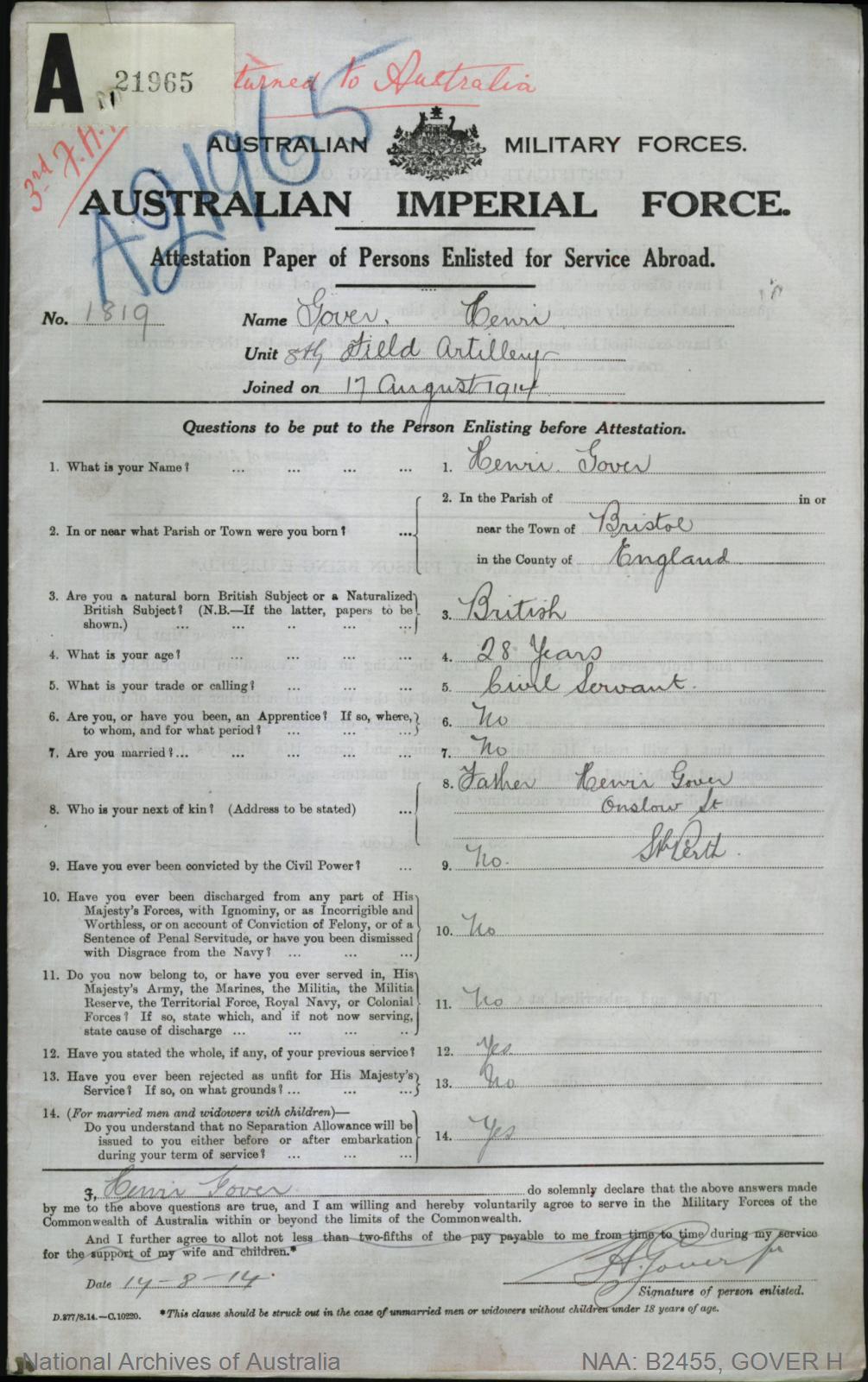
Henri Gover was born in the family home on West Grove Street in Bristol, England, on 21 August 1885. His parents, Henri Gover and Jessie Tuckett were prominent within the Salvation Army and accepted posts in Middlesbrough, Bristol, Leeds and Southampton before being sent to Hobart, Tasmania, in 1894.
The family were on the move again by mid-1897, this time to Perth following Major Gover’s appointment as Divisional Officer of West Australia. Parents Henri and Jessie, daughters Jessie and Eva along with youngest born Henri (junior) established themselves on Clifton Street, North Perth.
In 1903 Henri started playing football for the Ex-Students club, which played in the Junior League and drew its number from Perth Boys’ and Girls’ School. He remained with Ex-Students through to 1906 when he moved to Rangers where he featured in the middle of the park for two seasons. Henri was by now a civil servant with the Department of Mines.
Australia entered World War 1 on 5 August 1914 and twelve days later Henri enlisted with the 3rd Field Artillery Brigade. It’s possible he saw Hector McLarty (ex-Rangers), Harry Nagel (ex-Rangers), John Booth (Austral), Oswald Gomme (Claremont Glebe), Samuel Jackson (Training College), Frank Gill (YMCA), William Davies (Claremont), William Rockliff (Training College), Chris Ewing (Austral) and Josiah Skinner (Austral) amongst those also signing up.
Henri embarked from Fremantle late in the year and, on disembarking in Egypt, trained in Mena. The 3rd Field Artillery Brigade landed at Ari Burnu on the Gallipoli Peninsula early in the morning of 25 April 1915. They spent the new few months near the front line at Razor Back Ridge, supporting of the infantry and countering the Turkish gun known as ‘Beachy Bill’ in a nearby olive grove.
In mid-August Henri was trapped beneath wreckage of his gun after a Turkish shell scored a direct hit on his battery. Evacuated to a hospital ship where the diagnosis was debility, he was sent to England and admitted to the 5th General Hospital St Thomas’ in Lambeth, London. Henri spent time convalescing at Abbey Wood in London. In March 1916 he forfeited seven days pay and was awarded 72 hours detention for being absent without leave for a week. He transferred to Monte Video Camp near Weymouth soon after and in October was invalided to Australia, his service record citing debility and a cartilage issue with his right knee.
Henri hadn’t been back in Perth long when he moved to Sydney with Maria Sharpen, who left two of her three children in Perth. Having found employment with the Australian Gas Light Company, de facto couple Henri and Maria welcomed two daughters and a son of their own to the family home in Cabarita.
Henri Gover passed away from pneumonia and complications from alcoholism on 20 July, 1928, in Sydney.