
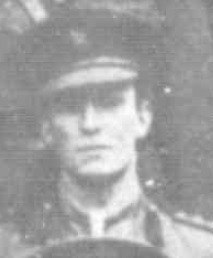
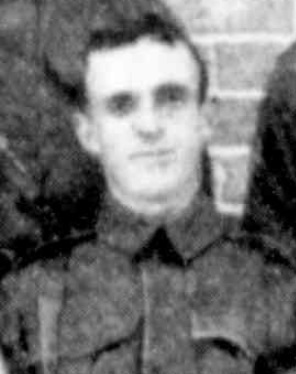
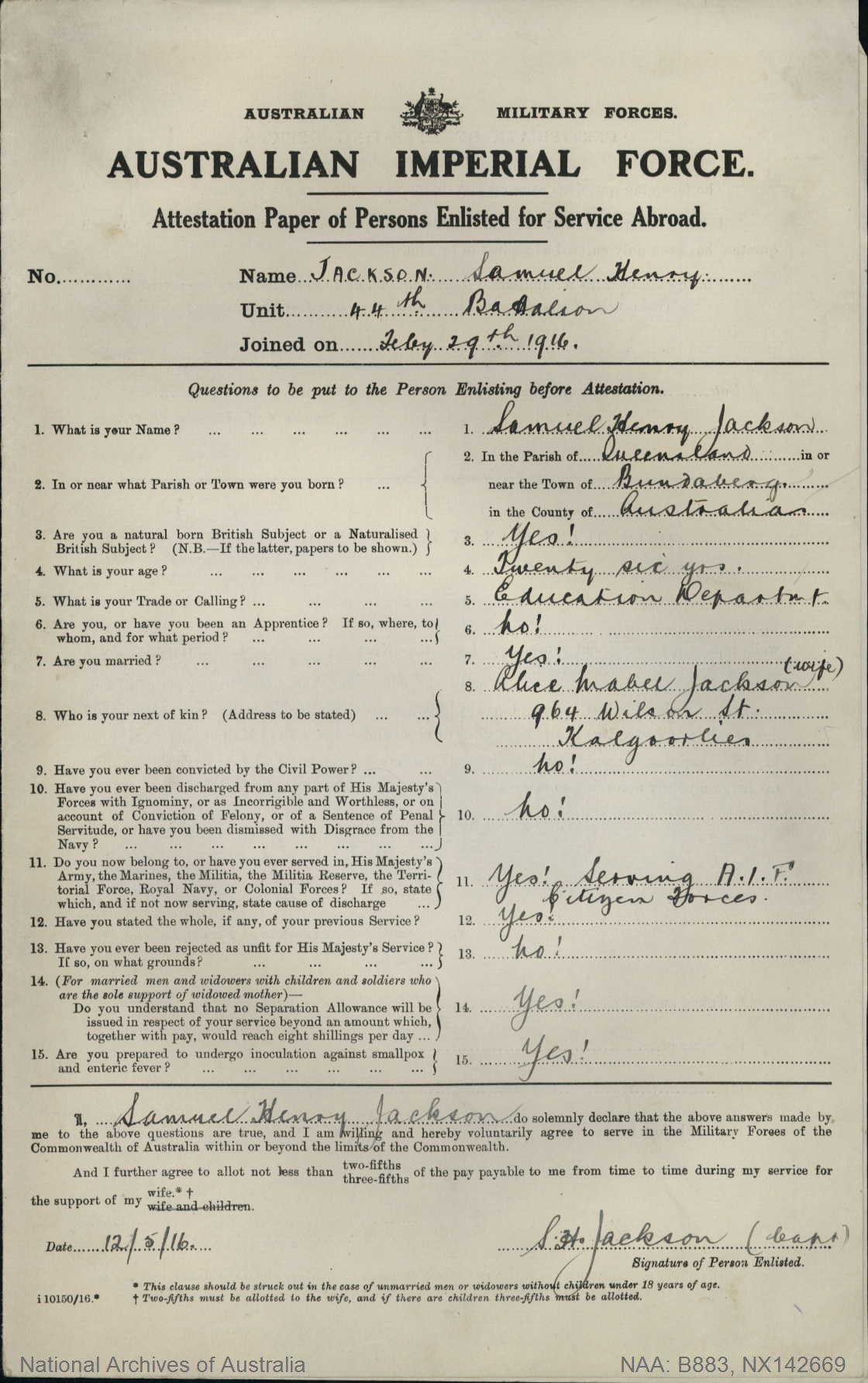
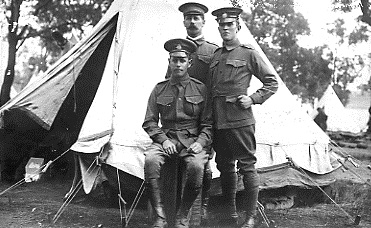
Samuel Jackson was born on 22 August 1890 in Bundaberg, Queensland, the third eldest of six children to Samuel Jackson and Sarah Woodland. In 1904 the family moved to Western Australia and Sam continued his early education at Perth Boys and Girls’ School where he passed the Junior Public Examination.
Sam probably played football at school and in 1906 he joined the Ex-Students club, where he played two seasons in the forward line alongside many of his former classmates. During this period he worked towards gaining his teaching qualifications, following in the footsteps of his father who taught in Queensland and Western Australia.
The Training College club was centred around Claremont Teachers College so it comes a little surprise that Sam joined the Collegians ahead of their 1908 campaign. He wore the clubs’ distinctive green and gold kit across seven winters, winning the Division One championship in 1909 and finishing runners-up in his final season.
Australia entered World War 1 on 5 August 1914 and twelve days later Sam enlisted with the 11th Battalion. He was assigned the rank of 2nd Lieutenant on account of having a years experience with as a senior cadet and two years in the voluntary 88th Infantry Regiment, who were part of the Citizens Military Forces. Sam was amongst the first ashore when the AIF landed at Gallipoli in the early morning of 25 April 1915, by which time he had been promoted to Lieutenant.
In late May he was made temporary Captain and led one of the attacking parties which took what later became known as Leane’s Trench. While serving at Gallipoli Sam was twice Mentioned in Despatches; “for having performed various acts of conspicuous gallantry or valuable service during the period 25th April to 5th May, 1915” and “for the gallant and good work performed on the night 31st July-1st August in connection to the taking of a Turkish trench”.
In early August 1915, Sam’s younger brother Dave, a former Ex-Students and Austral footballer, was killed at Gallipoli. A few days prior to this Sam had presented sick and was eventually diagnosed with iritis and enteric fever. Granted three months leave of absence and invalided home to recover, he married Kalgoorlie school teacher Alice Archibald in May 1916.
On rejoining the war effort Sam attended a two-month training course at Clare College in Cambridge, England. He proceeded to France in January 1917 having been allotted to the 44th Battalion as Staff Captain. Eight months later he was seconded to the 3rd Australian Division Head Quarters with the rank of General Staff Officer 3rd Grade.
Sam received a third Mentioned in Despatches for the role he played in the Battle of Messines and the early stages of the Battle of Passchendaele for “distinguished and gallant services and devotion to duty in the field during the period Feb 26 1917 to midnight 20/21 September 1917”. In March 1918 Sam was awarded the Military Cross. His citation read:
This officer … has proved a very valuable energetic and able officer and has served with conspicuous ability. He has organized and trained the Intelligence Services of the Division, and during the battle of Passchendaele (1917), his work left nothing to be desired
Sam was further honoured in June with the awarding of the French Croix de Guerre, presented for acts of heroism or distinguished service in combat.
Following the signing of the Armistice in November, he returned to England and was posted for duty with the Repatriation and Demobilization Department. The AIF Education Scheme provided Sam the opportunity to spend the second half of 1919 working for the insurance firm Thornett and Fehr in London.
At some stage Alice had joined him and together they returned to Perth in October. In 1920 they welcomed the birth of a daughter, Hazel, with a son, Murray, arriving two years later in Sydney. The offer of a job in Thornett and Fehr’s Sydney office took Sam and Alice to the eastern seaboard.
In Sydney they both changed career with Sam retrained as an accountant and auditor while Alice switched to journalism. The family lived at various addresses including Centennial Park and Rose Bay. Sam served in the Citizen Military Forces and the Australian Military Forces during World War 2. Post-war, he worked for the Department of External Affairs and was also Australia’s representative on the United Nations Temporary Commission on Korea. Sam and Alice lived in Edgecliff and Paddington before retiring to the rural settlement of Glenorie.
Samuel Jackson passed away on 7 January 1968 at Hornsby, New South Wales. He was 78 years of age.