

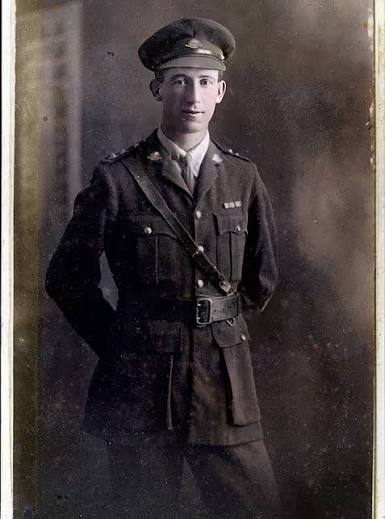
Hector McLarty was born in Fremantle on 3 March 1887, one of six children to Hector McLarty and Elizabeth Campbell. His grandparents, John and Mary McLarty, were among the first pioneers in Western Australia, arriving in 1838 and establishing the property Blythewood, near Pinjarra, which served as an inn and post office as well as the family home.
Roy began his education at Highgate School — only 500 metres from the family home on Beaufort Street, Perth — and later attended Perth High School where his pastimes included playing cricket.
On the first day of January 1903 and at the tender age of only 14, he began working as a clerk for the Australian Mutual Provident Society where he would remain through to retirement 47 years later. In 1904 Roy joined the Rangers B club, who competed in what would now be considered the third division of the British Football Association of Western Australia. Having made a name for himself as a goalkeeper of good repute, he moved to Ex-Students where played three seasons and was a regular in his teams debut top flight campaign of 1908. Roy didn’t return to the football field the following year, perhaps due to increasing work commitments. In November 1912, head of the family Hector, who had worked as both policeman and customs officer, passed away after a long illness at the age of 61. Not long after the family moved to Mount Street in central Perth.
Australia entered World War 1 on the morning of 5 August, 1914, and twelve days later Roy, work colleagues Victor Benson and Roy Timbury and former clubmates Harry Nagel (Rangers) and Henri Gover (Ex-Students, Rangers) enlisted in the 3rd Field Artillery Brigade, as a Corporal. They embarked from Fremantle in October and about four weeks later arrived in Egypt. Roy mentioned the death of former Perth BAFC forward Frank Parker in a letter home written in Mena on 20 March, 1915.
You will doubtless have heard of the regrettable death of Major Parker. It occurred with tragic suddenness. He was only ill about two days, and even now it is almost unbelievable that he is dead. He was, of all the men I know, the most cheerful and happy, and his loss is a great one for this Battery. His funeral was solemn and imposing.
Roy watched from onboard a ship, probably HMT Ascot, as the first wave of Australian troops landed at Gallipoli on the morning of 25 April, 1915. He arrived on the peninsula soon after and on 12 May wrote of his experiences,
This tremendous battle has been going 17 days now, and is still proceeding with unabated fury. The infantry landed on 25 April and after a superb charge gained the crest of a precipitous and rugged hill. There were about thirty to forty thousand Turks, who put up a terrible and determined resistance. The 11th and 12th were amongst the first to land. We (the artillery) landed about the 1st May, and have had twenty-two casualties to date in the Battery. Poor Alf Benson was killed on 6th by bursting shrapnel. Peter Benson was wounded in the neck and arm on the night of the 8th, while we were digging gun pits. He has gone to hospital, but it is not serious. The same night I was carrying sand bags across a crest, and to escape fire, dropped to the ground and found myself beside a dead Turk. I lay there for about ten minutes, and as he had been dead about ten days you can imagine how I enjoyed myself…. One sees some awful sights and views them with indifference. Things that would haunt a man for a month in private life are passed by unnoticed here. I can assure you WA will always do me after this.
Four days later Roy described the tragedy that unfolded after a Turkish shell exploded in a gun pit.
We had a disastrous day on the 17th instant. Two of our Battery guns engaged four of the enemy’s guns in an artillery duel. One of our guns was silenced early in the fight, and our boys behaved very gallantly indeed. A shell burst right in the gun pit, killing two men, and a third who I think will die. The two men killed were Stan Carter of Fremantle and Douglas Barrett Lennard of Guildford. Sergeant Taylor was the man wounded. This is how the men in this Battery die:— When the smoke from the bursting shell had cleared away, Wallis ran up to see the damage. He found Mick Taylor crawling about on the ground covered in blood, and dazed. Bill said, “Are you badly hit, Mick?” “No, Bill,” he said, “I am only scratched, look after Doug and Stan.” (We found subsequently that he was wounded in fourteen places). Bill then picked Doug Lennard up. The poor lad had one arm off, one leg shattered at the thigh, and internal wounds. He said, “I’m done, Bill, look after Mick and Stan. Don’t mind me.” Stan Carter had a fearful wound in the side. He said, “I’m sorry I’m moaning, I know it will upset Mick and Doug, but I can’t help it, I can’t help it.” He died, poor lad, almost immediately. His last words were, “Did they get the gun?” Doug was in fearful agony. He kept saying “I’m dying, but by God I’ll die hard.” He lingered for two hours, and it was pitiful to watch. He wanted an overdose of morphia to stop his pain and in the end he begged his pal (Tommy Cusack) to shoot him. His last words were “I died at the gun, didn’t I?”, and so he went, dear lad, the most gallant, the most unselfish little soldier God ever made.”
Roy was to have many more close calls while fighting at Gallipoli, including when “a large Howitzer shell (5-inch) struck the sides of my dug-out, within, I suppose, two feet of me, and by all the laws of war should certainly have killed me” he wrote in August.
His battery headed to the Greek island of Lemnos for some respite in October as suggestions of evacuating Gallipoli gathered momentum. Roy departed Anzac Cove for the last time sometime during the night of 17/18 December. The AIF spent the early months of 1916 training at Tel-el-Kebir, Egypt. It was here that newly promoted Sergeant Roy learnt his younger brother, Duncan, who was serving as a piper with the 9th Black Watch (British Army), had been killed in France the previous September during the Battle of Loos. Duncan, 25, had played football back as a youngster in Perth for the the High School and Ex-Students clubs. Roy’s artillery brigade returned to the frontline in June near Laventie where, towards the end of the month, they were firing for up to 20 hours a day in support of a major attack by the British. The following month they were subjected to heavy German shelling soon after arriving in Albert, in the early days of the Battle of the Somme.
Following the prolonged fighting at Pozieres and Mouquet Farm, the AIF moved into Belgium which is where Roy spent two weeks of September in a field hospital being treated for scabies. On being discharged, he returned to the Somme for what was to be the coldest winter in twenty years. He reflected on this in a letter dated 11 November:
For the last three weeks we have been in the mud and slush of the Somme once again, and the conditions this time are really awful. Ceaseless rain, bitterly cold weather, mud up to our thighs, little food, less sleep and fight, fight, fight, day and night. Thank God one gets into a kind of stupor and is numb to feeling. The horses are dying in thousands, and it is heartbreaking to see these poor docile creatures work until they drop dead of exhaustion … I came away from the guns a week ago and am at the wagon lines with the horses for a fortnight. It is not so bad here except that every second night I have a nightmare of a trip up to the guns with ammunition. It is about seven miles across pathless country, studded with millions of deep shell holes and miles of trenches, all filled with thick slimy mud. The nights are dark and often a thick fog envelops everything. We rarely get through without the loss of a horse, sometimes legs are broken, or else a horse gets in a shell hole filled with mud and suffocates. Drivers and horses are often killed by shell fire. Oh! it’s a blithering trip – takes about 10 hours.
As the German Army began withdrawing to the Hindenburg Line in the early months of 1917, the Australian troops were able to advance over farmland instead of through mud-churned battlegrounds. On the morning of 1 June, Roy was fortunate to escape death after a shell landed amongst his section while at Ploegsteert, near Messines Ridge.
About 8am we were having breakfast, the table being a dump of boxed ammunition near the gun. The shells continued to come over, bursting some two hundred yards to our rear. We were all eating, watching the bursts, and occasionally chipping Munro because of his early appearance — first time on record, and last too — poor chap. We were all smiling over some little joke when suddenly, in a one-thousandth part of a second, we heard it coming and knew it was the end. CRASH! Into our very midst came a shell. My dears, God save me from ever seeing such a sight again. Sellers, the Army Medical Corps Chap, was killed instantly. Beesley and Munro — the two corporals — died within five minutes, all mutilated. Macquire and Tudberry were seriously wounded — out of eight, three were untouched save for bruises. Of the five, three have been with the battery since Blackboy Hill memories. I do not think any of you can quite realise how very fond we are of each other — we old hands — how hard the parting is. We did what little we could to alleviate their pain as they died. Thank God, they almost instantly lapsed into unconsciousness. They are buried now — our comrades — sleeping in this beautiful land. Three years of hard fighting and then to be killed by a chance shell.
Two days later Roy was wounded in action. Treated by a field ambulance, he was evacuated by hospital ship and admitted to the Brook War Hospital in Woolwich, London, where his injuries were recorded as gun shot wounds to the “right foot, thigh, both arms, slight”. While recovering, Roy was awarded the Military Medal for his actions and bravery in the field at Messines. It would be October when Roy returned to France —
It was great to see the boys again — they all seemed genuinely pleased to see me. The battery has gone to pieces since the Major died but they have been through a perfect hell for the four months I was away, and many old faces have gone. Indeed, the day I arrived, four more were killed. I am not with the guns yet, but at the wagon lines. Yesterday I took six hundred rounds up to the guns – a 6-mile trip. The country is awful; even the utter desolation of the Somme battlefield is exceeded here. To come from the smiling fields of England to this country of hell, is an experience and a lesson in contrasts which I can never forget. The road for miles is strewn with the debris of wagons, guns, dead horses, and 58 dead men, and to one unused to such things, an awful spectacle. Yet, with all the obstacles which obstruct our path, including wretched weather, we seem to be slowly pushing the Hun back.
Shortly before Christmas 1917, Roy learnt he would be returning to London to attend six months of officer training at No.1 Royal Artillery School in St John’s Wood. On passing his final examination in June 1918, he took two weeks leave in Scotland before returning to France only to discover on arrival that he was to be transferred to the 5th Divisional Artillery Headquarters.
Four days after the signing of the Armistice on 11 November, Roy commenced his journey home. Entitled to have his return expedited as a 1914 enlistment, he chose to pay his own fare home and on 27 December he married Delcia Stanton at St Mary Magdalene Church in Wandsworth, London. It’s probably not too far from the mark to assume they met during Roy’s officer training stint earlier in the year.
The newlyweds set-up home on Malcolm Street, West Perth, in early 1919 with Roy resuming his work with the AMP Society. His mother, Elizabeth, passed away in late 1929 at the age of 76. The McLarty’s moved to Adelaide in 1935 and three years later Roy gained promotion to state manager for AMP in South Australia. Another relocation a few years later took them to Melbourne where Roy rose to be Chief Executive Officer of AMP.
Hector McLarty was 77 when he passed away on 10 September 1964 at Box Hill Hospital in Melbourne, Victoria.
From the AMP to the AIF : The wartime letters of Lieutenant Hector Roy McLarty” is based on letters and diary entries written by Hector McLarty during World War 1. The Australian War Memorial holds typescript copies of dozens, potentially over 100, of his writings.