

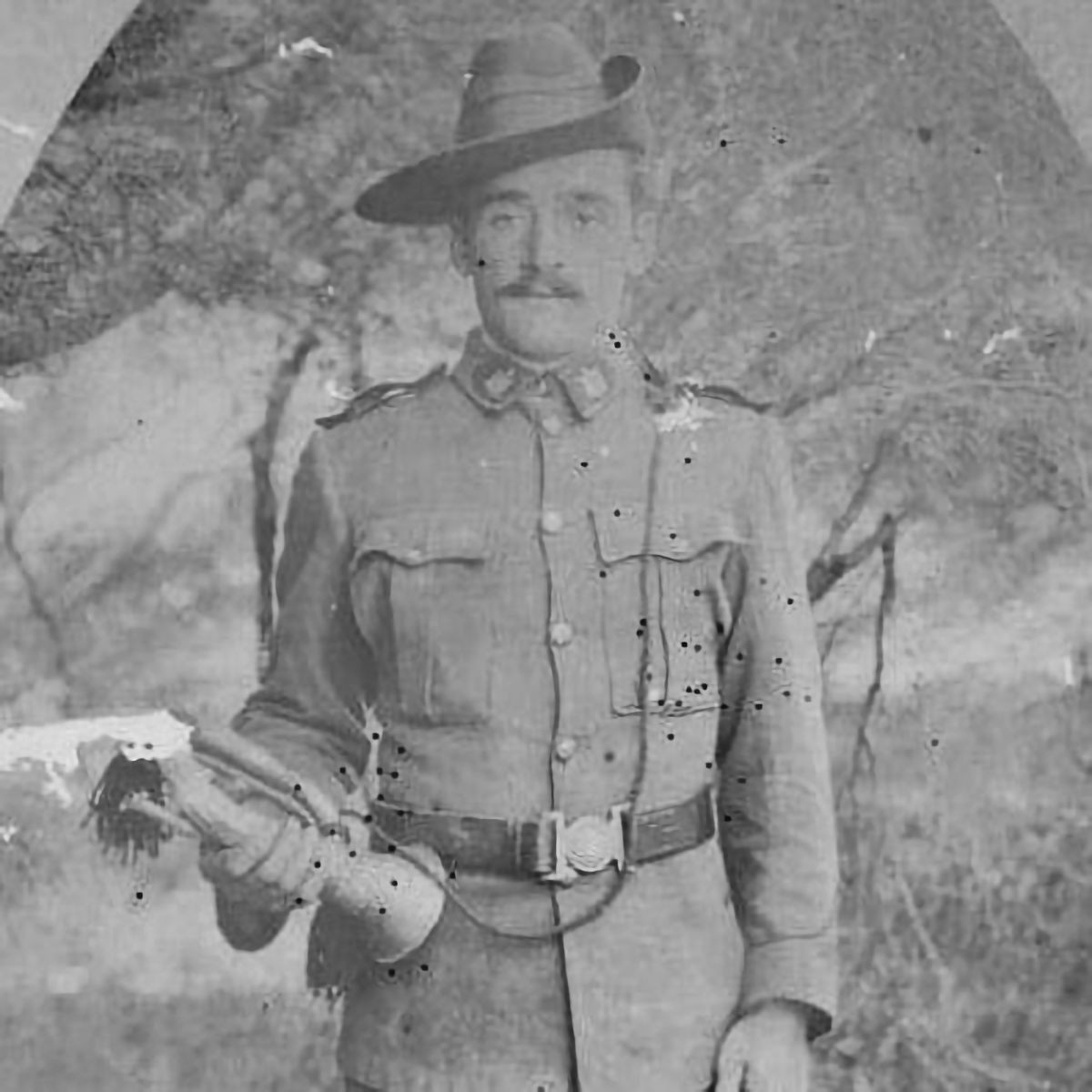
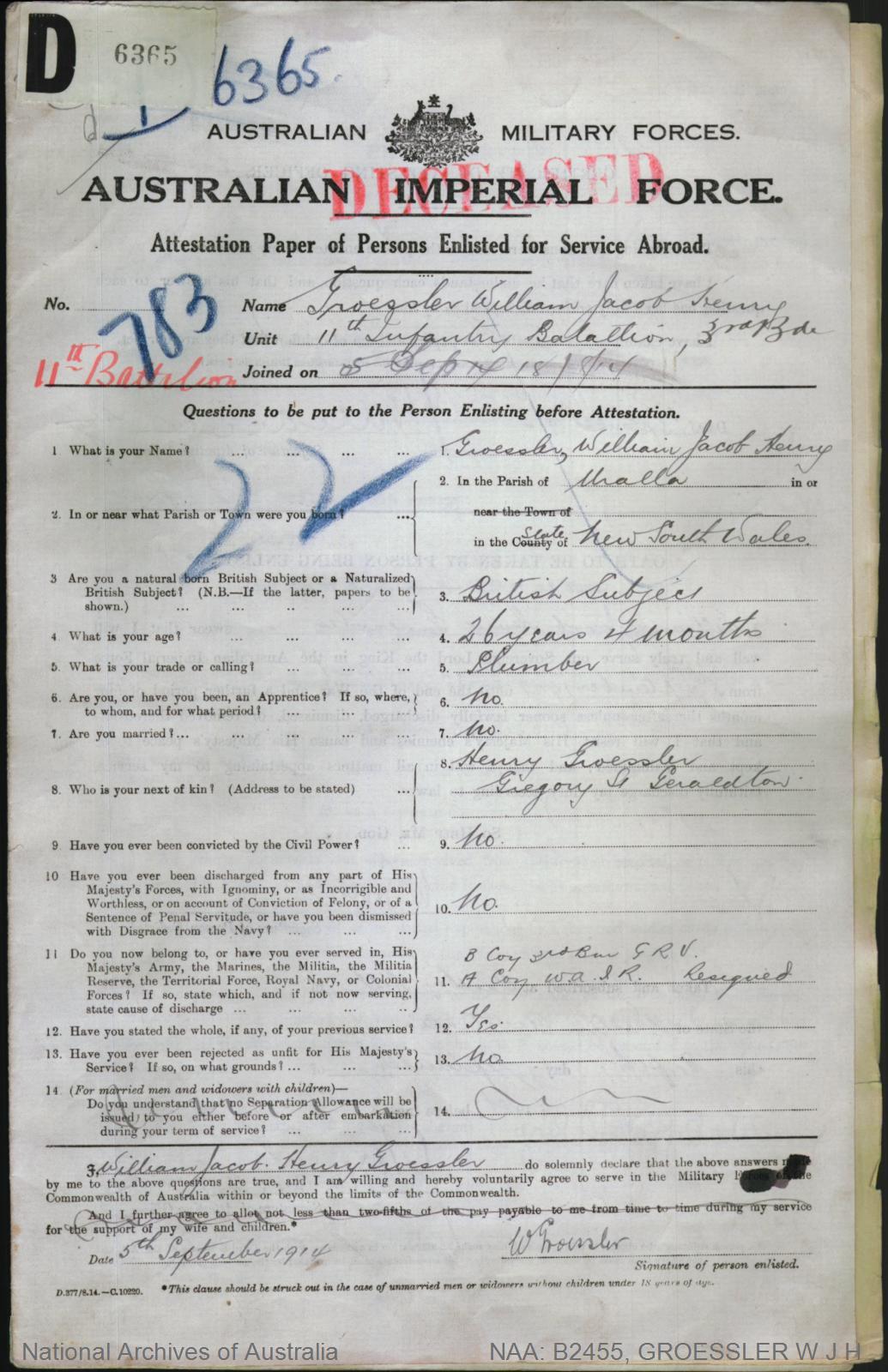
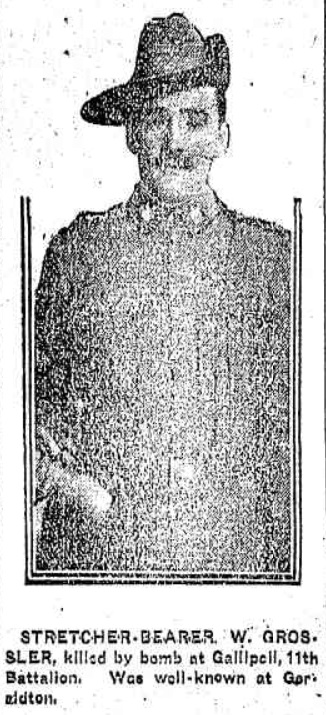
William Groessler was born in 1888 in Uralla, on the Northern Tablelands of New South Wales, the second eldest of nine children to German migrant Henry Groessler and Sophia Keppel. The family moved across the country in about 1897 to set up house on Gregory Street in Geraldton, Western Australia, where a 10-year old Billy joined the Geraldton Rifle Volunteer Corps as a bugler.
In addition to being an accomplished musician, Billy was a keen sportsman. He shone as a top order batsman for the Mercantile and Railways clubs, and also excelled at (Australian Rules) football with the Rovers and Railways clubs. His on field exploits were rewarded with representative honours in both arenas, including at the 1912 Country Football Championship played in Perth and won by Geraldton.
According to the Geraldton Guardian, Billy was “one of the best athletes in the district, and no team, whether cricket or football, could be called representative without his inclusion. In cricket he was best known as a bat, though in the out-field he was brilliant… All football followers knew his prowess. He was one of the safest backs in the town, frightened of nothing, and always in his place. He played with the Railway Club in both games.”
The arrival of association football in Geraldton saw Billy, who was working as a plumber with Western Australian Government Railways, take up the round ball code. In 1913 he turned out for Red and Blacks against Whites in the first game organised by the newly formed Geraldton British Football Association before joining the Thistle club, as a team selector and goalkeeper.
Billy was 26 when he enlisted as a Private with the 11th Battalion in August 1914. Twenty-four hours later he was amongst a group of 23 Geraldton men who caught the train to Perth, his companions Fred Ashton (Geraldton Town) and Joseph Rathborne (Queens Park Rangers) who he’d met on the football field. While training at Blackboy Hill camp, he was found guilty of breaking camp and fined one days pay and confined to camp for seven days.
The 11th Battalion departed Fremantle in early November, bound for Egypt. Billy was in the second wave of troops ashore when the Australian Imperial Force landed at Gallipoli in the early morning of 25 April, 1915. In a letter dated 15 May, “written in a dugout at Kaba Tipi” (Gaba Tepe) and published in the Geraldton Guardian, he described his experience of that first day:
I suppose it is common talk that we have been in action. We landed on the 25th April under heavy fire. When only a few hundred yards off shore the first shot was fired. I can tell you it put a nasty taste in my mouth for the time being. Then they opened fire on us with rifles machine guns and shrapnel. We were part of the second lot to land, and were about a quarter of an hour after the first lot. We jumped out of the boats up to our necks in water. I didn’t notice whether the water was cold or not. Our lads then took two successive hills at the point of the bayonet. The charge was the talk of the navy. As the boys were charging they did not sing out in English but in Arabic. When one sees the hills they charged up, you would not believe it possible. All that day there was very heavy fighting, the wounded were pouring in, and whilst carrying them in I didn’t know the moment I was going to stop a bullet or a shrapnel pellet. I don’t remember anything about a big part of that day (Sunday) but on the Monday, Tuesday and Wednesday there was heavy fighting all the time, and it is still going on. Now we are entrenched we do not mind the bullets so much, but the shrapnel makes us do some polite sprints for cover. The 3rd Brigade (that is our lot) has made a name that will live. We were the landing party. The rest of the Australians and New Zealanders reinforced us as soon as they could. I am scribbling this in a dug out, just off the firing line. If anyone had told me that I could live in a hole in the ground, I wouldn’t have believed him, but I have been glad at times to get into the smallest corner. I am tip-top.
On 29 July, the 11th Battalion was holding the line at Tasmanian Post when a bomb exploded near Billy, wounding him on the right side. Following assessment in the field, he was evacuated to the hospital ship Rewa where he was treated for wounds. William Groessler passed away on 30 July, 1915, and was buried at sea the same day. His brother, Frank, was also serving in the trenches of Gallipoli at the time while another brother, Harry, had enlisted only days earlier. A third brother, Eugene, would enlist in August 1916.
In late 1916, the family patriarch, German-born Henry, was declared an enemy alien of the Australian Government. Despite being a resident of Australia for 30 years, he was sacked from his job with WA Government Railways. His wife Sophia, who was born in New South Wales, was similarly ejected from her secretarial position. Questions about the case were asked in Australian Parliament, as reported by the Geraldton Guardian in January 1917:
The Case of Henry Groessler. Some few weeks ago we commented upon the action of the Wilson Government in dismissing Mr. Henry Groessler from employment as a plumber in the Railway Department at Geraldton. Mr. Groessler is a German, but has been naturalised for nearly a quarter of a century. Not only has be never been suspected of disloyalty, but he has sent four sons to the front to fight for the King, and one of these has already given up his life in the Empire’s cause, while another has been permanently disabled.
At a time like this, prudence, of course, directs and self-preservation demands that care should be exercised by the authorities as regards retaining in any position, in which they could possibly help the enemy, persons who originally belonged to any of the countries with which we are at war. It does not do to take risks where the issues at stake are so momentous. But it is difficult to see how a plumber, even if he were so inclined, could render assistance to the Kaiser’s hordes while pursuing his calling in a locality so remote from the scene of hostilities as Champion Bay. Nor is it suggested that Mr. Groessler would, by word or deed, behave contrary to the spirit which led him to offer his human treasure in such abundance towards aiding Great Britain to win this war.
The plea put forward is that it is the policy of the Ministry that all Germans must go from Government employment: that there shall be no exceptions, no matter how justified by circumstances. Thus we have here, in a portion of an Empire which is fighting in the name of justice against a devilish despotism, an old man refused a means of livelihood by the representatives of the Crown which had got from him all that he had to give. Is it not enough to make any genuine Britisher bow his head in shame?