
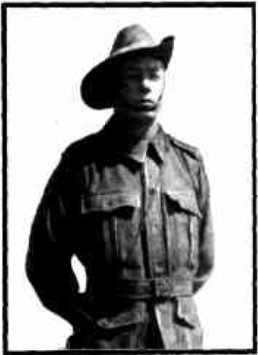
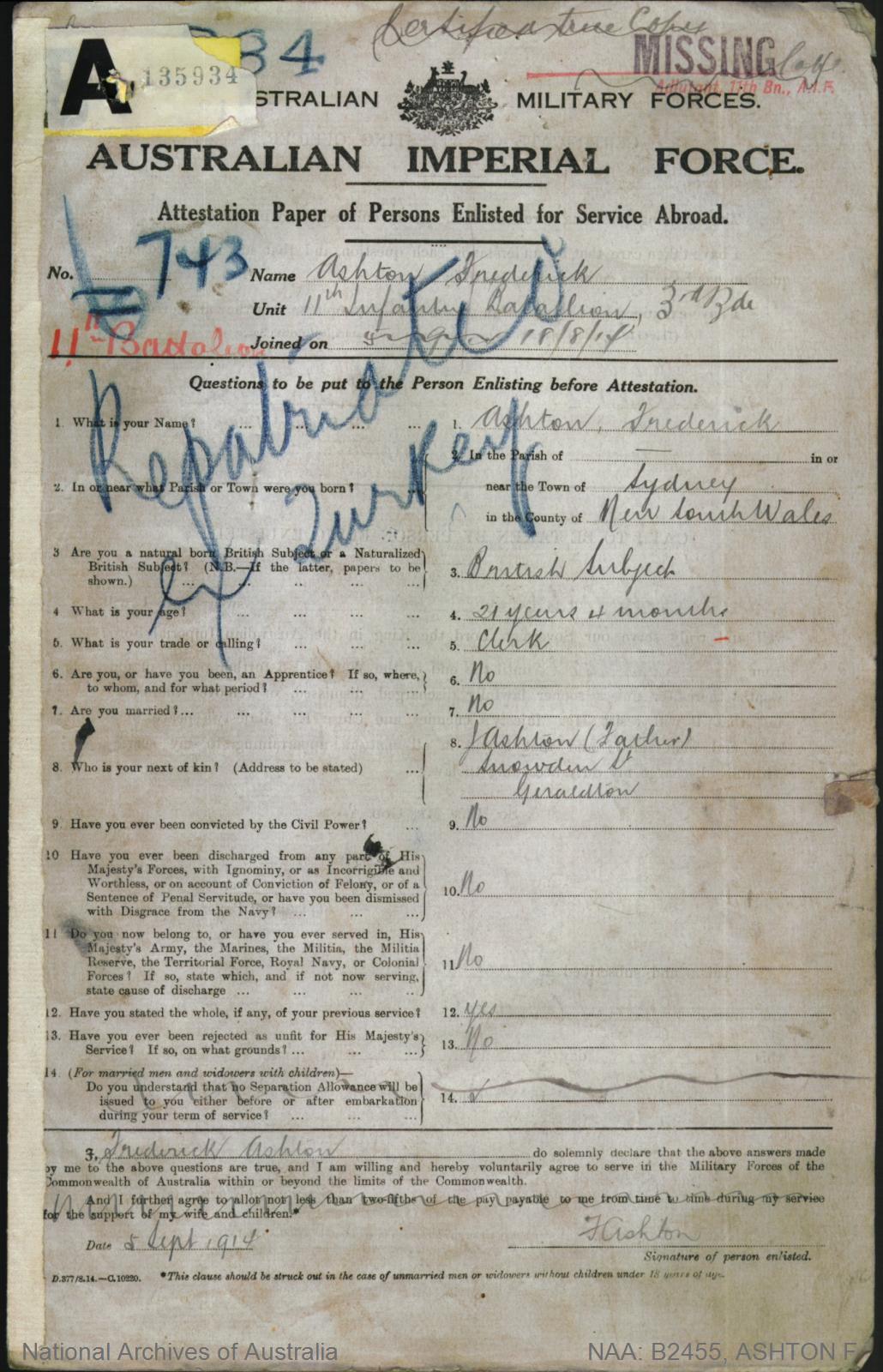
Frederick Ashton was born in April, 1893, in the inner Sydney suburb of Newtown, to Joseph Ashton and Frances Watson. In about 1912, the family moved to the West Australian port town of Geraldton where Joseph established himself as a painter, decorator and signwriter while Fred found work as a bank clerk.
When the Geraldton British Football Association was formed in mid-1913, Fred threw his lot in with Geraldton Town. A member of his teams’ forward line in their first ever outing, a 2-0 win over Thistle, Fred played a key role in Town being declared joint champions with Civil Service after the clubs finished the three-team, eight-game season on level points.
Fred would have been no doubt honored when Town named him team captain the following season, which was dominated by the Thistle club. But when news filtered through in early August, 1914, that Australian Prime Minister Joseph Cook had announced the nation’s entry into World War 1, 21-year-old Fred was no time in enlisting as a Private (Bugler) with the 11th Battalion.
“On the afternoon that war was declared, a Saturday afternoon, I was playing soccer on the local ground,” Fred recalled in an interview with the State Library of Western Australia in 1976. “As soon as the game ended, a friend of mine, Gordon Gunn and I hurried around to the Drill Hall and lined up for the Army.”
The 11th Battalion were one of the first ashore at Gallipoli on the morning of 25 April, 1915. “Our boat was maybe 100 yards from the shore in the dawn, the moon had just gone down and the sun hadn’t come up when the first shot was fired at us. It was a peculiar feeling, believe me, to be fired at,” Fred said. “We all jumped out up to our armpits in water and waded ashore.”
Thirteen hours after landing, Fred became separated from his battalion in the hills of Gallipoli and was captured by Turkish soldiers. He would spend the next three and a half years in a succession of prisoner camps as a guest of the Ottoman Empire. “The guards were barbarous,” he said. “They used to try (and hit us) but we would hit them back. We were put in prison and given punishment.”
Following the Armistice, Fred travelled to London where he was reunited with Joseph, who had enlisted in the 28th Battalion after learning of his son’s capture. Together, father and son returned to Geraldton in May 1919. Fred went back to his job at the bank and by August he was out on the football field again with Town.
In 1921 Fred married Alice Truman and over the years they had three children. By 1937 the family had relocated to the inner Perth suburb of Nedlands with Fred continuing to work as a bank officer. His wife, Alice, passed away in mid-1966, ending 45 years of marriage.
Frederick Ashton passed away on 13 September, 1981, in Mt Lawley at the age of 88.