


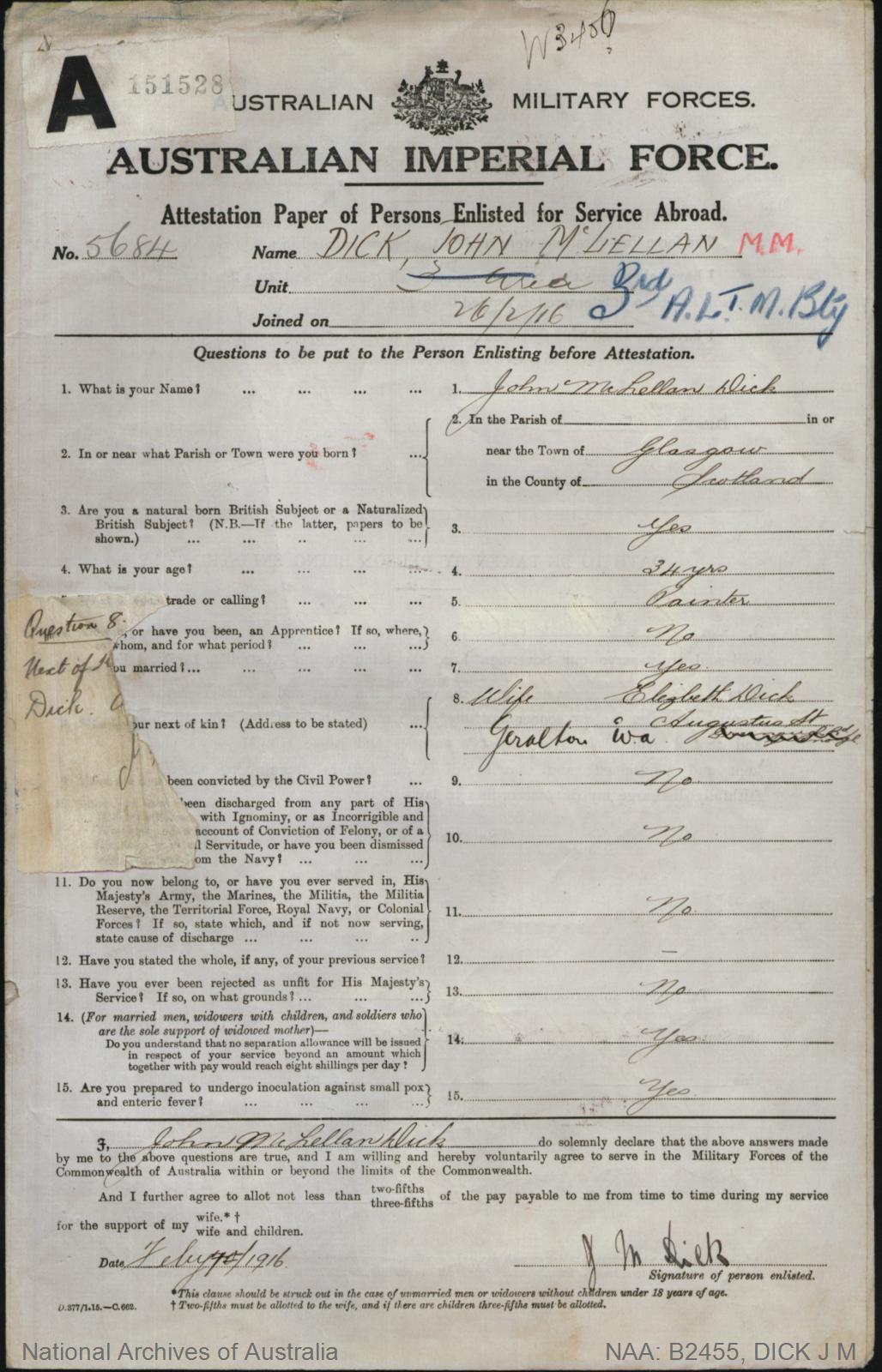
John Dick was born in Little Ilford, London, in 1881 (not Glasgow as his military record suggests). Working as a house painter, at the age of 22 he married Elizabeth Florence and eight years later the couple were living as boarders in West Ham with their only child, John McLellan Dick.
It appears Jack journeyed alone to Western Australia in about 1912 and by June 1914 had been joined by his wife and son, setting up home on Augustus Street in Geraldton. Aged a spritely 34, he turned out for Geraldton Town during the 1915 season and also served as club delegate to the Geraldton British Football Association.
Jack enlisted as a Private with the 11th Battalion in February 1916 and within four months had arrived in France where he took part in bloody trench warfare in the Somme valley, most likely seeing action around Pozieres and Mouquet Farm, before ending the year out of line in Flanders, Belgium. In January Jack was attached to the 3rd Light Trench Mortar Battery.
Soon after, Jack earned a Military Medal for bravery in the field. Commonwealth Gazette No. 140 records:
At LE BARQUE, FRANCE, on 27th February, 1917, no communication could be made with Stokes Guns which had gone forward. Private DICK went forward with a message from Battery Headquarters and after going through a heavy artillery barrage, delivered his message to Officer in charge, and although showing signs of fatigue volunteered and established communication with two other guns on left sector. He also guided ammunition carrying parties to the guns, and carried messages repeatedly under heavy shell fire.”
Jack suffered a minor wound to the right arm after being struck by an exploding shell in October. He rejoined his Battery and fought in the Passchendaele area before moving back to the Somme valley in the early part of 1918, participating in key engagements including the battles of Hamel and Amiens. After the Armistice, the 3rd Light Trench Mortar Battery was demobilised and in May 1919 Jack returned home.
It didn’t take long for football to resume in Geraldton. Jack accept the position of vice-president with the Town club in July 1919 and the following year was appointed vice-president of the Association. Tragedy struck the family on 11 September, 1921, when their 10-year old son John died after a short illness.
Nine years later Jack was swept off rocks by a wave while fishing at the mouth of the Murchison River. Despite a valiant attempt to rescue him by his fishing partner, William Leighton, his bruised and battered body was washed up on a beach several hours later. John Dick passed away on 1 December, 1930, at the age of 49.
Private J. Dick, in a letter to ‘Mr J. Scott from France on December 26 wrote:
I am doing well and in the best of health. I have seen several of our Soccer players, including Bill Murray and Jock Douglas. They are both doing well. Bill Murray is in the machine gun section. Bob Anderson was camped about 200 yards away, but he moved before I had a chance of seeing him. I also saw young McGilvray and Bellgrove, and both were well. Mick Glendinning is in Divisional Headquarters and has got a good job. McColl has joined up again and is going strong. I hear that Jimmy Wilson is a fireman at Harefield Park Hospital in England. Curtis is here and is a lance corporal. Pud Thomson, young Arthur Brown and his father are all here and doing well. So you can see Geraldton is well represented. We are not having a bad time of it, for you can bet we have had a dry Xmas — I mean ‘inside.’ But outside, well mud up to your leek, and raining every day. We are seldom idle when we have any spare time. You can see the boys with their shirts off killing the superfluous stock, and there are plenty of them. A clean shirt aud a bath are luxuries nowadays. There is no chance of a man catching cold through washing too often. We are doing our bit in the line at present, and hope to go back for a spell at the end of the old year. I am glad your efforts for the Tobacco Fund are a success, and Jack, take it from me they are highly appreciated, by the boys in the line. It very often happens we cannot get tobacco (I mean buy it) and a parcel of gift stuff comes along at the right time. As you know Jack, there is a power of comfort in a smoke, and the givers are blessed by the boys in words that may be crude, but are spoken with feeling.
Geraldton Guardian 24 February 1917