

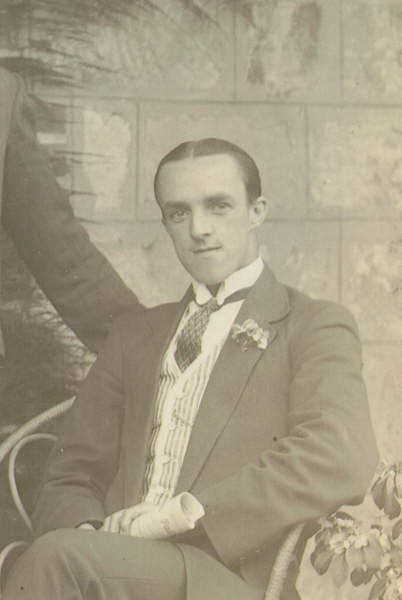
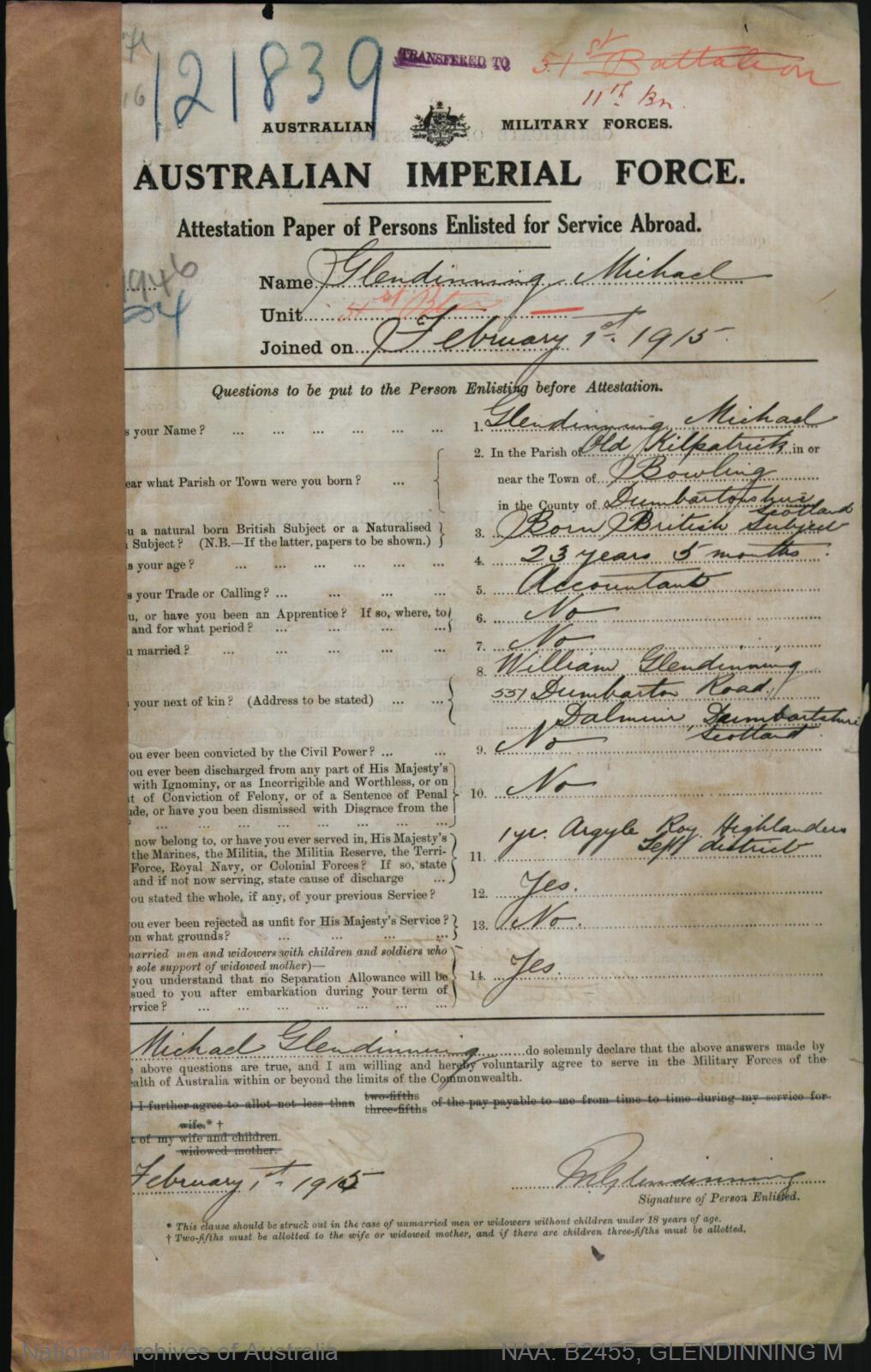
Michael Glendinning was born in Dumbartonshire, Scotland, on 15 August, 1890. The first of six siblings to William Glendinning and Agnes McInes, he worked as a labourer growing up and served a year with the Argyle and Sutherland Highlanders. Shortly after celebrating his 21st birthday, Mick and his cousin, Jenny Dickson, left London bound for Fremantle.
Mick accepted the position of junior clerk with the Geraldton Municipal Council in early 1912 and by year’s end had been appointed honorary secretary of the Geraldton Rowing Club. His interest in sport extended to football and in July 1913 he turned out for Red and Blacks against Whites in first game of organised football played in Geraldton.
The inaugural Geraldton British Football Association season kicked off soon after with Mick leading the attack for Civil Service, who were declared joint champions of the three-team league. He remained with the club the following year, when rebranded to Queens Park Rangers. Mick was now working as an accountant with the Council.
Mick enlisted as a Private with the 11th Battalion in February 1915. Deployed to the Gallipoli Peninsula in mid-June, he was admitted to a Maltese hospital ten weeks later suffering diarrhoea and dysentery. Sent to the 2nd South General Hospital in Bristol to recover, Mick was released after 5 weeks but did not immediately return to active duty, instead remaining in England.
The 11th Battalion spend the early months of 1916 guarding the Suez Canal in Egypt, which is where Mick most likely caught gonorrhoea. Two spells at Cairo’s Dermatological Hospital totalling 71 days following after which he was released to join his battalion on the battlefields of France, serving in the Somme valley and the Allies advance toward the Hindenburg Line.
Mick was transferred to 1st Australia Divisional Head Quarters in June 1917. Four months later he was promoted to Corporal, he received a second promotion in March 1918, this time to Sergeant. In June Mick was awarded the Meritorious Service Medal “in recognition of valuable services rendered with the Forces in France”. He returned to Australia early the following year and received his military discharge in August 1919.
Glendinning headed back to Geraldton where he resumed working with the Council and to playing football with Queens Park Rangers, where across seven seasons he won two league titles (1919, 1924) and two Hansen Cups (1920, 1923). In 1922 he captained a Geraldton select team at the inaugural Country Week, the Geraldton Guardian reporting “the opinion in Perth is that Glendinning is about the best back playing the game in this State”.
Two days after Christmas Day 1922, Mick married Fanny Green in the outer Perth suburb of Armadale. In September 1926 Mick resigned from the Geraldton Municipal Council after 11 years of duty to take up the position of secretary with the newly formed Main Roads Board of Western Australia. The family moved to Armadale where, in time, it was expanded to six with the arrival of three sons and a daughter.
After 28 years with Main Roads, Mick retired from life as a public servant in 1955. In June of that year Mick and Fanny sailed from Fremantle on board the Orsova to London before journeying to Scotland, where they spent three-months holidaying with family.
Michael Glendinning was aged 72 when he passed away in Mt Lawley, Perth, on 12 March, 1963.