
OPEN COLUMN.
‘A PLACE FOR SOCCER.’
(To, the. Editor.)
Sir,— I should; be greatly obliged if you would allow me small space to mention the above subject. A British Association Club has been formed in the town playing on Wednesday (the half-holiday); and clubs have also been formed at Condong and Burringbar. Now, despite the fact that there is no other football club playing on the weekly half-holiday in this town, and although the soccer game has been freely acknowledged as a good sport; yet the local club, in their last two matches have been unable to raise a paltry eleven men to play – though the country clubs have invariably had a surplus of players! I should like to appeal through your columns to any football players who are at liberty on Wednesdays to join the club; they will be welcome to learn the game. The sub. is small, and good, healthy game is assured. Surely, Murwillumbah, can do what; the smaller centres find so easy! The fixtures would not clash with the local Rugby games – the game is easy and interesting to learn, and if any players who would care to obtain information will apply to Mr. F. V. Pearce or Mr. Anscbacher (Holmes and Co.), they will heartily welcome. – Yours, etc., J. Boobbyer
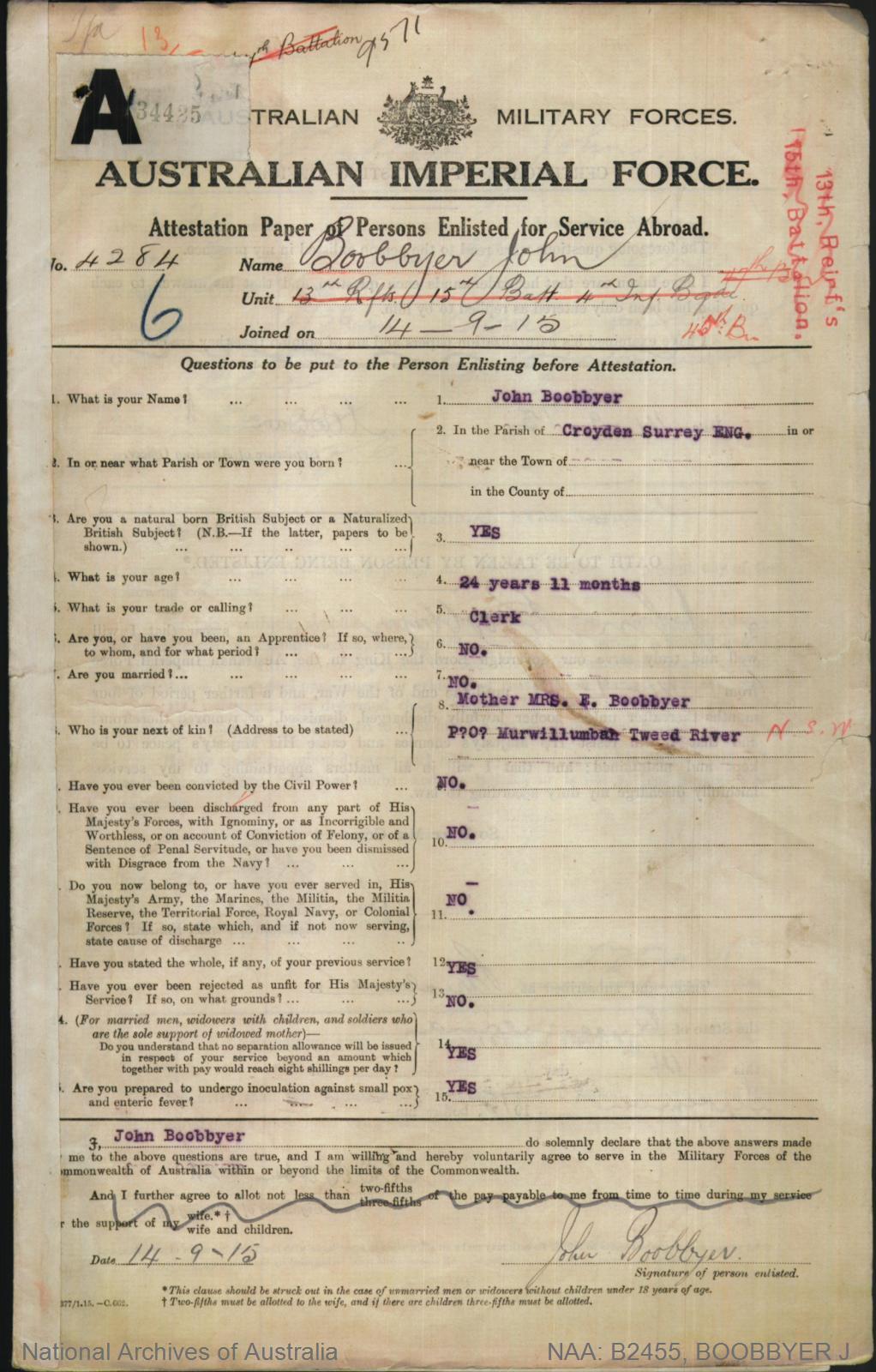
John Boobbyer’s letter appeared in the Tweed Daily on 24 July 1914. He was a member of Murwillumbah United, which had only formed in June. That United had to borrow players was reflected in the way the team’s line-ups, as published in the Daily, changed game to game.
Boobbyer’s plea for help appears to have paid off. The Daily of 13 August 1914 mentioned that two Rugby League players had joined the United ranks for a 1-all draw with Burringbar. Momentarily, the club was looking up. But war broke out four days after Boobbyer’s letter was published.
Soon enough, Murwillumbah United lost their first player to enlistment in John McAllister. The club limped on into 1915, but Boobbyer, who did so much to keep soccer in the Tweed region afloat, joined the war in September. Other players soon followed.
Boobbyer arrived in France in April 1916 and within months had suffered severe tonsillitis, shellshock and influenza. A year after arriving he suffered appendicitis and was evacuated to England, where he soon caught venereal disease. It wasn’t until late 1917 he was returned to any form of duty and not until April 1918 he returned to France with a depot. Boobbyer then caught trench fever within days of arriving. Boobbyer finally returned to active service when he was transferred to the 45th Battalion in June 1918 but further bouts of illness followed until after armistice.
He finally recovered in February 1919 and returned to Australia in April. A clerk before the war, it appears Boobbyer joined the Taxation department in Brisbane in the 1920s. He was often mentioned in newspaper over a number of decades as part of court cases brought about to chase unpaid taxes.
He married Florence Voght in 1921, and they had a daughter a year later. Boobbyer died in Brisbane in 1955.
Murwillumbah United did not survive the war. A new club was formed in the town in 1921, but it appears they could not find opponents to play, with a similar resurgence in Condong failing.