
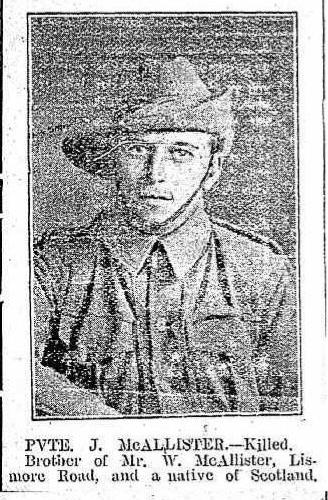
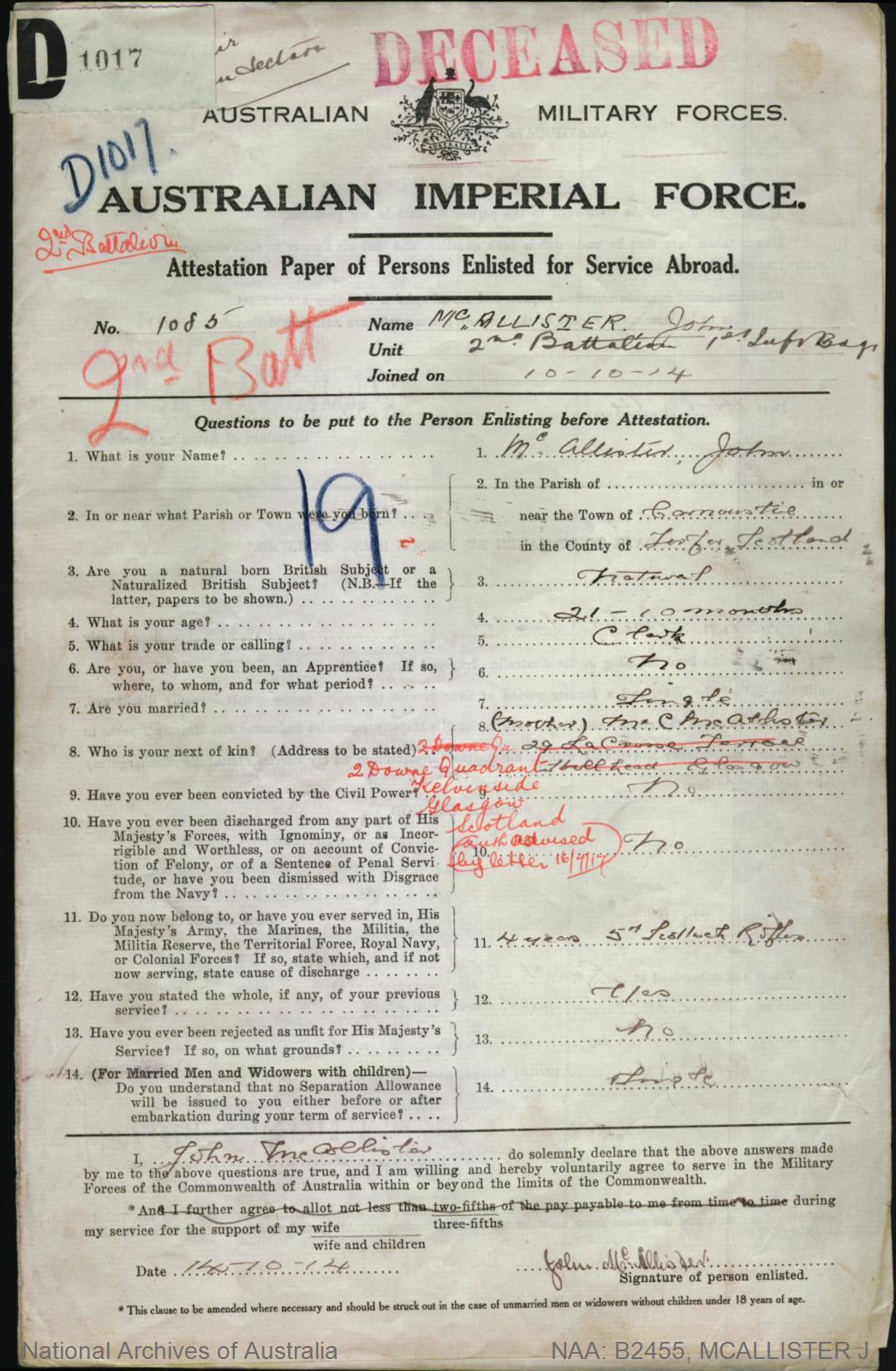
Jock McAllister was the first of several Murwillumbah United players to enlist in the war. The club had formed in June 1914, the month before the war commenced, and he enlisted in October. The club held a farewell for him the same month which was reported in the Tweed Daily on 9 October 1914.
McAllister joined the 2nd Battalion, and quickly rose through the ranks to Corporal by January 1915. A few months later he was dead. The only entry in his military records states he was killed in action at Gallipoli on 20 May 1915 and buried the next day. He was 22.
That might have been the end of the story, but for a coincidence a year later. Originally from Glasgow, McAllister had at least two brothers. One, William had also emigrated and lived in Murwillumbah during the war. Another brother enlisted in Britain. This brother wrote to William in 1916 to say he had met some soldiers from Murwillumbah district in France. The story was related in the Tweed Daily of 17 June 1916:
Mr W. McAllister, of Lismore Road, has just received a letter written by his brother on service in France with the British Forces., which serves to show how small a place this planet of our is after all. Since his brother was killed in action members of the family have been diligently searching for information from those who may have attended him in his last moments, and while in this case they were not altogether successful, it is not hard to realise the joy experienced by the brother at meeting at the front in France those who had known the dead hero well in Murwillumbah. We quote from his latter.
A week ago Charlie bought an Australian into the billet. He had chummed up with him by chance and had bought him round to tea. How often we go searching afar off for just what is close by us. After prosecuting inquiries about the battalion of Hardcastle (who had written Mrs. McAllister about Jock’s death) I had just turned the conversation into other channels when I became conscious that the Australian watching me closely. Then quite suddenly he said, “is it possible your name is McAllister?” I was taken aback, but guessed what was to follow. “Yes,” I answered. He appealed to the others asking if I was joking and it if it was right. Made certain he spoke of Willie, Murwillumbah, Lismore Road, and then quietly of Jock. He hadn’t met any of Jock’s battalion since he saw them off in Australia. He was at Jock’s send-off in Murwillumbah. Staines is his name. Later in the evening he took me round to their billet and introduced me to the brothers Moss who played in Willie’s Orchestra.
Private Staines, mentioned in the letter, was prior to his departure for the front, employed at Condong Mill. One of the brothers Moss, Len, was at the time of enlisting on the ‘Daily’ staff, and the other was employed in the building trade in the district.
In the middle of the war, the unnamed brother had met McAllister’s Murwillumbah United teammate Leonard Moss, who had been named in the Tweed Daily’s report of McAllister’s farewell in 1914, and Walter Staines of rival team Condong.