

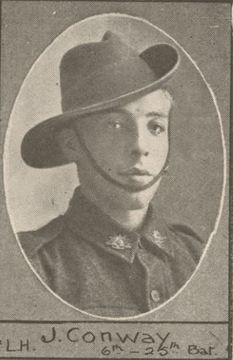
Jimmy Conway was one of several names which appeared in a letter from the front penned by Alf Perrett and published in the Queensland Times on 8 January 1918. While Perrett namechecked many local soldiers he had recently seen, he listed Conway among his fellow Ipswich soccer players who fought beside him in the 9th Battalion. Moreover, Perrett stated Conway had recently won the Military Medal during a period of heavy fighting.
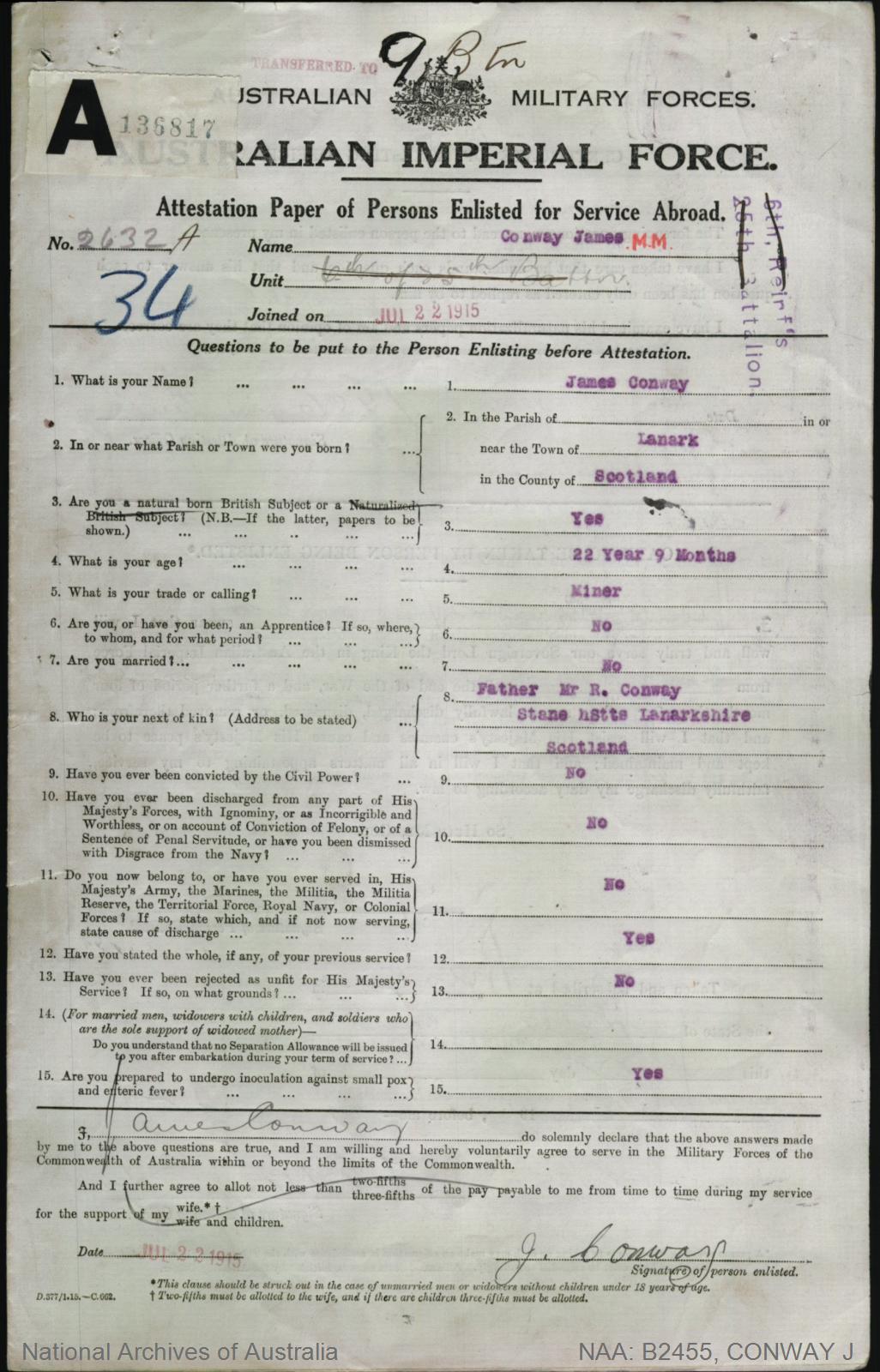
Conway arrived in Ipswich from Scotland not long before Labour Day 1914. He took part in the holiday’s sports program and won a medal in the six-a-side soccer competition. He signed with Bundamba Rangers and was part of the side which drew with Perrett’s Ipswich City side in June 1915. Conway and Perrett both enlisted a month later on 22 July.
Conway was initially placed into the 25th Battalion and departed in October 1915. According to The Queenslander on 5 January 1918, he fought at Gallipoli, but this is not backed up by his military records. Like other soldiers who departed Brisbane at the same time (see Thomas (Henry) Jaggs), there is a gap in the records between their departure and early 1916, with nothing stating they arrived before the evacuation of Gallipoli in December.
Conway was transferred to the 9th Battalion in early 1916, and soon left for France. He was evacuated back to England in October that year with illness. During his convalescence, Conway was among many soldiers who wrote letters thanking the ladies of the Bundamba Soldier’s Comforts Club for the parcels they had received. These letters were printed in the Queensland Times on 2 May 1917, and as one of the soldiers wrote, “It’s fun to see a bloke when he gets a parcel – he’s like a kid with a new toy.”
Conway returned to the front in mid-1917 and was soon involved in heavy fighting. The actions which won him a Military Medal were described in the Commonwealth Gazette on 7 March 1918:
At HOOGE, FRANCE on 20th September, 1917, during the advance on GLENCORSE WOOD, Pte, CONWAY showed conspicuous gallantry and devotion to duty throughout the action. He proved invaluable as a Runner to his Platoon Commander and was ever ready for duty and carried important messages through extremely heavy artillery fire. His conduct was exemplary and marked by coolness which cannot be too highly spoken of.
Conway was wounded in action in October but only missed a month of fighting. His military record shows no further entries until his discharge back in Brisbane in July 1919.
He was living in Rosalie, Brisbane by 1922, when he signed a statutory declaration to request new discharge papers to replace those which had been stolen. Little is known of his movements after this point.