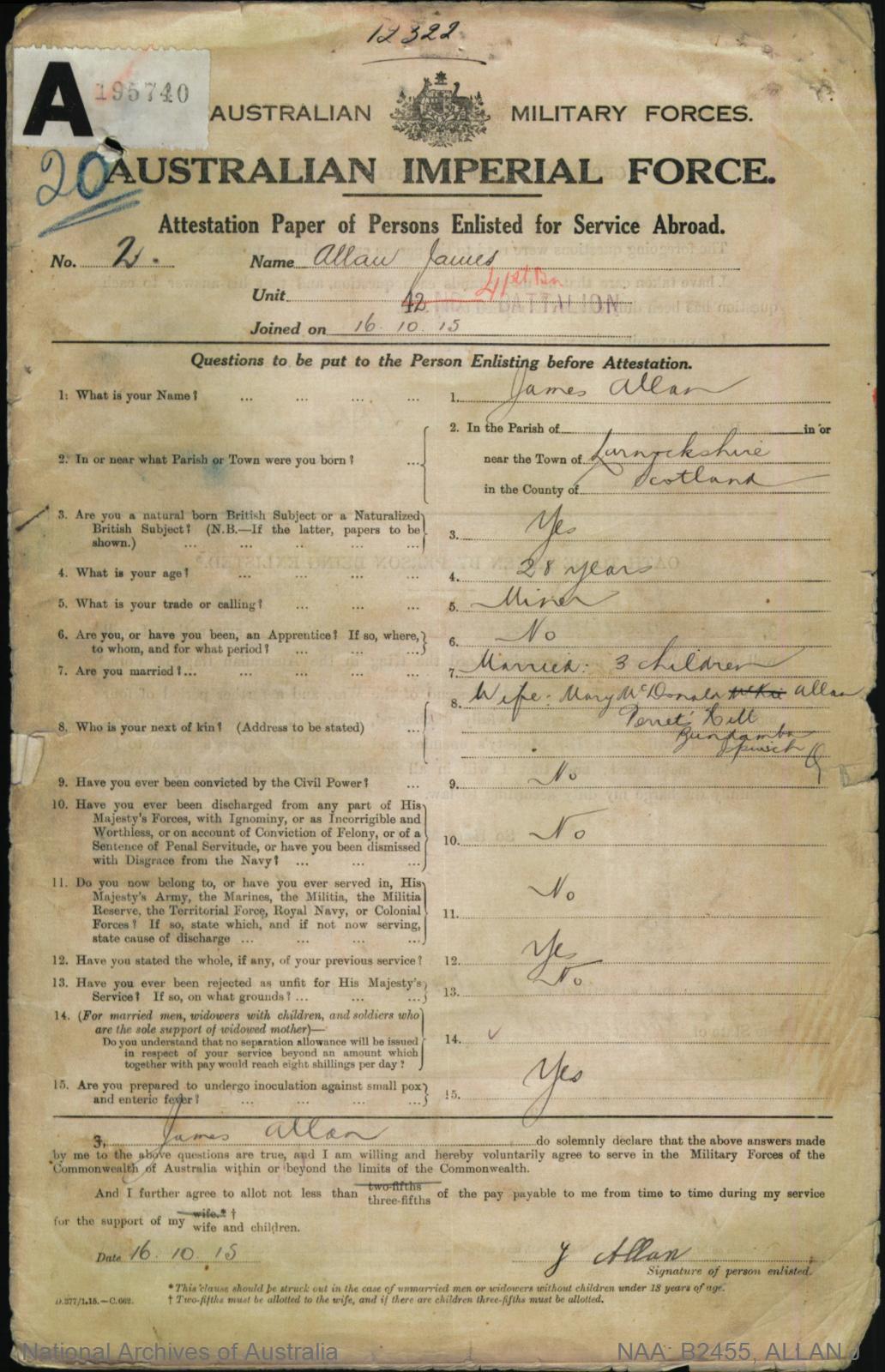
James Allan was a miner who played for Bundamba Athletic in 1912, alongside his brothers Fergus and Alex, and future Socceroo captain Alex Gibb. Most of the Allan family had met Gibb on the Paporoa while emigrating from Scotland in 1911, with Gibb marrying Allan’s sister Margaret on arrival in Ipswich. James, his wife Mary and their newly born daughter followed on the Waipara, leaving Scotland in November.
James Allan and Gibb moved to Bundamba Rangers in 1912, with Athletic seemingly folding. Whether Allan played soccer in subsequent years is unknown, though members of the Allan family later played for St Helens and St Stephens. Both James and Fergus enlisted separately in 1915, at a challenging time for their family.
Their father, another James, had been badly injured in a mining accident in June, and would ultimately pass away in December. It was the first of several mining tragedies suffered by the Allan family in the coming decades. Allan was 28 when he enlisted, and a father to three children. His employer, New Chum Colliery in Dinmore, presented him with an engraved wristlet watch in January 1916.
He departed Australia in June 1916 after training and arrived in France with the 42nd Battalion in November. He was wounded in action in July 1917 but recuperated in France, rejoining his unit in September. His 1918 was only interrupted by a bout of illness, and a late transfer to the 41st Battalion.
Allan set off back to Australia in mid-1919. His brother Fergus also survived the war and arrived home around the same time. Tracking James Allan after the war is difficult due to the number of people who share his name. He lived in Bundamba for many years working as a miner and was a member of the Oddfellows lodge.
Fergus was killed in a mining accident, leading the Queensland Times of 7 February 1945 to claim that Allan was the only miner in the family to have been unscathed by the industry. His brother Alex Allan had previously been killed in the mines, while another brother Robert had been badly injured in a roof collapse. After retirement, James continued to live in Bundamba until his death in 1968 at the age of 81.