
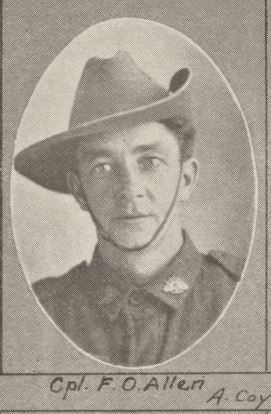
Fergus Allan was among the guests at the silver wedding anniversary celebrations of former Socceroo captain Alex Gibb and wife Margaret. Allan was Margaret’s brother and Gibb’s best man. The Queensland Times of 21 November 1936, in covering the event, described how the couple had met.
In May 1911, Allan, Margaret, their other siblings and parents boarded the Paporoa in Scotland to emigrate to Australia. Onboard they met another Scottish emigrant in Gibb. Margaret and Alex struck up a romance during the voyage, and were married three weeks after arriving in Ipswich, Queensland, leading to Allan being selected as best man.
Allan and Gibb not only became brothers-in-law but also teammates, along with Allan’s older brother James. The trio played soccer for Bundamba Athletic during the 1912 season. One game saw all three score in a win against Booval Stars on 27 July. Allan and Gibb’s form saw them selected for the Ipswich and West Moreton team to play the visiting Howard Rovers in September. The newspaper’s match report spelled Allan’s name as “Allen”, a common occurrence throughout his life.
While Gibb went on to stake his place in Australian soccer history, the Allan brothers largely disappeared from the sport after the 1912 season. It is possible their names were simply not mentioned in match reports in an era when team line-ups were rarely published. Both Fergus and James were still living in Ipswich and working as miners when they enlisted separately in 1915.
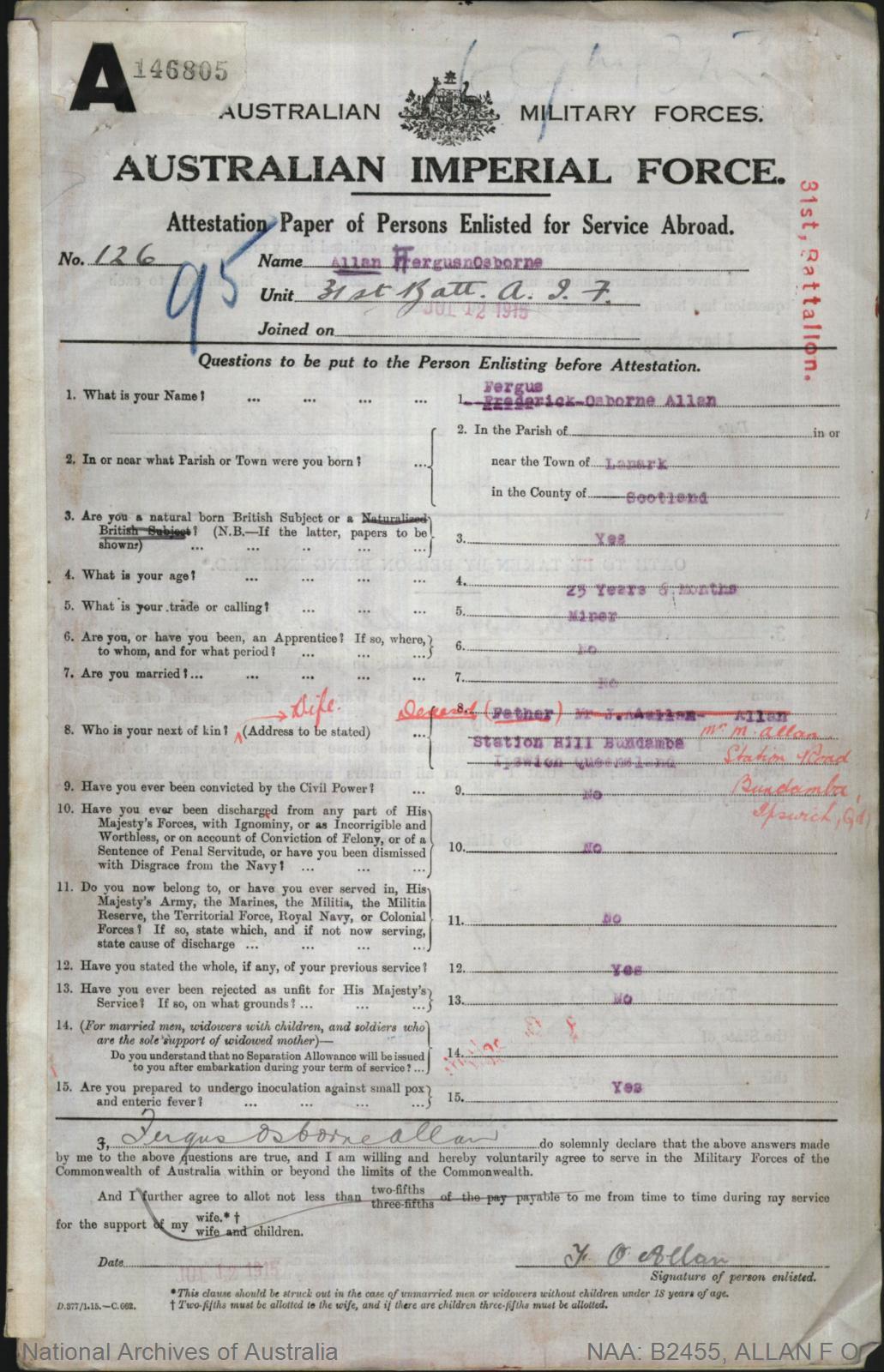
Fergus enlisted in July and married Mabel Perret in September before his departure. Their son Osborne Anzac Allan was born in April 1916, several months after Allan had departed. The military records of those who left Australia in October and November 1915 are often blank until early 1916. Any plans of arriving in Gallipoli were scuppered by the evacuation of the peninsula in December.
It appears Allan initially arrived in Egypt before being redirected to France with the 31st Battalion. Two bouts of illness, including appendicitis, saw him away from the fighting for much of 1916. Allan was transferred to the 69th Battalion in 1917 which saw him spend much of the year in England. He finally returned to France in October where he stayed until receiving a gunshot wound and fracture to his right leg in February 1918. By the time he returned to France in October 1918 the war was all but over.
Allan started back for Australia in June 1919, where he joined his brother James who had also recently returned. Allan returned to mining and was seen playing soccer for Rhondda Colliery against Aberdare in a one-off game, but it seems he did not return to club football.
Mining would play an important part of the remainder of his life and ultimately led to his death in 1945. On 1 February 1945, an explosion at the New Ebbw Vale No. 3 Colliery at Woodend, Ipswich, entombed and killed four miners: Allan, Thomas Adamson, Colin Schulte and Arthur Keidge. A rescue effort began immediately, but it took until 5 February for Allan’s body to be found, with Adamson being found later that day. Mining was suspended in the region to allow for their funeral.
An inquiry, reported in the Telegraph on 23 March and subsequent days, suggested the explosion was caused by the ignition of firedamp – gasses which were found around coal deposits. It was reported that gas ignition had regularly happened in the mine over the previous nine years with one miner stating he had ignited gas four times in the previous 12 months.
Allan, the mine deputy, had entered the mine at 7am for a before-shift inspection. The other three miners often entered the mine before the end of the inspection but were supposed to stay in the deputy’s underground cabin until the all-clear was given. It seemed they were not together at the time of the explosion. The inquiry heard the explosion was likely caused by the safety lamp, carbide lamp or the torch Allen held, but also that Allen was a competent user of the equipment.
Hundreds attended a memorial service for the four miners, which was reported in the Queensland Times on 19 February. Rev. Kestell Cornish, one of the ministers who conducted the service said in his address:
As I look at the hundreds of men who attended the funerals of the victims, the tremendous realisation came upon me of that which bound these men together in common fellowship. We are too prone to forget that the conditions under which they worked are more than hazardous – they are desperately dangerous. People who work together in a common cause or common danger learn to love one another.