
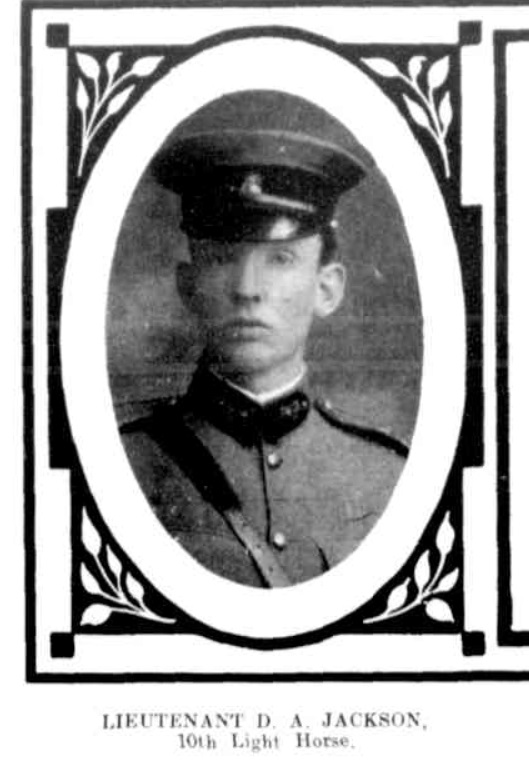
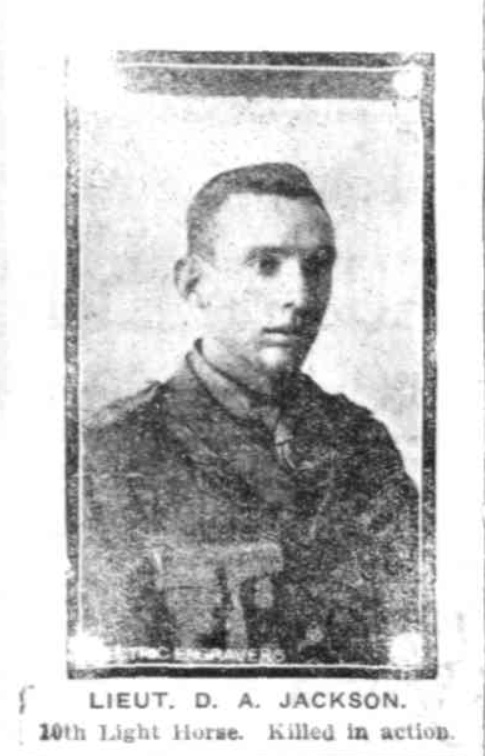
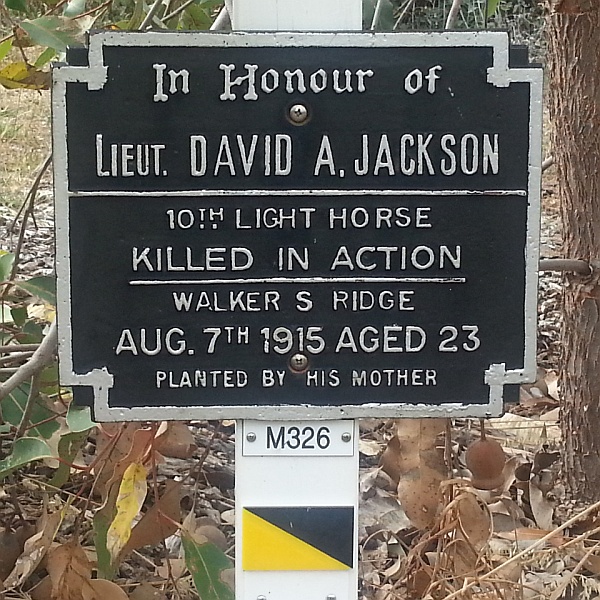
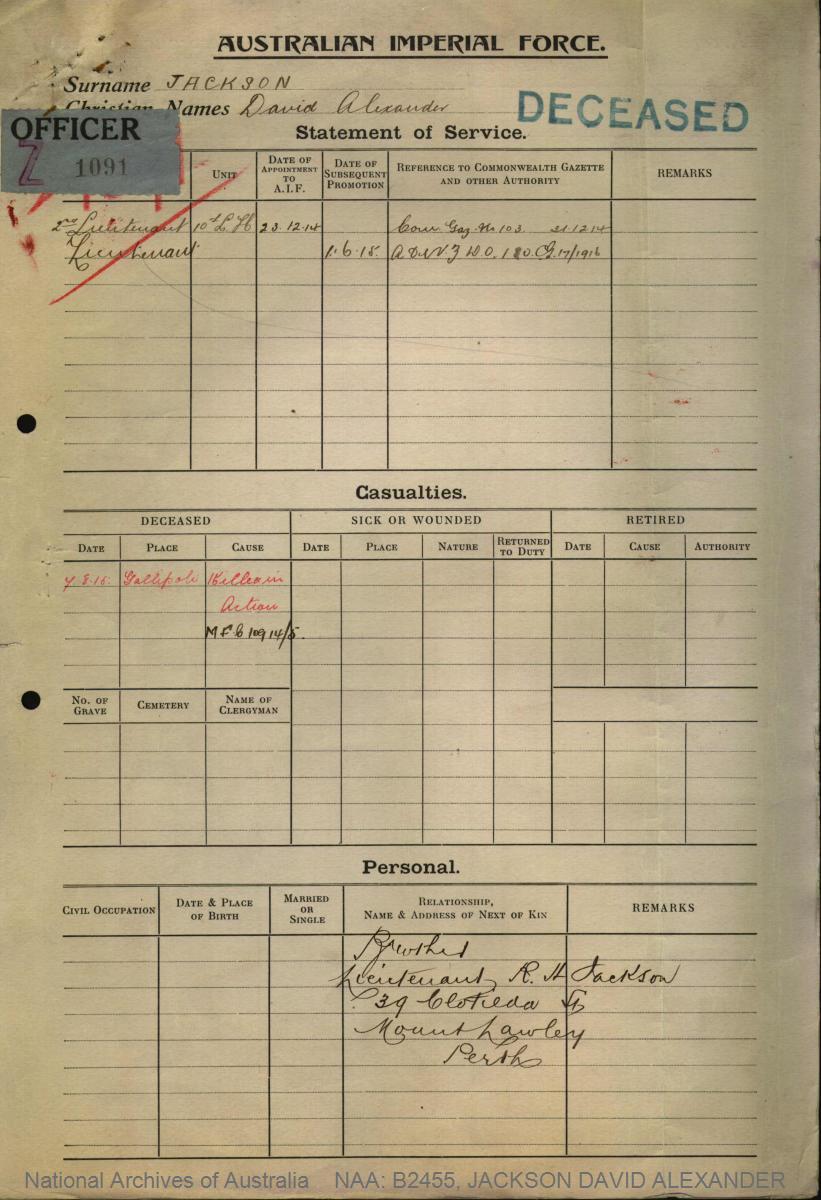
David Jackson was born on 30 April 1892 in Bundaberg, Queensland, the fifth of six children to Samuel Jackson and Sarah Woodland. In 1904 the family moved to Western Australia and set-up home on Newcastle Street in North Perth, which provided their children a 400m walk to attend classes at Perth Boys’ and Girls’ School.
While at school Dave started playing football, most likely inspired by older brother Samuel who was ran around for the Ex-Students club. When the 1908 season rolled around Dave threw his lot in with Ex-Students’ Junior League team, who ended the winter mid-table in Division Three.
The following year Dave played in the second tier and in 1910 he donned Ex-Students’ purple and green in their debut Division One campaign. The club changed their name to Austral, and their colours to blue and gold, ahead of the 1911 season in which they were pipped for the league title on goal difference by Claremont.
Dave featured regularly at fullback for Austral to the end of the 1914 season, captaining the club that final winter. By this time he had completed an architectural draftsman course at Adelaide University and served four year with the Australian Field Artillery, where he had risen to the rank of Lieutenant. The family had also moved to Clotilde Street in Mt Lawley.
In December 1914 Dave enlisted with the 10th Light Horse Regiment, serving as 2nd Lieutenant. His elder brother, Robert, had joined the 10th Light Horse only three weeks earlier while Samuel had signed up with the 11th Battalion the previous August, just twelve days after Australia entered World War 1.
The 10th Light Horse trained at Rockingham prior to departing for Alexandria, Egypt. They landed at Gallipoli in mid-May 1915 and after around a fortnight on the peninsula Dave was promoted to Lieutenant. In July he was treated for a scalp wound, the result of a fall in his dug out.
David Jackson was killed in action on 7 August, 1915, at Walkers Ridge. Roy McLarty, who played for Ex-Students in 1908 and was serving in the 3rd Field Artillery Brigade, noted in a letter home that “I have heard bad news of the Light Horse. ‘A’ & ‘B’ Squadrons charged an almost untakeable trench and suffered badly”.
News of Dave’s death was reported in the West Australian on 21 August 1915 –
Lieutenant D. Jackson, who is reported as being killed in action at the Dardanelles, will be received with the deepest regret by all who knew him. ‘Dave’ had been connected with soccer for a number of years, but as junior and senior he only played for one club. After leaving school he played with the Ex-Students, which eventually took the name of Austral. As skipper, he was one of the mainstays of the Austral last year, and his untimely end will be a great loss not only to his late club but to the game in general.”
The following year ‘Unomi’ wrote in the 24 June 1916 edition of the West Australian,
Many stories have been told as to how Lieutenant ‘Dave’ Jackson, of the 10th Light Horse, and of the Austral Club, met his death, but as they have been in the main mostly incorrect, it might be fitting to relate the story as told by Trooper Murray last Saturday, in answer to a query by the writer. It appears that subsequent to the now historic event through which Dave, contrary to other versions, came through unscathed. Murray was crawling back from the trenches, but owing to his severe wound was unable to pass some obstacles in his way. ‘Dave’ came to his aid, and assisted him into safety and then returned to his position. Some minutes later he heard the moans of another member of his company, who was lying wounded on the enemy side of the trenches, and though it was certain death to go to his help, Lieutenant Jackson never hesitated, or gave a thought to himself. He immediately climbed the parapet and went to the succour of his fallen comrade, but, alas, he never returned. Thus the career of one who, according to Trooper Murray, was one of the most popular officers of the Light Horse was brought to a close. Truly, greater love no man could have than this, and the pity is that his heroic action was of no avail. Whilst one may deplore his untimely end, all who knew ‘Dave’ must feel proud of him. He did what one would have expected of him under the circumstances, and all that remains is a cherished memory.