
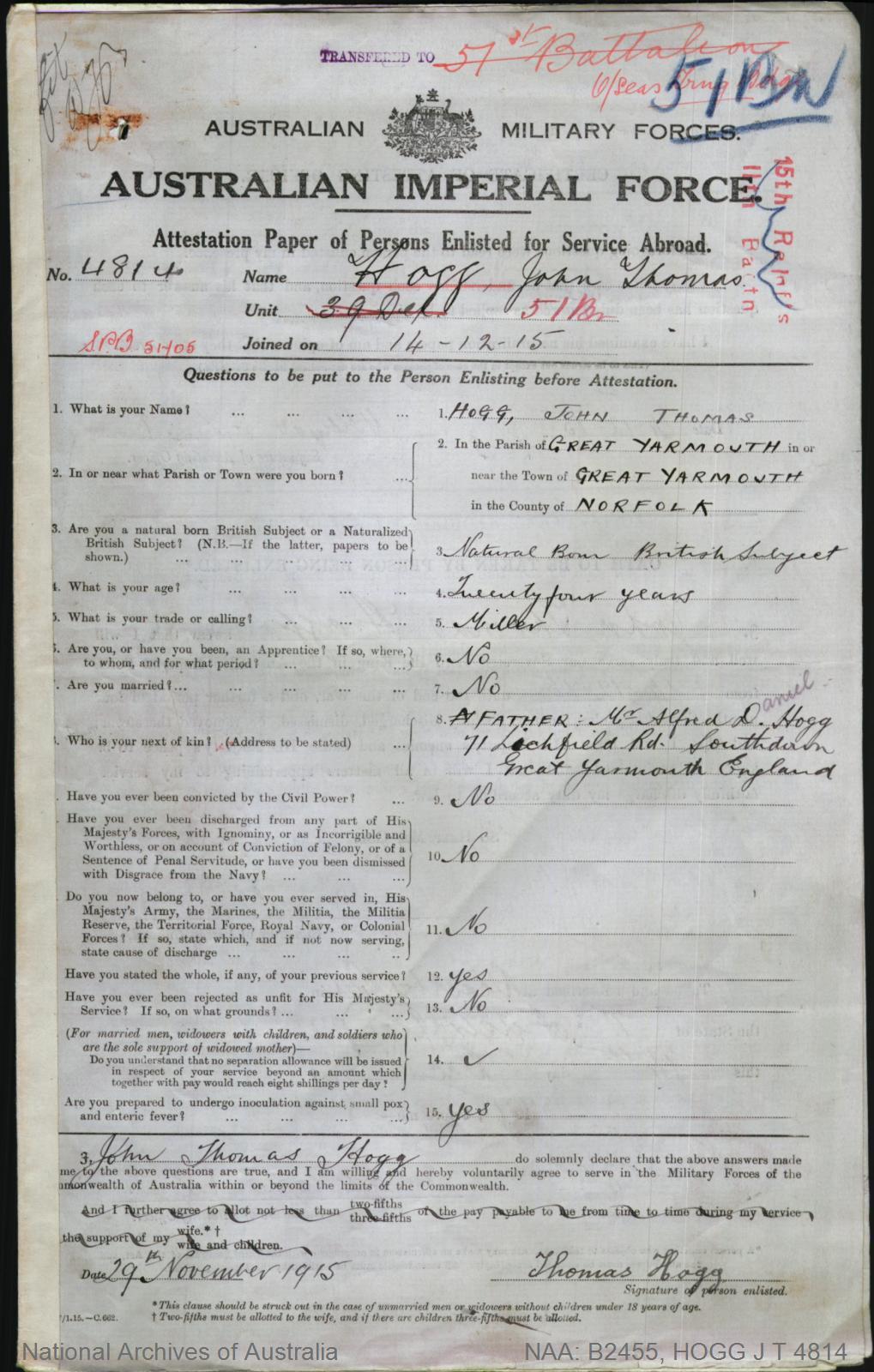
Jack Hogg was born in the English seaside town of Great Yarmouth in about July 1891. He worked as an agriculturalist and in mid-1911 emigrated to Western Australia, most likely attracted by the State government initiative that offered passage, land and support to farm workers. Jack found employment in the Wheatbelt town of Narrogin as a miller, processing cereal grains into flour.
When Narrogin entered the newly formed regional football league in 1913 Jack was amongst the first to sign up, playing in defence and midfield against neighbouring towns Cuballing and Toolibin. Jack also represented Narrogin in mid-season friendlies with Training College, from the metropolitan leagues, and Collie.
He remained a regular part of the Narrogin eleven throughout 1914, highlighted by a sterling performance at centre-back alongside John Clunas in another mid-year friendly with Training College.
In November 1915 Jack enlisted as a Private with the 11th Battalion. On arriving in Egypt he was transferred to the newly formed 51st Battalion and by June had been deployed to the Somme Valley in France. The 51st Battalion suffered over 650 casualties at Mouquet Farm in August/September 1916 before alternating between rear and front-line duties for the rest of the year.
Promoted to Lance Corporal, Jack participated in the Allies advance toward the Hindenburg Line during the early months of 1917. In July he suffered a severe gun shot wound to the left thigh and was evacuated to hospital in Brighton, England. Released after two months of treatment, he trained extensively at Hurdcott before rejoining his unit in France in August 1918.
On his return to Australia, Jack assisted with the establishment of Narrogin’s Returned Soldiers Association. He joined the local Rifle Club and soon gained State team selection for tournaments in Sydney and Melbourne. His standing within the local community was recognised in 1923 when he was appointed inaugural captain of Narrogin’s Volunteer Fire Brigade.
Jack also played his part in football’s return to Narrogin after a six-year absence. In May 1920 he played for Narrogin alongside fellow returned soldiers John Clunas, John Bonney, Hugh Primrose and Joseph Johnson in a 3-1 friendly loss to visiting metropolitan league side Claremont.
He served as secretary and treasurer of the Narrogin British Football Association for a period and played his final game in 1922.
It is not known when John Hogg passed away.