
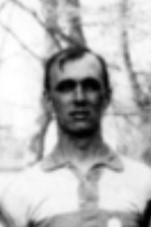
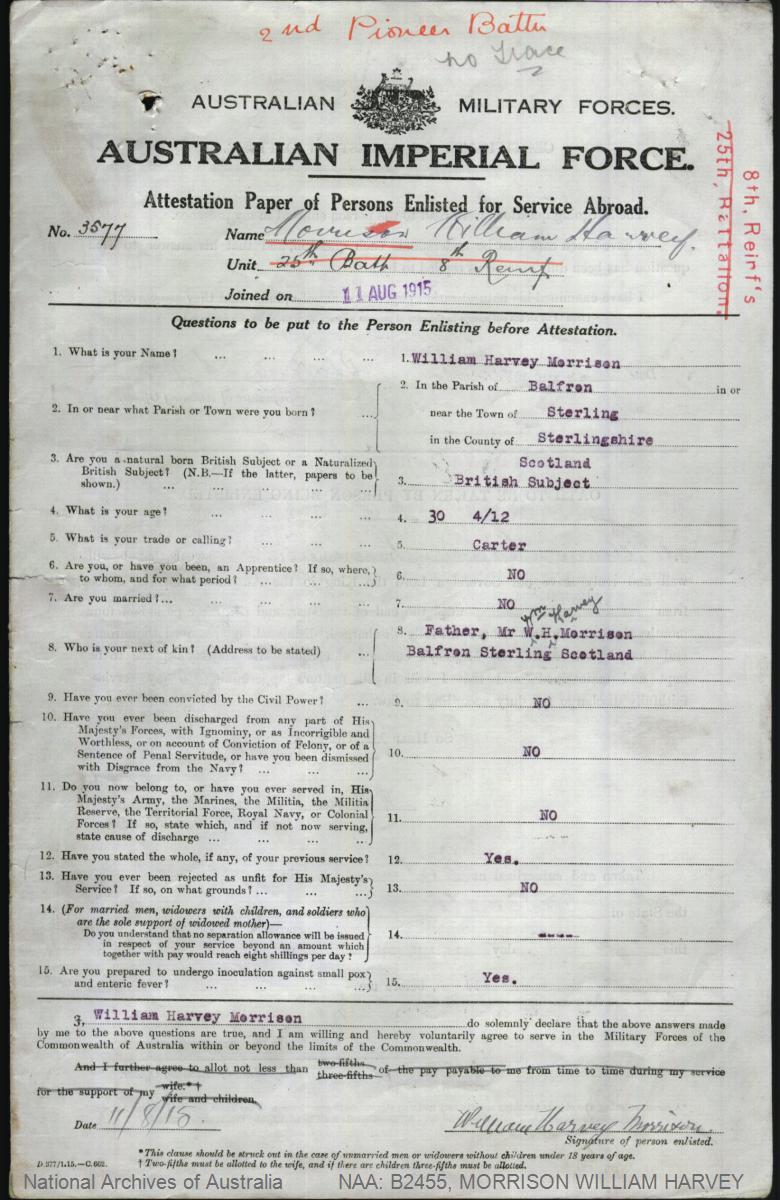
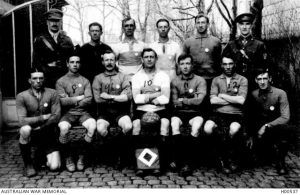
Private William Morrison is third from left, back row in the team photograph of the 2nd Pioneer Battalion Soccer Football Team held by the Australian War Memorial. The team had won the Brigade Group Medal Competition, though the year isn’t given. While his teammates were predominately from Victoria, Morrison was one of two players – with Walter Overson of Brisbane club Eskgrove – who hailed from Queensland.
It is unknown which Brisbane club, if any, Morrison played for before the war. A “H. Morrison” played for Eskgrove, and Morrison, sharing a first name with his father William, may have been known by his second name. It is also unknown when he emigrated to Brisbane from Scotland.
He enlisted at the age of 30 in August 1915. At the time he was a carter. Morrison left Australia on 3 January 1916 and was transferred to the 2nd Pioneer Battalion in March. The battalion embarked for France by the end of the month. His record is otherwise empty until 1918, when he spent a few months seconded to the 3rd Pioneer Battalion. A bout of influenza after armistice saw his return to England in March 1919.
While Morrison remained part of the 2nd Pioneer Battalion after the war, he was allowed to take leave in July 1919 for non-military employment. He worked as a baker’s vanman in the Scottish village of Balfron, where he was born and his family still lived. Here he married domestic servant Elizabeth Fraser on 25 September 1919.
Hints of his wartime work and his return to Australia came from letters written by and to William Sinclair starting 1919. Sinclair originally wrote to the Victorian branch of the Department of Repatriations asking to be put in contact with Morrison. Morrison had been the batman – or personal servant – of Sinclair’s brother Captain A. N. Sinclair, who died in 1917. Sinclair sought information regarding his brother’s death. Captain Archibald Neven Sinclair’s record states he had died of his wounds in Belgium on 11 October 1917.
Posthumously awarded with the Military Cross for work undertaken before July that year, Sinclair’s citation read:
For conspicuous gallantry and devotion to duty in leading his company with ammunition for the front line, through heavy barrage and across the open several times during the day, doing much useful work without heavy casualties. During subsequent operations he reconnoitred and arranged for his company to construct strong posts during consolidation of captured positions. He displayed the greatest fearlessness throughout.
It is possible that Morrison assisted in this work, including the construction of the captured positions. The Pioneer Battalions were tasked with engineering works, including defensive positions and improving camps. But a batman’s duties largely included conveying orders, driving the officer’s vehicle, sometimes under fire, and maintaining uniform among other tasks.
The Department passed the request onto Base Records, who replied to Sinclair on 18 November 1919. Their response stated that Morrison was still with the 2nd Pioneer Battalion and would most likely be returning to Australia “in the near future”. They encouraged Sinclair to contact Morrison on his return, and “enquire from this soldier the names of any members of the 2nd Pioneer Battalion who may have been present at the time your brother was killed”. Sinclair wrote to Base Records on 11 May 1921, asking whether Morrison had indeed returned. This time, Base Records stated that Morrison had returned to Australia and was discharged from the AIF on 24 June 1920.
It is unknown whether Sinclair ever got in contact with Morrison, The Morrisons arrived in Australia in time for their first son to be born in Queensland in July 1920. A second was born in Victoria in 1923. Otherwise, there are few public traces of their movements.
Morrison died in Queensland in 1974.