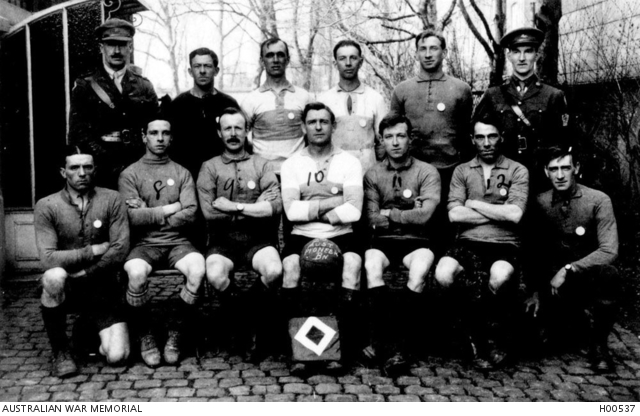
Walter Crask Overson played for Eskgrove soccer club before the war, alongside younger brother Crask as well as Herbert, his half-uncle and Queensland representative player.
He enlisted in September 1915 just over a year after Crask. Two other brothers, Ernest and Arthur also enlisted, while their father, also known as Crask, served in Australia and played in the AIF Base Band, though it is unknown whether any had links to soccer.
Walter was assigned to the 2nd Australian Pioneer Battalion, and played for their soccer team, winning the Brigade Group Medal Competition. A picture of the winning team is held by the Australian War Memorial, which shows squad number 12 scrawled on Overson’s shirt. He was one of only two Queenslanders in the team, which was largely made up of Victorians and a single representative of Western Australia.
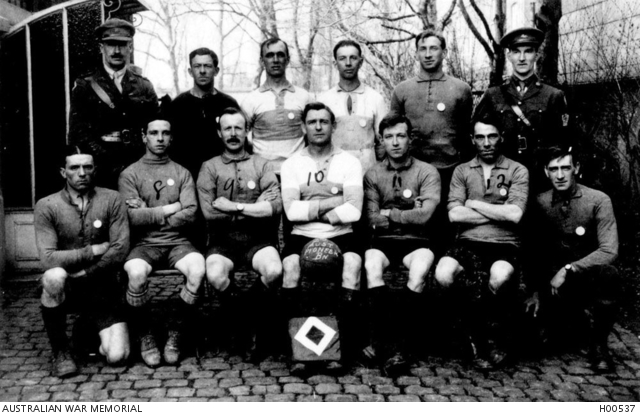
The Pioneer battalions were trained infantry who had other trade skills to undertake some engineering tasks, such as digging trenches or constructing light railway.
Overson received a gunshot wound to the right eye in August 1916, presumably at the Battle of Mouquet Farm. The injury saw him out of action for two months. In 1917 he contracted gonorrhoea, one of almost 50,000 Australian troops to contract a VD at the Western Front. With penicillin yet to be discovered, each infected soldier required daily treatment for at least six weeks.
By late 1917 he was back in action with the 2nd Pioneers until it disbanded in May 1918. Overson was briefly transferred to the 37th Casualty Clearing Station, where he was a member of the Regimental Band but otherwise it is unknown where else he served until his discharge in mid-1919. His band experience continued after the war, where he became bandmaster of the Biggenden Town Band.
He lived with his family in Biggenden, north-west of Brisbane, for many years after the war and died at Greenbank Repatriation Hospital in May 1949.