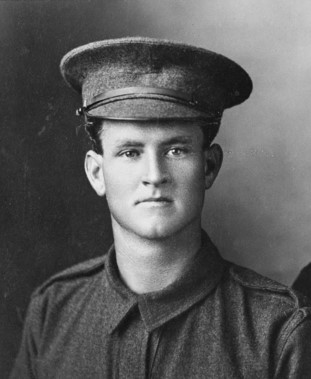
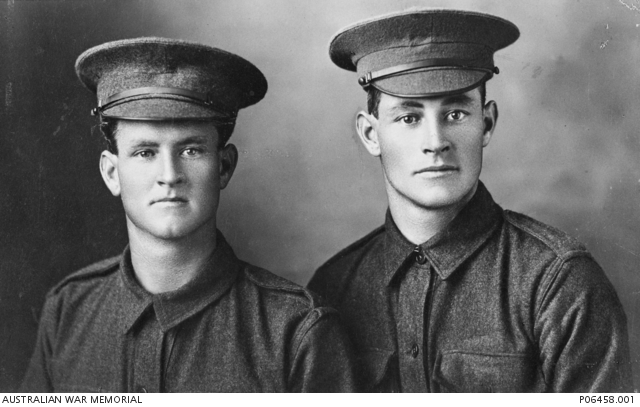
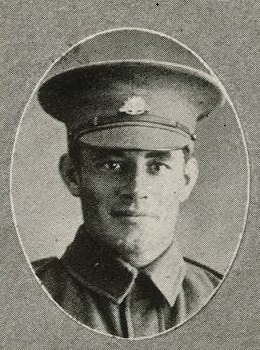
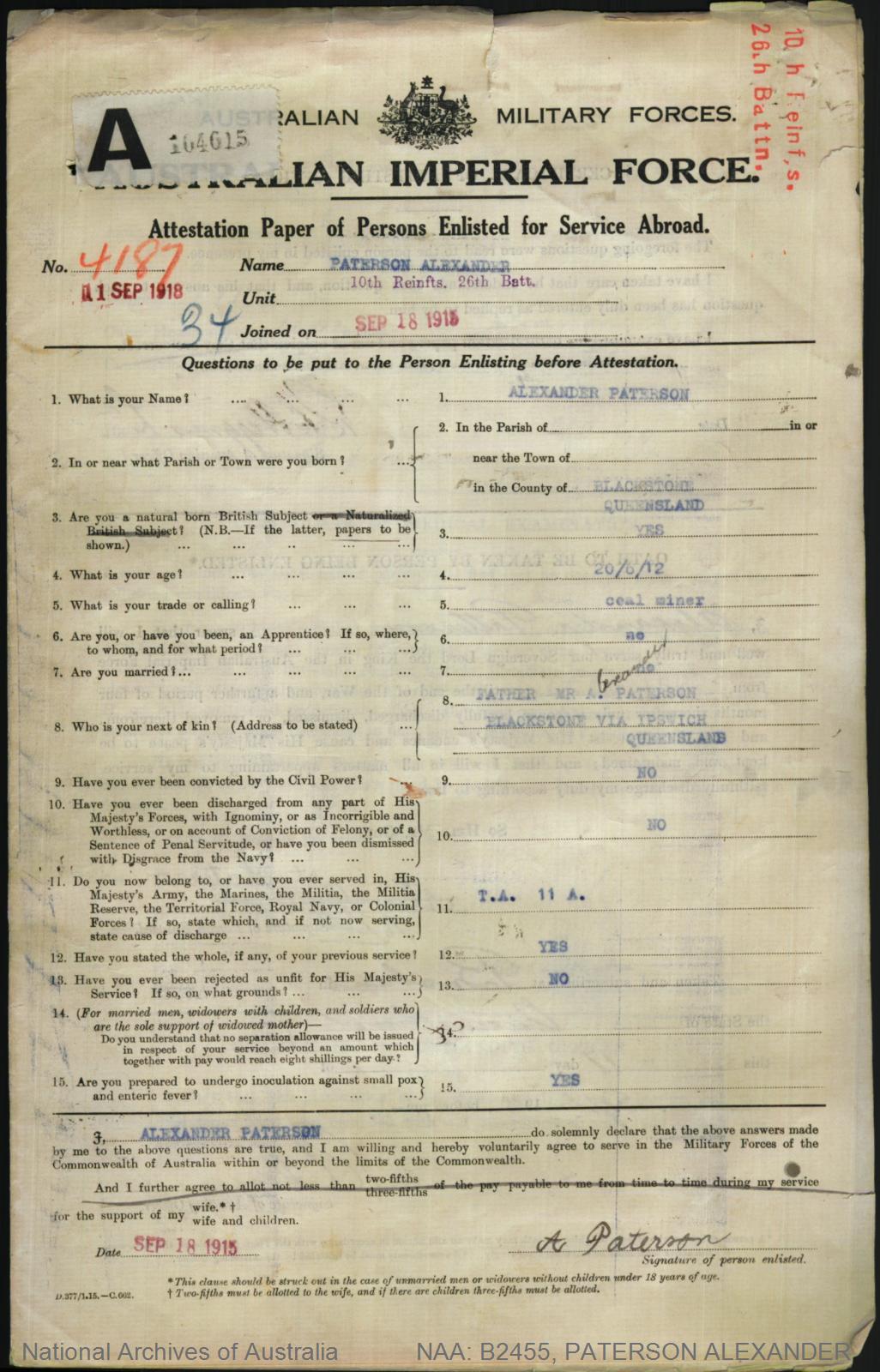
Alexander Paterson was the younger brother of Queensland soccer representative William Patterson. Both played for Blackstone Rovers, Alexander for the junior division team in 1915, William for the seniors. Both were born in Blackstone, worked as miners, enlisted on the same day in September 1915 and were allocated to the 26th Battalion. Only Alexander Paterson returned.
September continued to be an eventful month for Paterson. He reached the front in September 1916, was shot for the first time in September 1917, leading to 6 months recuperation, and was wounded again in September 1918, ending his war. This last injury, a gunshot wound to the thigh, saw him return to Australia at the start of 1919.
Paterson continued to live in Ipswich after the war. It appears he did not return to the game and was not seen in the press until the Second World War, when he did his bit for Australia’s home defence.
Paterson was living in the suburb of Silkstone by 1943. His mother Emma had died in February that year. Days later, Paterson gave a lecture at Silkstone State School on “Emergency Bomb Recognition and Disposal”, which started with a minute’s silence for his mother.
Paterson was a warden in the Silkstone ARP (Air Raid Precautions). The warden’s duties included first aid, rescue and demolition, mine rescue, fire brigade and dealing with damaged electrical and gas services. The ARPs were set up as part of national preparations for the threat of Japanese bombing. Some wardens were involved with dealing with bombs and received training by Paterson and others.
The Queensland Times of 31 May 1943 reported on a public display of warden’s work which:
Included in the programme were flares and detonations, treated by Bomb Reconnaissance Warden A. Patterson (sic) and squad. No. 6 post dealt with incendiary bombs, using the sand and mat method; No. 2 post used the rake and shovel method, and in each case the process was repeated by women wardens. Nos. 1 and 4 posts dealt with incendiary bombs, using special trollies built by the wardens. … Women wardens dealt with incendiary bombs the stirrup method and wardens from headquarters post, under Warden K. Woods, dealt with an incendiary bomb requiring the use of a ladder.”
Paterson later became heavily involved with the United Serviced bowls club during the 1950s.