
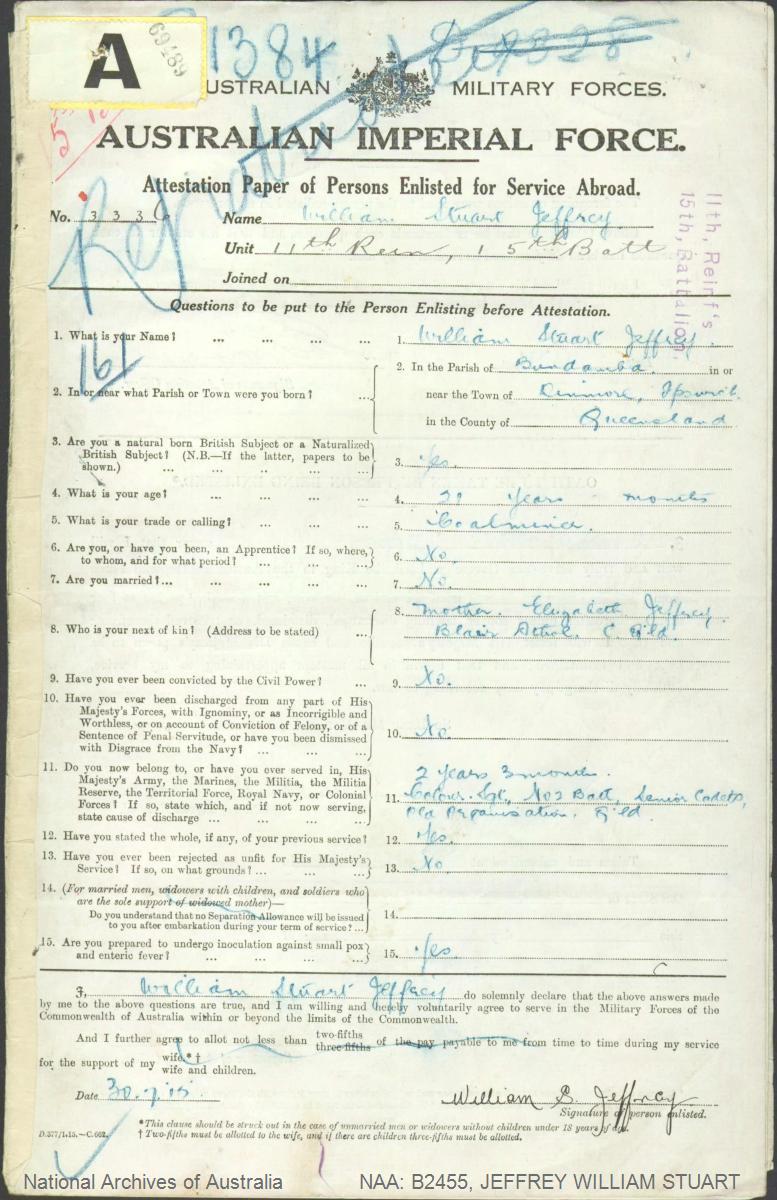
When William Jeffrey died in 1932, the Queensland Times on 24 May mentioned the lasting impact the war had on him. Jeffrey had been severely injured in the shoulder in France and taken as a prisoner of war by the Germans until a prisoner swap occurred.
He returned to mining after the war, but in the year before his death the state of his shoulder saw him take employment as a liftman at the Cannon Hill Government abattoir, as he could not perform manual labour. While he was undertaking this job Jeffrey was accidentally shot and killed at the age of 37.
Before the war, Jeffrey was a miner and played with the Dinmore Bush Rats. His family was involved the creation of the club, originally known as New Chum Bush Rats and first seen in 1891 but likely to have started the previous year. His grandfather Michael Jeffrey ran the New Chum colliery from which the team sprang, while his name-sake father played in the club’s first competitive team, as did his maternal uncles William and George Duck.
Around 1909 the family moved to Blair Athol, near Claremont, Queensland, where Jeffrey’s father became the manager of the local coal mine. Initially Jeffrey stayed in Ipswich, where he played for the junior Bush Rats in 1911 and 1912 but moved to Blair Athol to work in his father’s mine by the time he enlisted. He may have also been the player named Jeffrey in the Blair Athol soccer team of 1913, being the only son in the family.
Jeffrey enlisted in July 1915 and was allocated to the 15th Battalion. He was wounded in action in August 1916 and suffered two bouts of illness the same year. On 14 April 1917 he was declared by the Commanding Officer of the 15th Battalion as being killed in action at Reincourt three days earlier. This was later cancelled. Meanwhile the Germans recorded Jeffrey’s particulars on his capture, forms which appear in his military record. By the end of May, the AIF officially cancelled the death notice, having received word that Jeffrey had become a prisoner of war. It appears the prisoner exchange occurred in January 1918 in Holland, with an AIF casualty form stating Jeffrey had a severe gunshot wound to the left arm and had been transferred to hospital.
Jeffrey was repatriated to Australia in April. He returned to Blair Athol where he continued to work at the mine, though the exact nature of his work is unknown. In 1931 his injured shoulder necessitated working the non-manual labour at the abattoir in Brisbane.
Here he married Mary Bell Hogan in 1932, but two months later he was accidentally killed. According to the coroner’s court report in the Brisbane Courier on 8 June 1932, the paymaster was returning to his office with uncollected wages, and decided to remove the cartridges of the automatic pistol he was carrying while in the lift. Jeffrey, running the lift, asked the paymaster if the gun was properly unloaded, leading to the paymaster to reexamine the gun. The paymaster was unaware there was still a cartridge in the barrel and the gun went off, shooting Jeffrey in the abdomen. Jeffrey died soon after arriving in hospital. No one was charged in the incident.