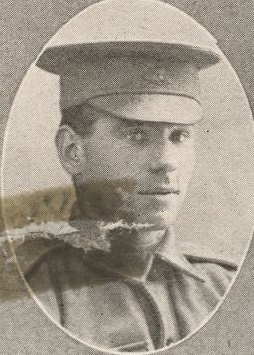
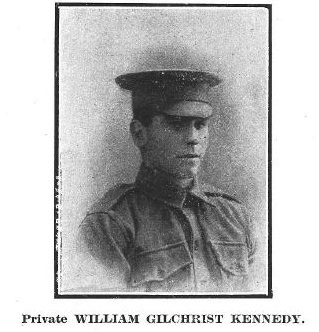
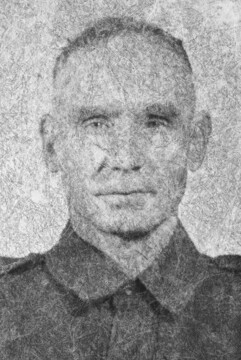
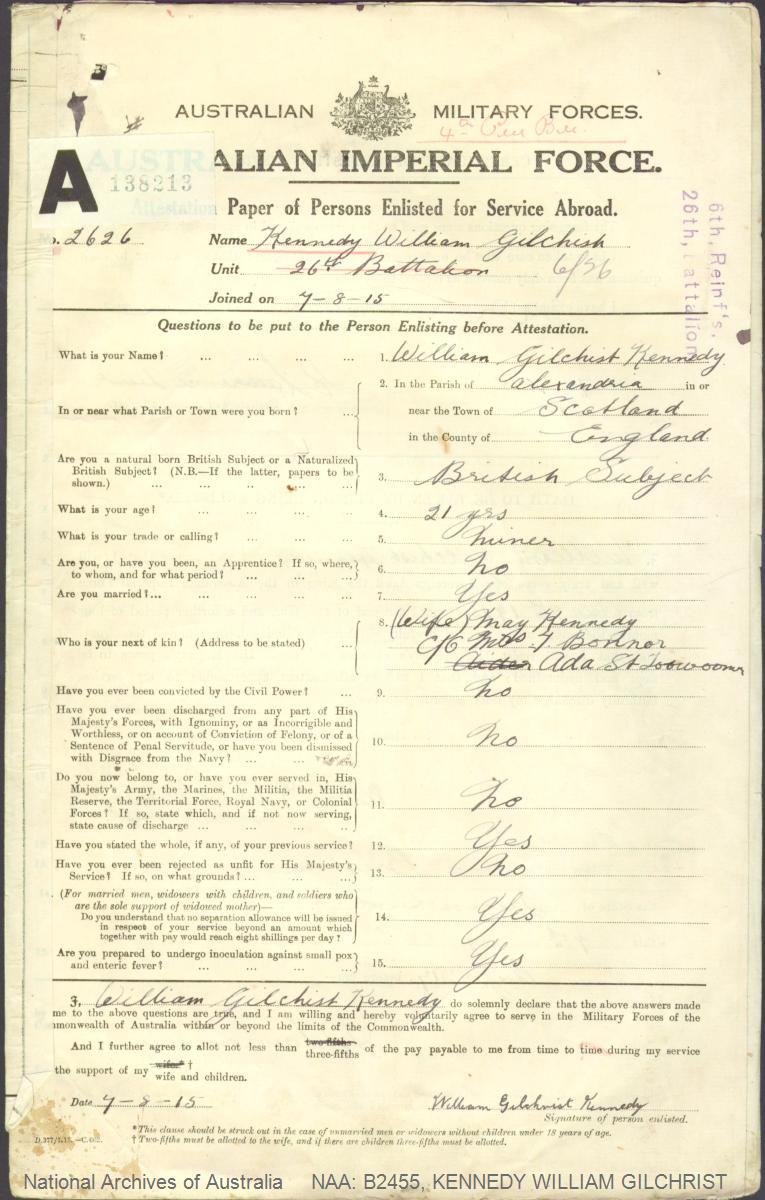
Billy Kennedy was “a recently returned ‘digger’”, according to the Toowoomba Chronicle of 21 June 1919, who was picked to play for the Returned Soldier’s Soccer Club that same afternoon. Kennedy had returned to Australia in April, having originally enlisted in August 1915.
At the time of his enlistment, Kennedy was a married 21-year-old miner. The Chronicle article also implies he played soccer at the time. Several Kennedys were reported as playing in the area before 1915, with two noted as appearing in the same match by the Darling Down Gazette on 30 July 1913.
He arrived in Egypt around January 1916. The post-Gallipoli reorganisation saw Kennedy initially allocated to the 15th Battalion before being moved to the 47th Battalion in March, and then onto the 4th Pioneer Battalion by the end of the month. He reached France mid-year and was promoted to Lance Corporal, then Corporal in 1917.
His military career soon stalled due to a court martialled in July. Kennedy was charged with being absent without leave, after overstaying approved leave. In all he was away 13 days without permission. Kennedy pleaded guilty and was docked pay, and seemingly lost rank but continued fighting.
In August he received a gunshot wound in the back whilst fighting near Boulogne. He was evacuated to England, where he was court martialled in mid-December, again for being absent without leave. This time he was away from the Hurdcott Camp near Wiltshire for two weeks and was subsequently sentenced to 29 days detention. This was reduced to time already served due to good conduct. In all Kennedy was detained for 14 days.
Kennedy returned to France in February 1918. He was wounded in September and recovered in France, rejoining his unit a month before armistice. By the time he left France in January 1919, Kennedy had regained his rank of Corporal.
On his return to Toowoomba, Kennedy joined the Returned Soldier’s Soccer Club, alongside his elder brother Duncan, who had enlisted in New South Wales but lived in Toowoomba after the war. The club soon renamed itself Diggers, though was briefly known as Casuals in 1921. While Kennedy had a handful of games for nearby Cawdor in 1921 and 1922, he predominantly played for Diggers. He captained Diggers to the 1920 premiership and helped them secure the 1923 Charity Cup. Kennedy was last seen playing for the club in 1927.
Kennedy signed up again for the second war in July 1940, lying about his age. He claimed he was born in August 1900, despite having been married to May at the time of his original enlistment in 1915. His war service initially took him to the Middle East in December 1940 and by 1942 was attached to the 7th Division. Kennedy and the 7th were later moved to Port Moresby in August 1942. Soon after arriving in Papua New Guinea, Kennedy moved to the 2/7 Mobile Laundry and Forward Decontamination Unit within the 7th Division and was later promoted to Sergeant. The unit consisted of a convoy of trucks pulling laundry trailers to clean bedding and clothes in what was a humid and hot theatre of war. He was discharged in mid-1945.
He died in Toowoomba on 2 March 1956.