
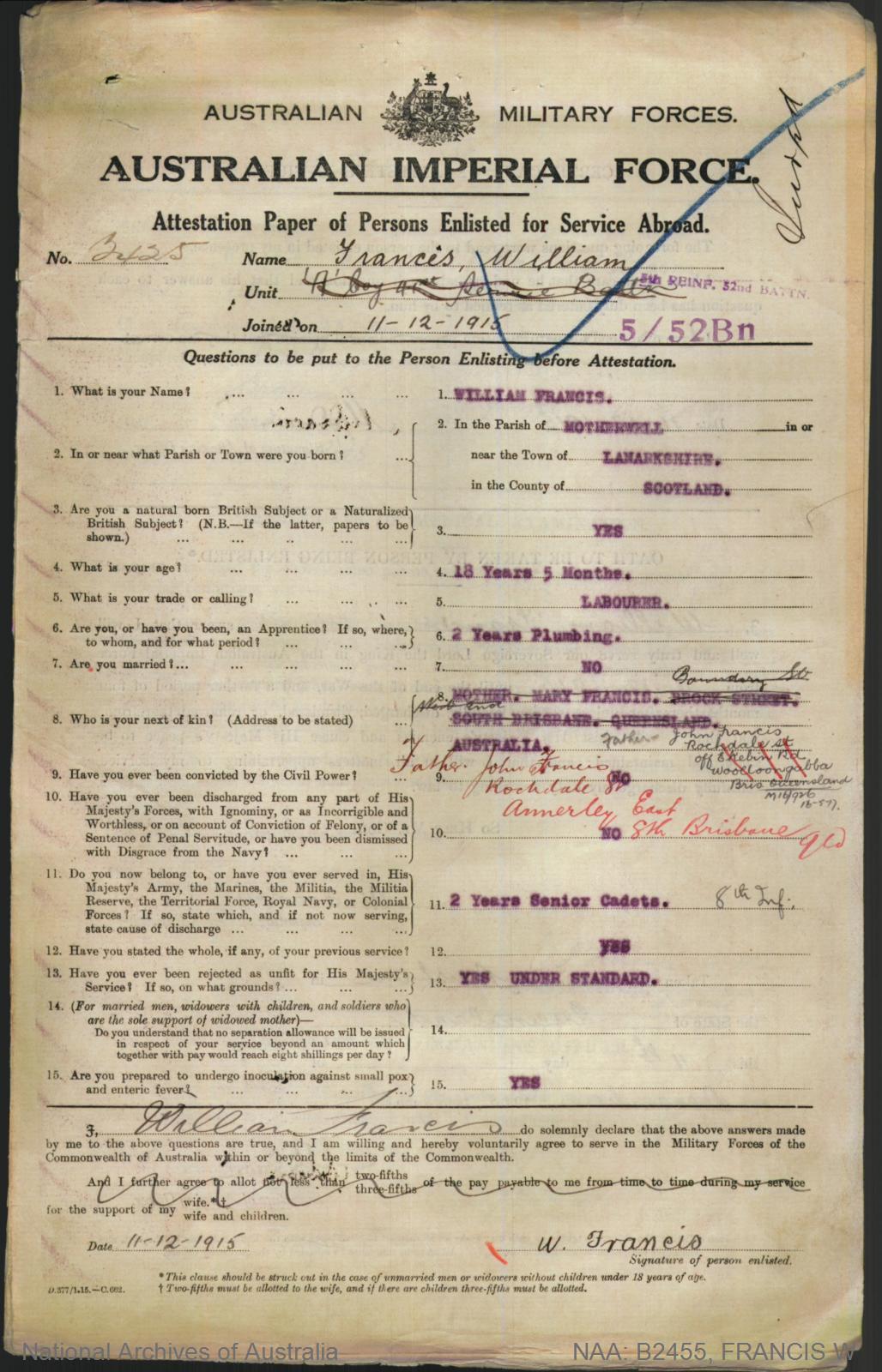
The following testimony is contained in the Australian Red Cross Society Wounded and Missing Enquiry Bureau file for William Francis.
With reference to your enquiry for – 2425a Pte. W. FRANCIS, 47th Battalion, A.I.F. Who is officially reported to have died of wounds on 16-10-17. We beg to inform a further unofficial report we have just received concerning him from 2668 J.P. Keenan of the same Battalion.
Informant states:- “His name was Willie and he belonged to D.XIV. His No. was 2425a. The date when he was his was either the 14th or 15th. We had just finished an attack on Passchendale Ridge on October 12th and had to come back on that day on to new lines. On the 14th or 15th we still held the line in shell holes and trenches. The O.C. – Capt Anderson, – called Francis to take a message about 11.0 a.m. Francis was just bending to speak to the Capt. Who was in the Coy Headquarters shell hole, when a sniper got him. I was quote near and saw it happen. We put him in the trench and bandaged him up, he was wounded thro the mouth. He was still conscious and asked if they would send him to Blight. On account of the shells and snipers it was impossible to remove him from the trenches for some time. I heard afterwards he had died of wounds at a C.C.S. where he had been taken from the R.A.P. He was a youngster – 19 1/2, single – his people lived at Rockdale Street, South Brisbane, Queensland.”
These files collated testimonies given as part of Red Cross investigations which took place during the war. It appears the Red Cross enquiry came in response to a letter dated 5 November 1917 by Francis’s grandmother, Mrs Gavin Shaw, who had asked for more information about his death.
Perhaps coincidentally, Francis’s military record contains a single sheet dated 2 November with the heading “No Trace”, noting his date of death but implying no further information could be found. With authorities unable to give more details to Mrs Shaw, an enquiry was held in 1918 to discover where Francis was buried. It appears those who were with Francis were uncertain about what happened, as per the testimony of Private A.F. Hayes (4520), who saw Francis in the immediate aftermath of his shooting.
He was in D. Company and a Signaller attached to H.Q. I knew him well he was called ‘Billy’. I saw him on October 1st after he had been badly wounded through the mouth at Pesscendaele; he was in a shell hole. We were just settling down for a further hop-over. I think he would be buried as he was behind us. He was rather tall, slim, dark, good soccer footballer. His brother had just been wounded Private. Jack Francis on April 10th. I carried him out.
Hayes, in a follow-up, went on to state “It was most unlikely that he was buried under the circumstances.” The answer finally came from his brother, Jack, whose testimony stated, “I saw his grave in cemetery, Poperinghe.” This was confirmed by a M. A. Searcher, who gave the burial place as Nine Elmes British Cemetery near Poperinghe, Belgium. No testimony gave the date of the burial, but a side note was later handwritten in Francis’s military record stating he had been buried on 19 October 1917, with the service conducted by the reverend attached to the Clearing Station where he died of his wounds.
The Red Cross were able to reply to Mrs Shaw in May 1918, collating much of the information from the various testimonies. Confusion surrounding soldier burials continued to be common, despite the best efforts of the AIF and the Red Cross. Later, in the early 1920s, a formal process was initiated to vet burial records.
William Francis was born in Scotland but emigrated with his family to Brisbane in 1912. As Hayes noted above, Francis was a skilled soccer player, though given the lack of coverage of Brisbane soccer below first grade seniors during the era, it is unknown where he played. A player named Francis played for the Brisbane City junior side in September 1915 though it is not possible to confirm their first name.
Francis enlisted aged 18 in December 1915. It took him 12 months to reach Plymouth. He didn’t arrive in France until March 1917 where he joined the 47th Battalion. No other information is contained in his record until his death in October.
His brother, Jack, survived the war and lived until 1965.