

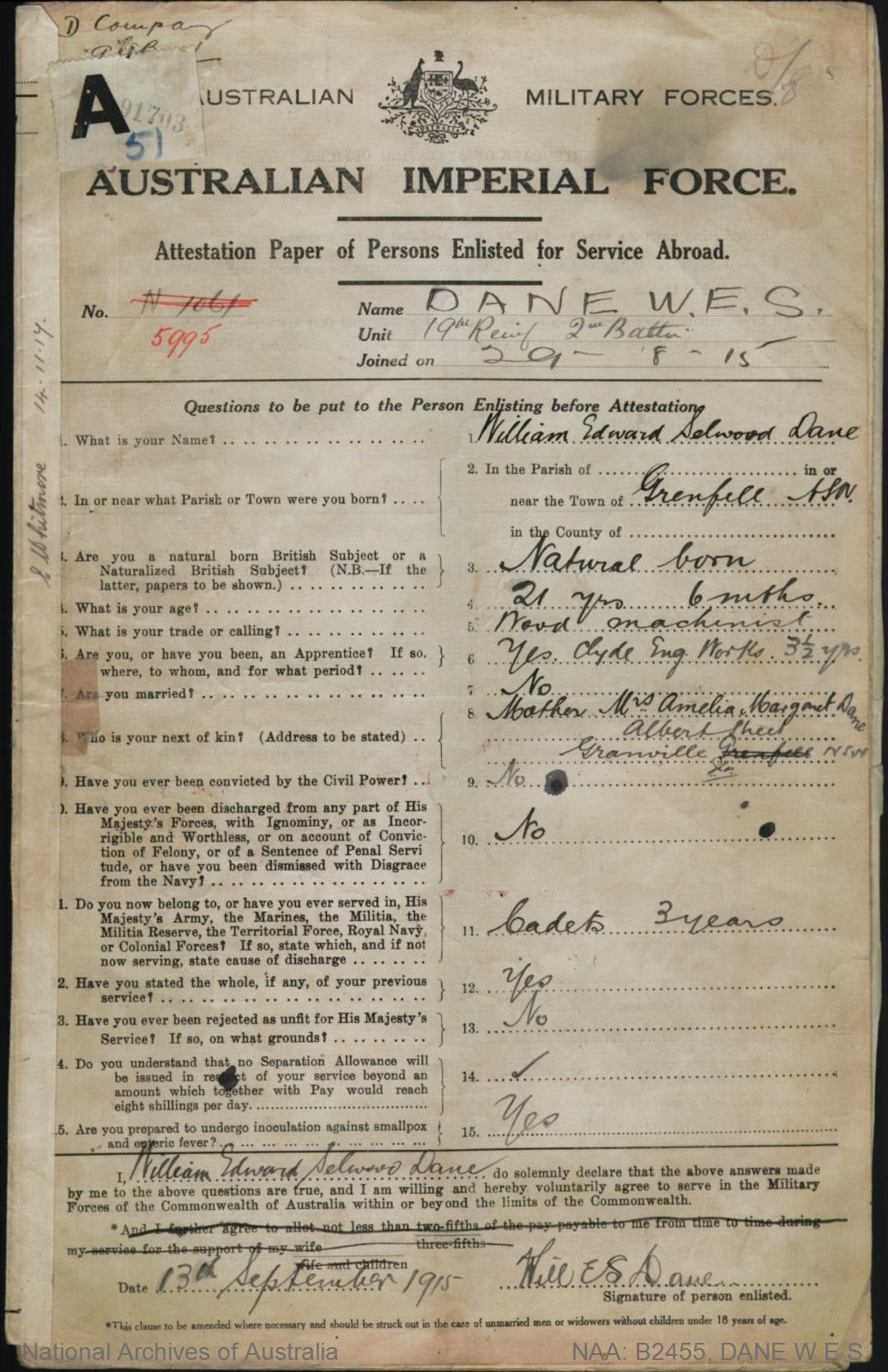
William Edward Selwood (Bill) Dane has left Australian football fans a legacy none can repay. Carefully wrapped in acid free paper deep in the archives of Parramatta library, lies the crest that adorned the left breast of the sky blue uniform Bill wore into battle against NZ in Australia’s first international football match in Dunedin in June of 1922.
He wore a very different uniform seven years earlier as he embarked on the ‘great adventure’.
Born on February 26 1895, in Grenfell a part of the NSW south-western slopes deeply ingrained in Henry Lawson lore, Bill Dane moved with his family to Bathurst, and then Holroyd in the Parramatta district where he and his younger brother George’s love for football was built. Bill would play as a half back for the famed Magpies of Granville and eventually Australia, while George would also play with the black and whites and earn representative honours with NSW in 1921.
Enlisting in September of 1915, Bill left with the 19th Reinforcements of the 2nd Battalion AIF. After an overly long wait they embarked for the front almost a year after enlisting. He found himself in France a week before Christmas in 1916 just as the Battle for Verdun was being won by the allied forces.
Records indicate that Bill spent much of the following year being shipped between France and England, the reasons are yet to be unpicked, but most likely they were medical. Dane was discharged from the army in March of 1919 returning to Granville and his beloved magpies within weeks.
A year later he was named as one the eight representatives from NSW who made up half of the first Australian touring party to play in New Zealand. Bill played in both the first and third tests of that series writing some scathing reports on the abilities of some of his lesser known teammates in private letters back to the family.
He also wrote to friends in 1917 from ‘somewhere in France’. This extract was published in The Cumberland Argus & Fruitgrowers Advocate on 28 August:
We must keep going at old Fritz. He is nearly beat, and it would not do to show any slackness now. God help Fritz. It would surprise you to see the preparations being made for the spring. I would not be in the German’s shoes for anything. I saw Judy Masters at—-. He is well known to Granvilleites. He was quite well then. We had a raid on our left flank, and the Scotchmen gave Fritz a terrible doing. In about 10 minutes 50 Huns were killed. In returning to the trenches I and others fell over dead bodies. It was dark. Every time I fell I had to be assisted up owing to the weight of my equipment. We don’t mind any weight so long as we get a spell at times. I can’t tell you what I would like owing to censorship: but I hope to give you something more sensational next time I write. I would give a lot for the Argus over here; but although I have it sent regularly from friends in Granville, I never see it. Goodness knows where it gets to. These cold, frosty mornings, after washing my head and face, the hair sticks up like a cock’s comb with the frost before I can dry it, it’s terrible.
The Granville team post war was almost as strong as the club prior to the war making the Gardiner Cup final in 1920, 1921 and 1922. The win in 1922 was the third in Granville’s history following its wins in 1904 and 1914, the side famously guided by RH Moore and featuring a handful of NSW representative players a number of whom were Soccer Anzacs.
Bill married Ida Whittaker in 1923 the couple producing a son, Bill Jr a year after their marriage. It is thanks to grandson Robert that we have that iconic badge kept safe for posterity. Bill passed away in 1964.