

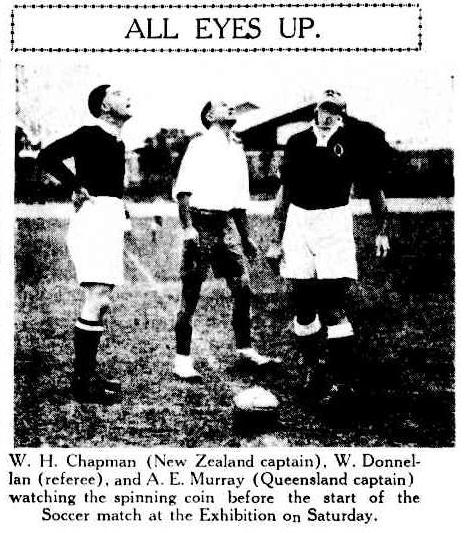
William Donnellan was one of the most well-known football referees in Queensland from 1911. When he ran for the 1934 Brisbane City Council election, the Telegraph of April 24 saw fit to only mention Donnellan refereeing in their short biographies of candidates:
For 20 years Mr W. E. Donnellan, who is contesting South Brisbane in the National Citizens’ interests, has been a referee of Soccer football. He blew the whistle when the Englishmen were here in 1925, and also for matches against New Zealand, Czecho-Slovakia, Canada and China.
Curiously, while The Telegraph article mentioned about a dozen returned soldiers were among the candidates it made no mention Donnellan’s war service.
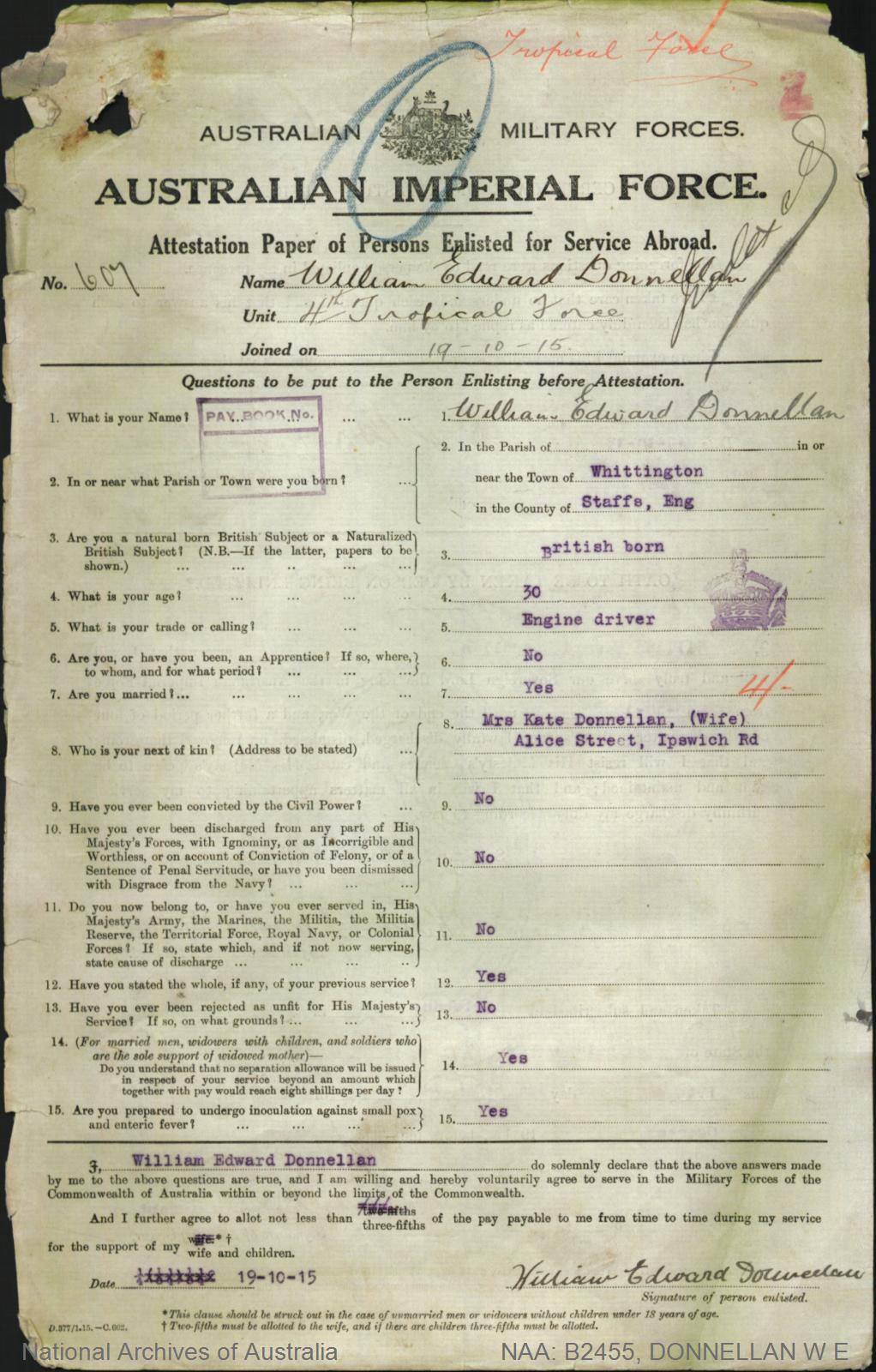
Donnellan had been in Brisbane for several years before enlisting. He had been born in Whittingham, Staffordshire in 1886. The first reference to a W. Donnellan refereeing in Brisbane appeared in the Saturday Observer in May 1911, taking charge of a game between Wallaby and Wellington. The same year he married Kate Lester, and their daughters were born in 1913 and 1914.
He ran the lines in the 1913 Brisbane Charity Cup semi-final between Bulimba Rangers and Albion, but his details of his pre-war refereeing career are scant. Newspapers of the era Brisbane were short on details outside of fixtures and results, obscuring Donnellan’s refereeing career. This changed after the war when Donnellan regularly appeared in newsprint.
At this time of his enlistment, Donnellan was a 30-year-old engine driver living on Ipswich Rd, Annerley. He was assigned to the Tropical Force and arrived in Rabaul in November 1915. He served in Papua New Guinea until June 1917, when he was furloughed and eventually discharged. No further details are given in his military record other than his arrival and departure. German New Guinea was captured by the Australian Naval and Military Expeditionary Force in 1914. Germany had been in control of the northern-eastern parts of New Guinea and the islands to the east since the 1880s and established a series of wireless and telegraph stations.
Australia’s first engagement of the war was to destroy the communication network and take German New Guinea. The Tropical Force took over administrative duties for German New Guinea in 1915. Donnellan would have been part of the force now controlling the region.
Donnellan first returned to the whistle in 1919. He also became the chairman a Queensland British Football Association looking to rebuild the game as soldiers started to return. Later that season he officiated the senior division grand final between Pineapple Rovers and Merthyr Thistle. He also had a stint as manager, coaching the Brisbane representative side against Ipswich and West Moreton XI in the second inter-city fixture of the year.
The 1920s were Donnellan peak years as a referee. His first taste of international refereeing was when a North Coast representative XI took on the touring New Zealand (6 June 1923). He refereed Australia twice, in matches against the England XI (27 June 1925) and China (16 July 1927), as well as Queensland’s matches against Czechoslovakia (11 June 1927) and New Zealand (3 June 1933). The Telegraph’s assertion he refereed a game involving Canada cannot be shown. Donnellan was behind the whistle during the visits for several visits of New South Wales, including two tour matches against Brisbane (11 August 1926 and 14 August 1929) and one interstate test. His performance in controlling 1928 match between Queensland and New South Wales was praised by The Sun Sporting Pictorial on 8 June:
How many Soccer referees can claim to have controlled, a 90-minutes match and never had cause to blow the whistle for an off-side infringement? The answer does not come within the ambit of my records, with the exception of Mr. W. E. Donnellan, Queensland inter-State and inter-national referee, Who experienced this in last Saturday’s big fixture. Seldom does a referee so completely control a game as did Mr. Donnellan, and so seldom was a whistle silent. Ever abreast of play, his keen eye detected every semblance of an infringement and when such occurred his decision was spontaneous, definite and just.”
Donnellan refereed many club games, including the finals of the Tristan Shield (1924), and the Charity Cup (1922 and 1925). He held the whistle as late as 1933, though in later years he more often controlled games in Ipswich.
His time as a referee was not incident free. In the worst incident, Donnellan was assaulted by a Bundamba Rangers player named Miller. The Queensland Times of 3 October 1923 said Donnellan had presented a report to the Queensland Football Association claiming Miller had struck him twice during a match between Thistle and Bundamba Rangers. He also claimed two other Bundamba players had used abusive language towards him. Miller was subsequently suspended for life, while the other two players, Routledge and Heaton, had to appear before a hearing.
It is implied the decision caused some consternation, as The Referee’s Union, in a letter published in the Daily Standard on 5 November, distanced themselves from Miller’s suspension. They claimed the prosecution was instigated by Donnellan at the behest of the Queensland Football Association Executive and not by the union.
Donnellan was also suspended by the Referee’s Union in 1929, which, according to the Queensland Times on 5 September came “without receiving any notification as to any charge laid against him.” The incident caused much confusion in the press, but no reasoning was ever published, and Donnellan was again refereeing the next season.
His attempt at a pollical career was unsuccessful, losing 1934 vote in the South Brisbane Ward to Labor’s W. V. Hefferan 4033 votes to 2479. The Donnellans continued to live in Annerley.
He made a return to football in 1954 after being elected to the disputes committee of the Brisbane and Ipswich competition. Donnellan died in November 1963.