
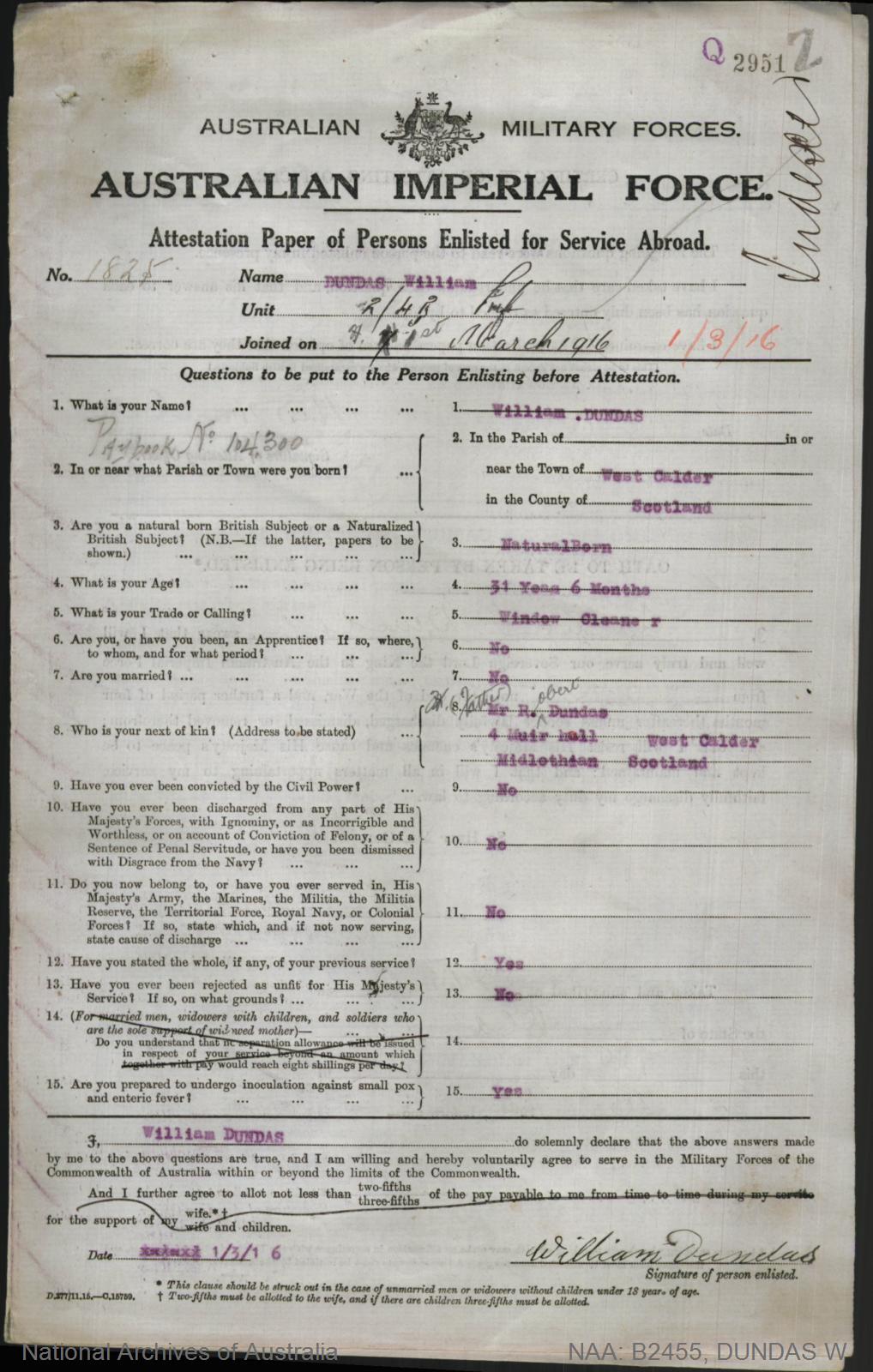
In 1921 the apparent body of William Dundas was discovered in Zonnebeke, Belgium during an Australian war graves audit. Among the effects on the body was a waterproof sheet containing Dundas’s identification. This was a problem for the Office of Records as Dundas had survived the war and had only been discharged earlier in 1921. The Office tried to contact Dundas to see if he could remember why another soldier carried his details but could not find him. It was soon discovered that he had moved to his birthplace of West Calder, Scotland. Much internal communication within the AIF followed but no response from Dundas is among his records. Even if he had been contacted, there was a good chance he could not give them the answers they were looking for due to the injury which ended his war.
Dundas enlisted in 1916, leading the Darling Downs Gazette to mention he played soccer for the Toowoomba-based City Club. His younger brother and City teammate Archie had already enlisted the previous year. The Gazette also published a letter from Dundas detailing the voyage to Europe, and his surprise at encountering Archie at their parent’s house in West Calder, Scotland. Archie was recovering from a shrapnel wound but hoped to return to the front shortly.
Neither were to know Archie would be killed in action, while Dundas would be lucky to survive. In May 1918, while fighting with the 42nd Battalion, Dundas received a gunshot wound to his head which put a hole in his skull. He would spend the next year in hospital, requiring a bone graft and suffering memory loss and periods of constant headaches. Much later, in 1937 he wrote, in a letter in which he requested a new copy of his discharge paper, that he was still feeling the effects of the injury.
Dundas and Archie were both added to the Toowoomba British Association honour board in 1918.
The unknown soldier was exhumed and reburied in Tyne Cot British Cemetery in Grave 19, Row C, Plot 22. In early 2024 the identity of the solider is still unknown.