

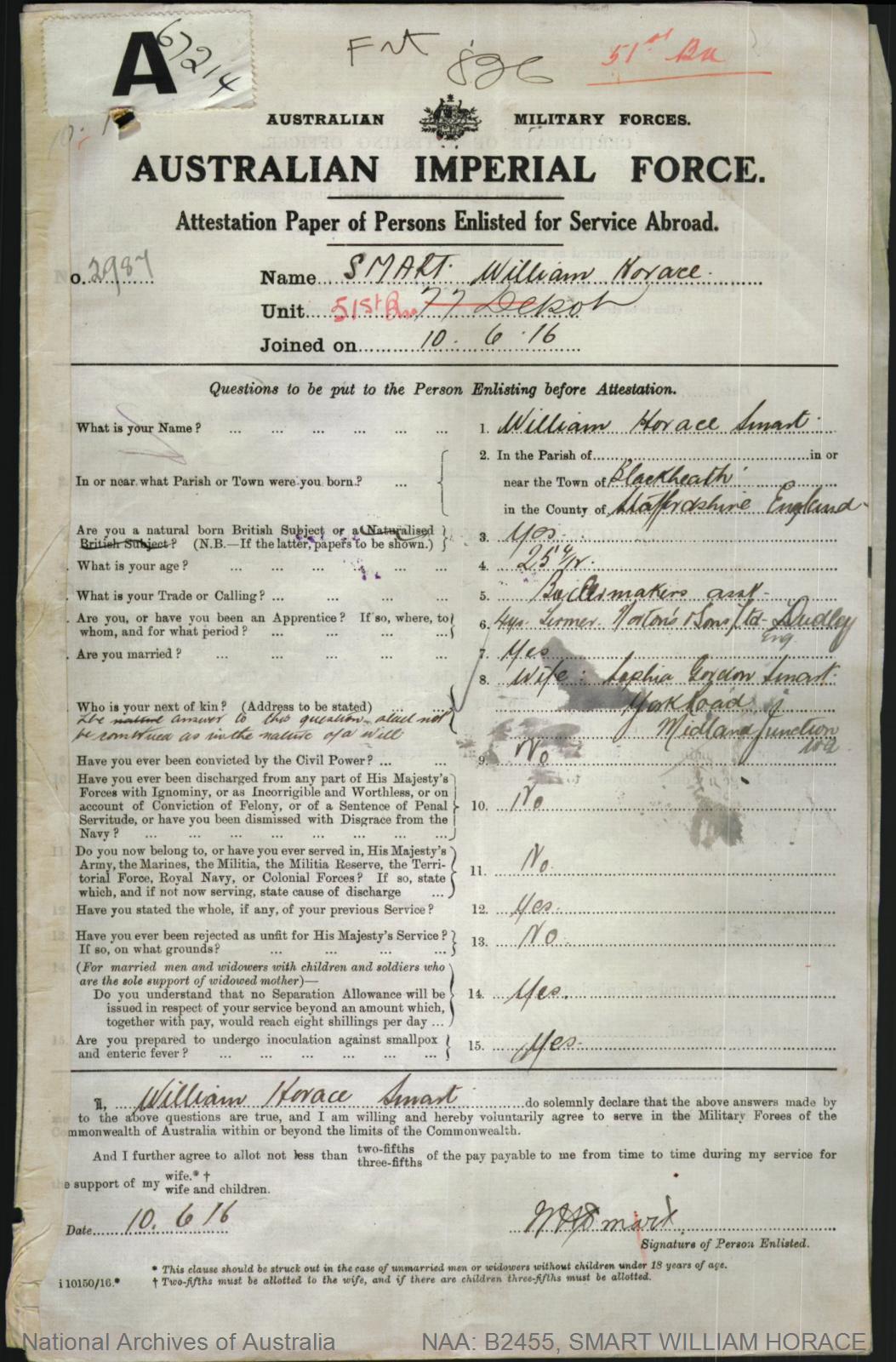
William Smart was one of the best finishers in Western Australia during the pre-war and interwar eras. Born in London, England, in January 1890, he had trials with West Bromwich Albion, one of the founding members of The Football League, prior to setting off to start a new life in Western Australia.
Billy, a cabinet maker, and his brother John, a boot maker, arrived in Fremantle early in October 1911. If that journey wasn’t long enough, the siblings then travelled a further 300km south to set themselves up in the agricultural town of Katanning. With football in the south-west just beginning to get established, Billy and John represented Katanning against teams from Albany and Narrogin.
Lured to Perth by the promise of playing competitive football for the Thistle club, Billy accepted an offer to work as an assistant boilermaker with Western Australian Government Railways in May 1913. Two months later he married Glasgow-born Sophia Taylor in West Perth with the newlyweds setting up home on York Road in Midland Junction, walking distance from the WAGR workshop.
Billy was a key figure in Thistle storming their way to the 1913 Division Two championship without loss before scoring twice in their Charity Cup final defeat of Perth. The Jags marked their entry onto the top tier by claiming the Division One title at the first attempt, to which they added the Challenge Cup and Shield. A second Division One title following in 1915 along with another Charity Cup. In mid-1916.
Billy answered the call to arms by enlisting in the 51st Battalion along with Thistle teammate and railways co-worker Bart Nesbit. In February 1917, while stationed at Codford, they left the training camp at 1:00am with Billy not returning until four days later. His punishment for being absent without leave was 96 hours in detention and forfeiture of eight days pay.
The 51st Battalion proceeded to France in April where they were heavily involved in fighting around Noreuil, supporting the Allies push following the German retreat to the Hindenburg Line. After a spell resting in the nearby Becordel-Becourt camp, they relocated to the Ypres sector in Belgium where they were engaged in the Battle of Messines.
Life in the trenches was gruelling and Billy’s health was suffering. Sick and admitted to a field hospital toward the end of July, he returned to his unit for less than a month before being diagnosed with trench fever. Billy was relocated to England where he would remain hospitalised through to the new year. In December he forfeited eight days pay after being found guilty of being absent without leave for four days.
Transferred to Weymouth’s No.2 Command Depot in March 1918 to convalesce, Billy was classified by a medical board as “B.1.A.2.” – unfit for front-line duty.
He returned to Fremantle in August and was discharged as medically unfit a month later, a note on his service record stating “illness being specified as Diluted Action of Heart”. Billy resumed working at the railways Midland Junction workshop in 1919. Across the next decade he filled the positions of labourer, driller and borer before resigning in 1929.
Reunited with Sophia, they welcomed the arrival of their only child, daughter Beatrice, to the family home in Bayswater in January 1922. F
ootball had always played a big role in Billy’s life and in 1919 he scored in Thistle’s 2-0 Challenge Cup and Shield final win over Claremont. The other goal that day came from fellow returned serviceman Bart Nesbit. The following season was curtailed by a serious leg injury but, nonetheless, he returned late on for Thistle’s Charity Cup final win. Three seasons with Northern Casuals were highlighted by success in the 1921 Challenge Cup and Shield. Billy was still very much feeling the effects of Europe, as evidenced by a May 1922 edition of The Call which described him as one “of the most brilliant players in the State before the war” but who had “never fully recovered from the effects of war injuries”. Even so, Billy earned a spot in Western Australia’s attack for two games against the touring England FA XI in mid-1925. By now he was back at Thistle who lifted the Division One title champion and played a two-game end-of-season tour of Adelaide. His final three seasons were alongside his old friend Bart Nesbit at Bayswater, winners of the 1926 Cronshaw Cup and Division Two champions twelve month later.
William Smart passed away in Rivervale on 20 November, 1973, at the age of 80.