
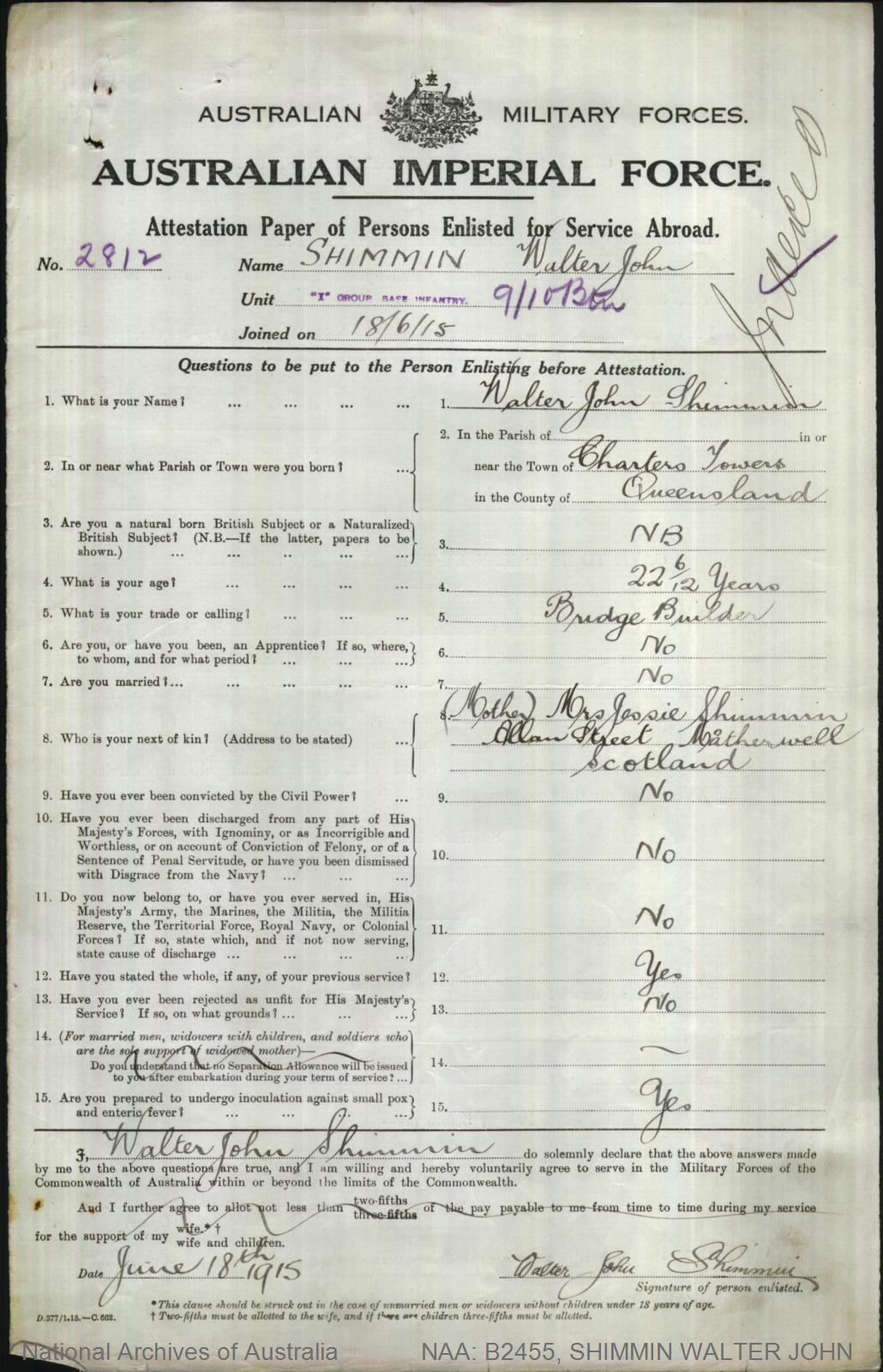
Walter John Shimmin was a Queenslander who played for Adelaide’s top club before going missing while serving with the 10th Battalion at Mouquet Farm.
Born in Charters Towers on 28th December 1892, he arrived in Adelaide in 1913 and seems to have immediately cemented a place in Hindmarsh’s first team. The Reds had not won the league since 1909, but finished strongly in 1913 to clinch the title. Shimmin seemed to have been an inside forward of the “scientific football” persuasion — one match report described him as “linking well with his winger”. Soccer was played at the Queensland mining town, and it had attracted its fair share of Scottish immigrants. It was no surprise that Walter Shimmin was a ready made “professor” when he arrived at Hindmarsh.
Shimmin’s widowed mother had re-married and moved to Motherwell in Scotland, and was named as Walter’s next of kin when he enlisted at Keswick Barracks in June 1915. He had continued with Hindmarsh in 1914, when the Reds finished runners up to the strong North Adelaide. They had reached the Webb Harris Cup final in both seasons, but lost to their nemesis, cup specialists Adelaide.
Shimmin described his occupation as “bridge builder” when he enlisted — perhaps an aspirational description of “labourer”. His final letter, to his sister in Scotland, mentioned that he had not prospered as much as he had hoped because of “poor seasons”. It is possible that between the end of the 1914 football season and his enlistment in June 1915, he had tried his hand at rural employment at Mallala.
Shimmin’s name appears on the war memorial of this small town 70 kms north of Adelaide. Shimmin arrived at Mudros with the 9th reinforcements for the 10th Battalion in November 1915 — too late for the disastrous Gallipoli campaign. The 9th reinforcements arrived at Marseilles on 3 April 1916 as the biggest battles in history were taking place in France. He was promoted to lance corporal in May and the 10th were soon involved in the fierce battle of Pozieres. The Third Brigade attacked Mouquet Farm in August, and after heavy fighting were driven back by a German counter attack.
It was here that Walter Shimmin became one of the 10th Battalion’s 335 casualties suffered in that battle: “missing in action” between the 19th and 23rd of August.
In May 1917 Mr John Good of Torrens Street, Hilton, wrote to the military authorities. His daughter Maude was engaged to Walter Shimmin and his queries related to his will and back pay. On 19 June 1917 a court of enquiry determined that Shimmin had been killed in action around 20 June 1916. In May 1918 Mr Good again wrote to the authorities from his home in the western suburbs of Adelaide saying that he was still in the dark about Walter’s financial affairs.
The final document on Walter Shimmin’s service records is his final letter, written in May 1916, to his sister Annie. He explained that he had placed his financial affairs in the hands of Mr Good, and this letter had been certified by the army as his official will and testament. It is to be hoped that Mr Good contacted Walter’s relatives in Scotland and an amicable agreement was reached over the estate.