



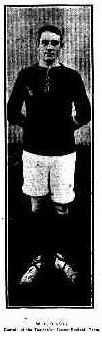
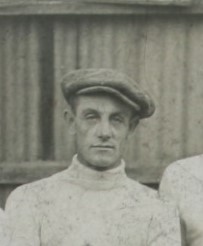
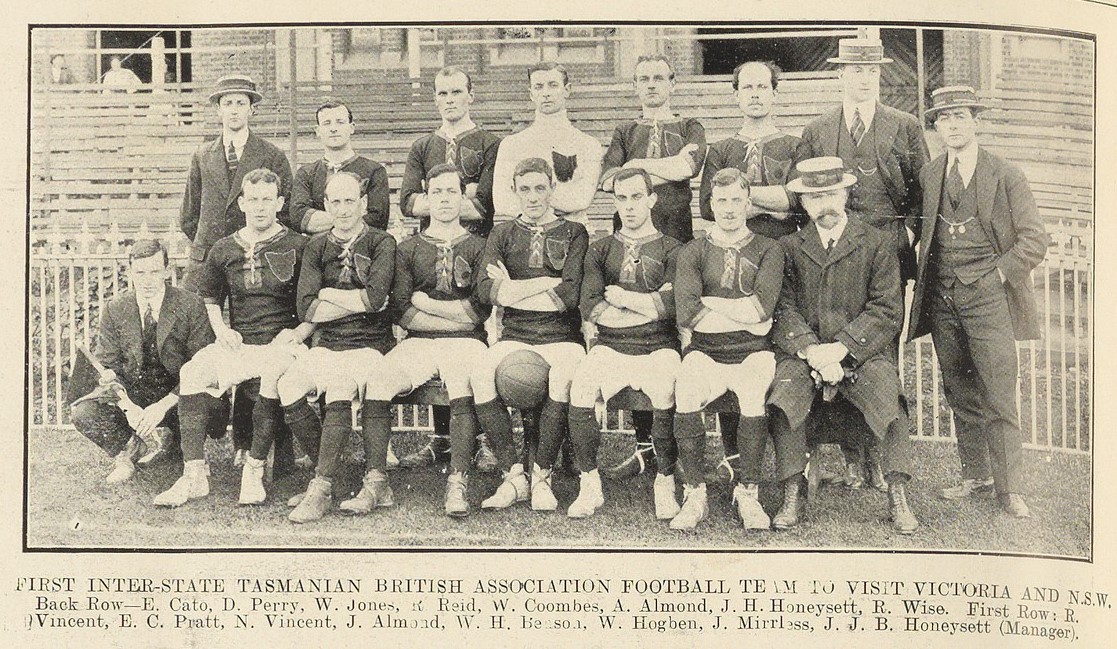
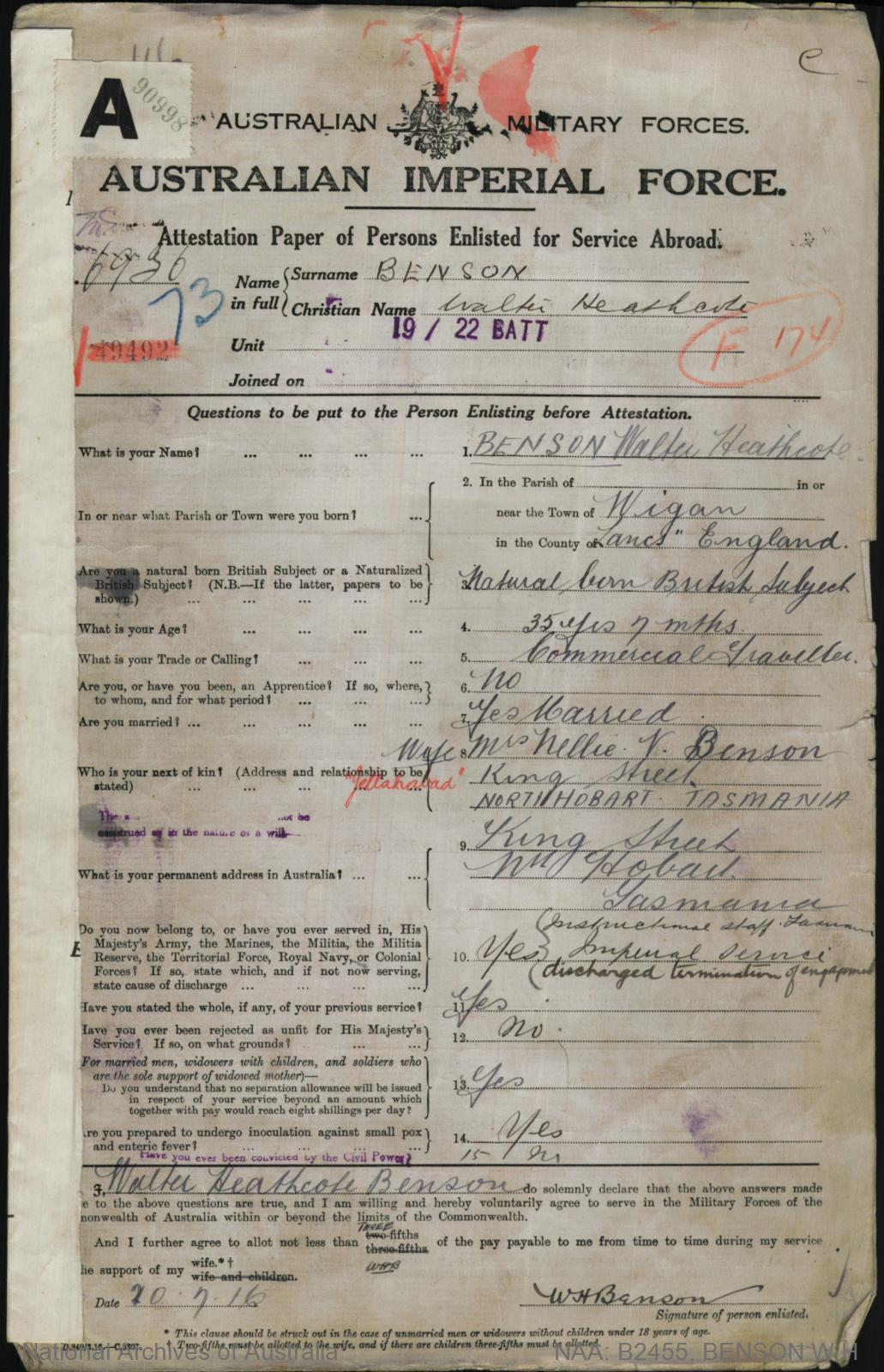
Walter Heathcote Benson migrated to Hobart from England in late 1911 and joined the St George club, playing his first game on 27 April 1912.
Walter made an instant impact, being selected for Southern Tasmania in the first intrastate match against Northern Tasmania and selected for Tasmania’s tour of Victoria and New South Wales in July 1912. His player profile in Sydney newspaper The Arrow describes him as follows:
W. Benson has been connected with some splendid clubs at Home [England], and although he will appear in the forward line in Sydney, is a first class goalkeeper. He is a certificated referee of the Football Association, and what ‘Benny’ does not know about the game is not worth knowing. He has scored many goals for St. George this season
Walter played in all five matches of the tour, including games at the Melbourne Cricket Ground and Sydney Cricket Ground, scoring 2 of Tasmania’s 6 goals from the inside-right position. His play also propelled St George to the league title, their only championship before he moved back to his preferred position of Goalkeeper in 1913. He became a mainstay of soccer in Tasmania during this period, playing in all Southern Tasmania and Tasmania fixtures up until the war, including the match against Victoria on August 8 1914, just after war was declared.
He also became treasurer of the governing body, the T.B.F.A, secretary of the St George club and was a member of the Referee’s Association.
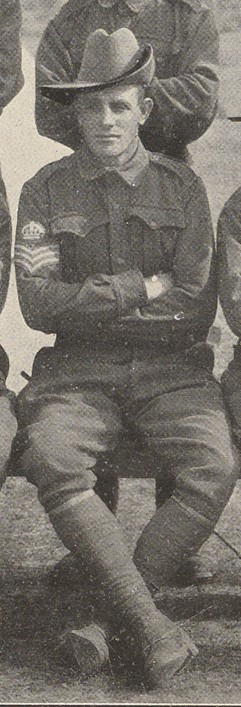
By September, Walter was already involved in the war effort, making him one of the first soccer players involved. In November 1914, he was temporarily employed on the instructional staff at the Claremont camp and made an acting Staff Sergeant-Major. He would hold this role until May 1916. This role allowed him to continue to be involved in local sports throughout 1915, continuing to play both cricket and soccer. During this time, Walter worked as a commercial traveller, and married Nellie Reardon on 16th February 1916. They had their first child, a son, the following year.
After his appointment in the instructional staff was terminated, Walter enlisted as a soldier in Melbourne on 20th July 1916, joining the 22nd Battalion. After further training at Duntroon, he was sent overseas in early 1917 before being transferred from the 22nd Battalion to the 12th Battalion in December 1917, a largely Tasmanian battalion.
In April 1918, he received a gunshot wound in the left shoulder, before contracting chronic gastritis. A medical report reveals he had indigestion for 3 years, and spent a month in Bath Hospital, before.
Following his return to Tasmania in December 1918, Walter chaired the first meeting of the Tasmanian Soccer Association post-war, and spoke of the great service the game gave to the war effort. He played club football for St George in 1919 and 1920 and represented Tasmania one final time in 1920, in a match against the visiting warship H.M.S. Renown. He moved to Corinthians when St George folded in 1921, although this would be his last season on the field.
He remained an active administrator until his departure from the state in 1924 to New South Wales. His departure was met with sadness from the locals, as typified by the article in The Mercury:
Tasmania’s pre-war inter-state goal keeper, W H Benson, leaves today to take up his residence on the mainland, and the best wishes of all his old Soccer confreres will go out to him more especially in regard to improved health. “Benny” was a great worker for the game in the pioneer days, and has occupied the positions of chairman, treasurer, and vice-patron of the Association, as well as being the finest goalkeeper the game has seen in Tasmania, a record which will always live in the annuls of Soccer football in this State.
He lived in Bankstown for a short time, passing away on 14th August 1927 owing to stomach and heart failure. He was buried at the Rookwood Cemetery in NSW, leaving behind a wife and 2 children.