

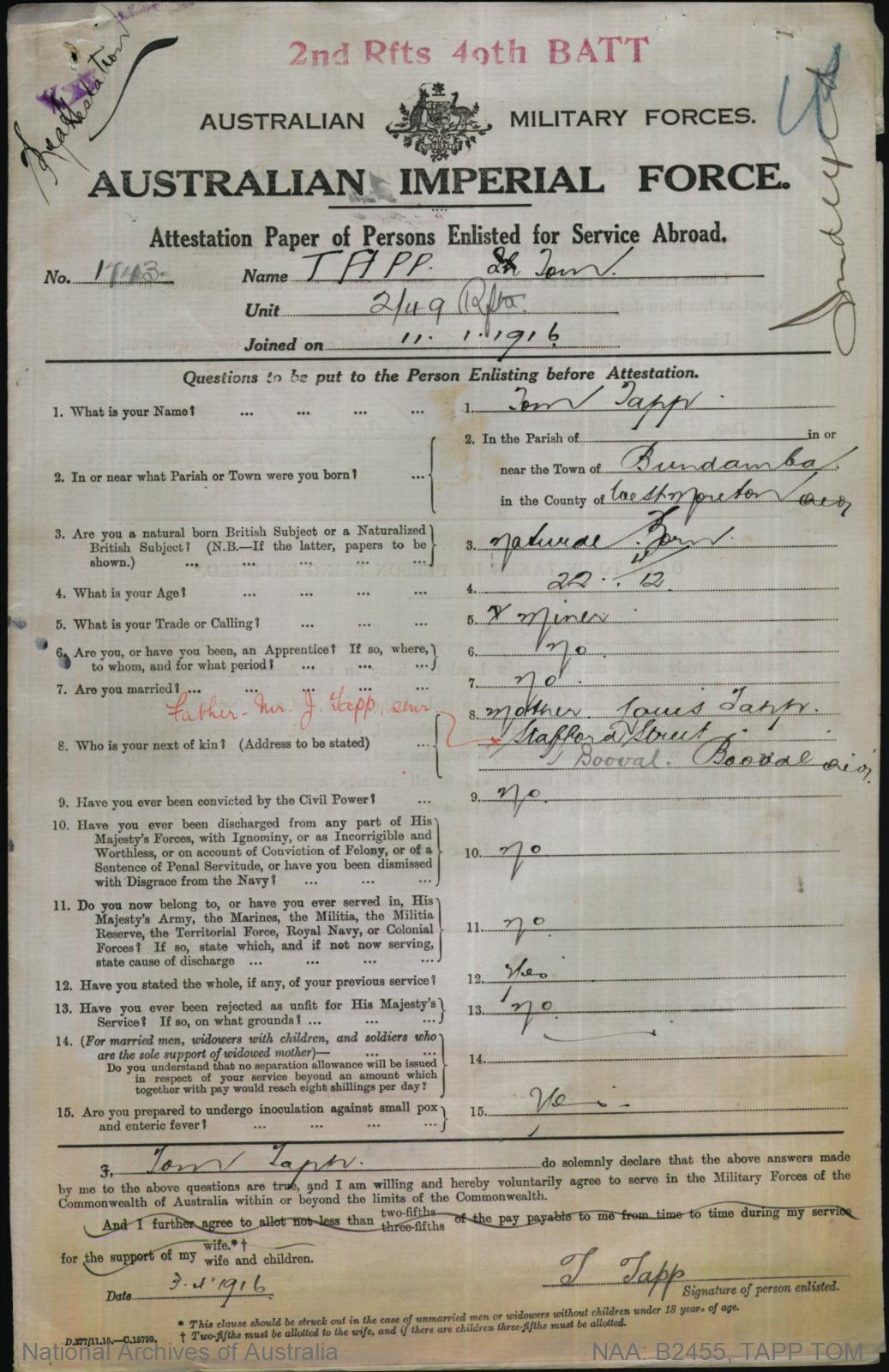
A letter written by Tom Tapp from France appeared in the Queensland Times on 9 November 1916, sixteen months before he was killed in action. The letter did not show the positivity of many such letters. Reflecting of his situation, he wrote:
In reference to the photo I sent you of a ‘cobber’ I am sorry to say that he was killed four hours subsequent to he and I having a chat about our future. He said, ‘Hello Tappie! How goes it? Do you think we’ll get home again?” and I said, ‘Yes.’ He then told me, if he got knocked out, to take his books, which I promised to do on the condition that he would do the same for me. But I am lucky, and he the unlucky one. I was not near him when he was killed, however, although I would have given the world to have been alongside of him at the time. When we first came to France there were six of us – all mates, and I am now left on my own.
Tapp was from Ipswich, where he played soccer for Bundamba Rangers. He came from a long-established Ipswich soccer family, with his father Jacob Tapp playing for Blackstone Rovers as early as 1891. One brother, Robert was an Ipswich representative player in 1909, while another, Jacob, was a referee. Later, a Jake Tapp played for Queensland in 1935.
The Tapps were also a mining family. Tapp’s father had been a child worker in Welsh mines, before emigrating to Australia to join the growing Welsh mining community at Blackstone near Ipswich. Tapp followed his father into the mines, where he was working when he enlisted on 11 January 1916, aged 22.
Tapp arrived in France in August 1916 with the 49th Battalion. By 11 September, when he wrote his letter, his friends were either killed or wounded. “I will find new friends,” he wrote, “but none like them. Each of them were a fine fellow.” He went on to detail the greatest danger they had faced. “It is the German shells that do the harm, and, to tell you the truth, we were just waiting our turn to come, but luck was with me.”
Soon, Tapp went missing from his unit for 17 days from 6 January 1917, two months after his letter was published. His military record shows no details of his disappearance other than the consequences he faced. Tapp was charged with desertion, but the charge was downgraded to absence without leave, to which he pleaded guilty. He was sentenced to 12 months imprisonment with hard labour.
He rejoined his unit early, in January 1918 and was killed in action two months later, likely around Dernancourt. Tapp was buried at Point 106 British Cemetery near Bresle, but this was later said to be destroyed in the war. Some graves were later moved to Ribemont Communal Cemetery.