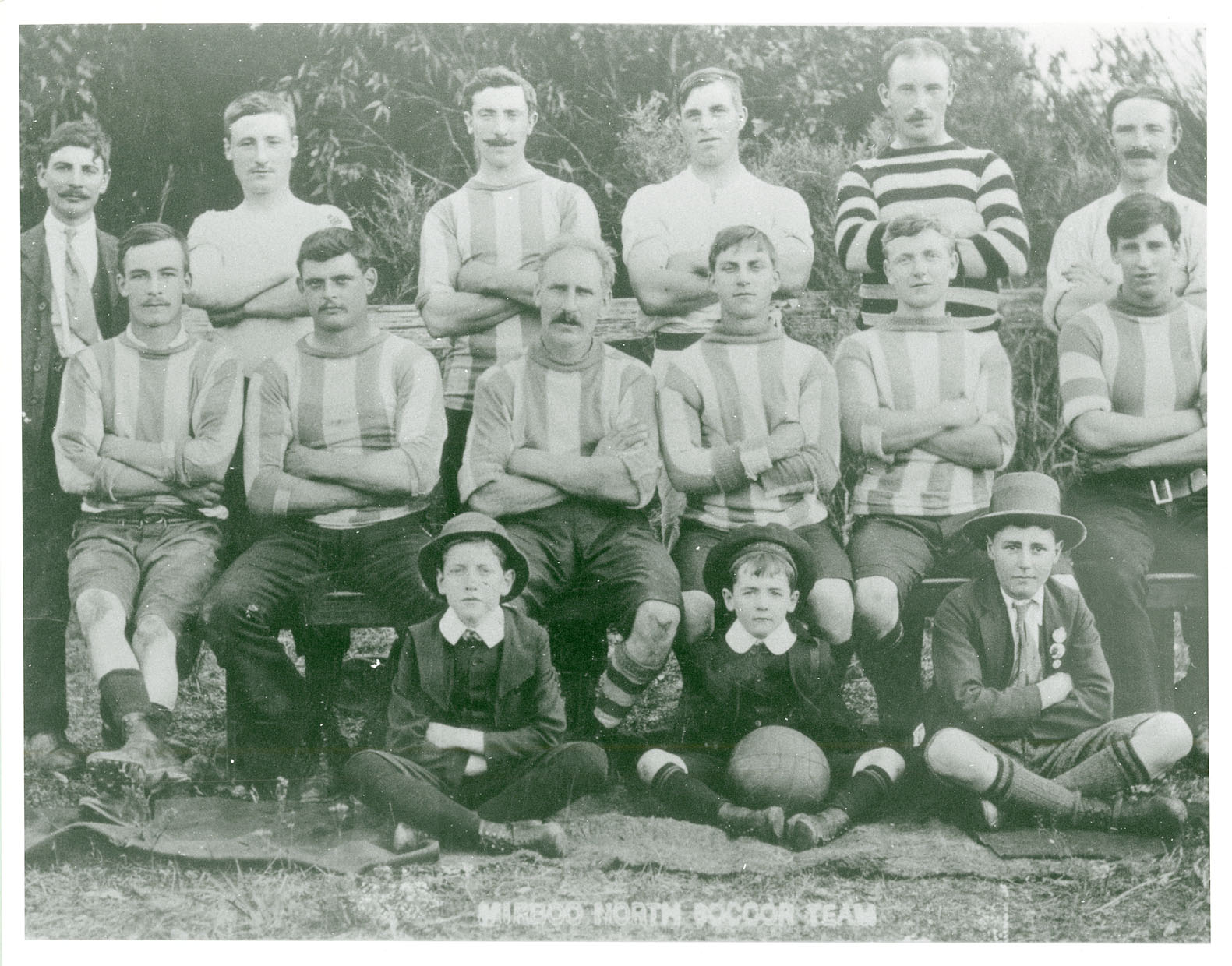
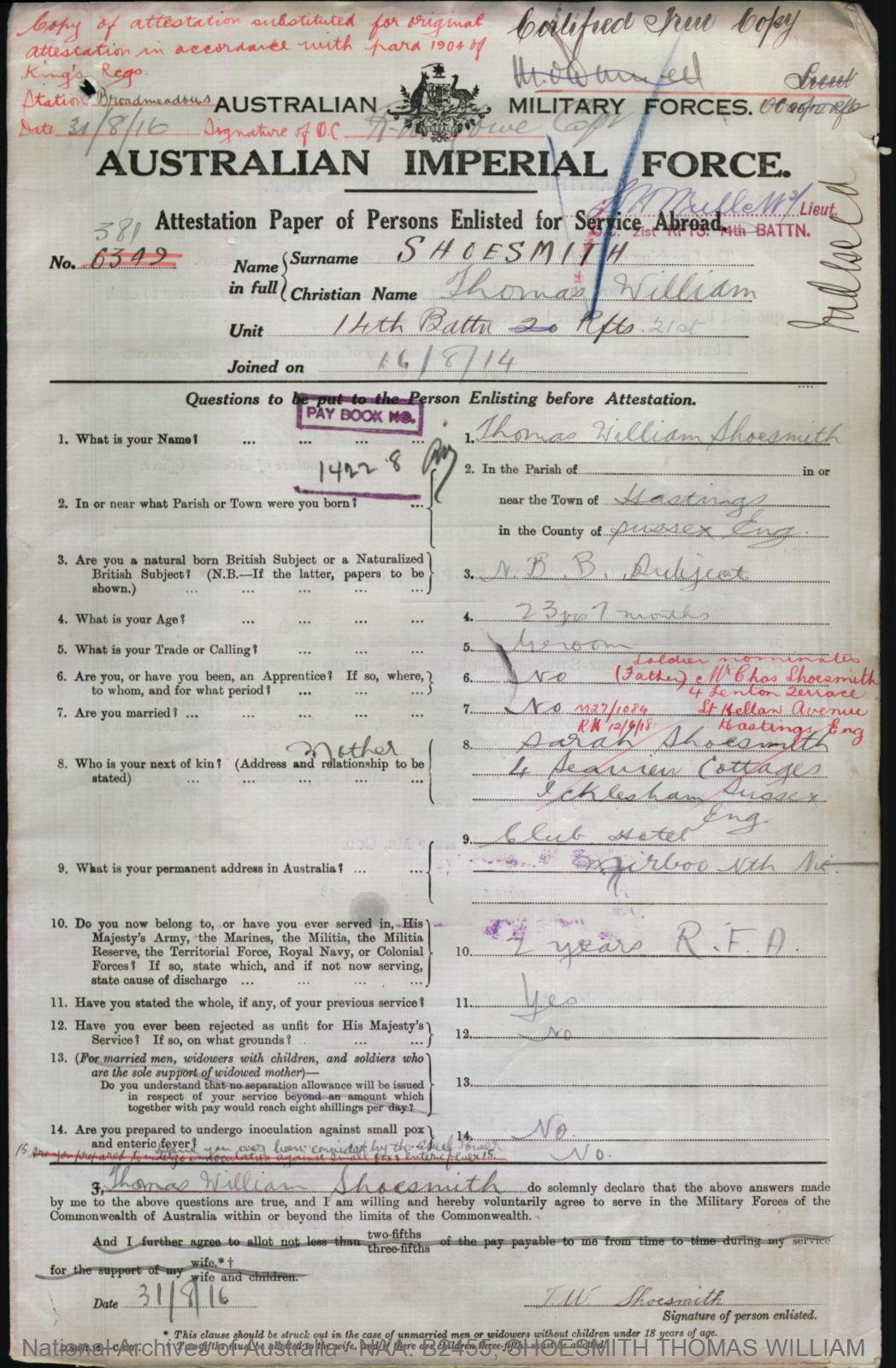
Thomas Shoesmith was born in Hastings, Sussex on 21 January 1891. After working their passage to Australia in 1913, he and his mate William Preston enlisted in the AIF early in the war. Both men played in the first recorded game in Mirboo North in 1914.
While they embarked separately, both had left for Egypt before Christmas and met up in time for the Gallipoli offensive. Shoesmith was extremely fortunate in battle, surviving when those around him were falling. Preston was not so lucky. Wounded in action in the abdomen, he was buried at sea. Some discrepancy exists between the AIF records and the Gippslander and Mirboo Times which claimed on 16 March 1916,
Will Preston (of Mirboo North,) was killed alongside of [Shoesmith], the top of his head being blown off by an explosive bullet. The loss of his comrade was naturally greatly felt, as they were like brothers. He had a look at the late Dave Mills’ grave, which has a cross on it. A note has been left, asking the Turks not to interfere with the graves. He says the Turks are clean fighters.
Shoesmith was repatriated to Mirboo North in 1916 where he received something of a heroes’ welcome. The local newspaper reported that:
On Monday last Signaller Thomas Shoesmith returned to Mirboo North. This young man was one of those who landed at Anzac on the morning of that memorable 25th April. He belongs to the famous Fourteenth Battalion-the Battalion that bore the brunt of most of the severest fighting that took place at Gallipoli. One can imagine the work they performed when we state that out of the 1,400 who disembarked that morning there now remains only 42 of that Battalion – and practically all of them are wounded and out of action …
Signaller Shoesmith has, perhaps, seen more fighting than any of the men who left this place, or, in fact, of any who left the Commonwealth. He had five solid months of it – and the first five months at that. He had dozens of narrow escapes, and he says he cannot hardly realise that he is safe and in Australia again. He had his water-bottle broken by a bullet, on another occasion his pouch was pierced by one, and his haversack was also hit by one. He was also struck on the face by shrapnel. He was eventually put out of action as the result of a shell exploding close to where he and three others were. The four were buried.
Even though he had been playing what he saw as the ‘greater game’ of war, Shoesmith nevertheless kept the round-ball game in his mind. The newspaper reminded its readers that he ‘was a soccer player of some repute. He hoped the war would soon be over and that Mirboo would again have a football club, and a team of returned soldiers.’
Unbelievably, after all his trauma and injury, Shoesmith returned to the front, fighting in France. Here, he struggled with chest infections and bronchial problems and was repatriated once more in 1919.
In 1921 he requested a piece of land in the Soldier Settlement scheme and applied to bring his sweetheart out from England.