

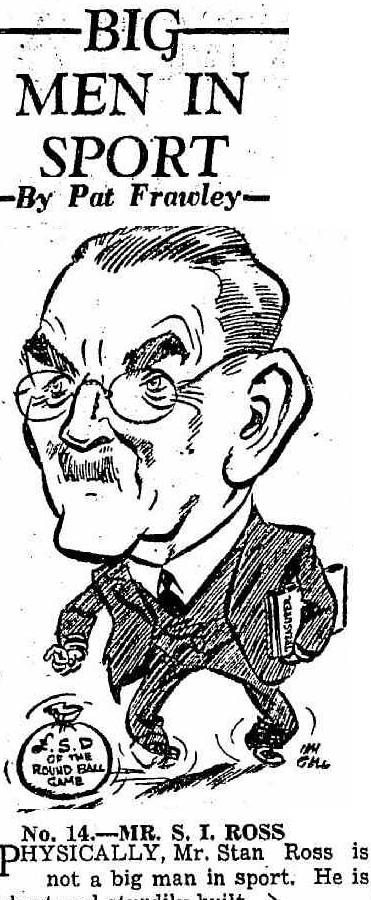
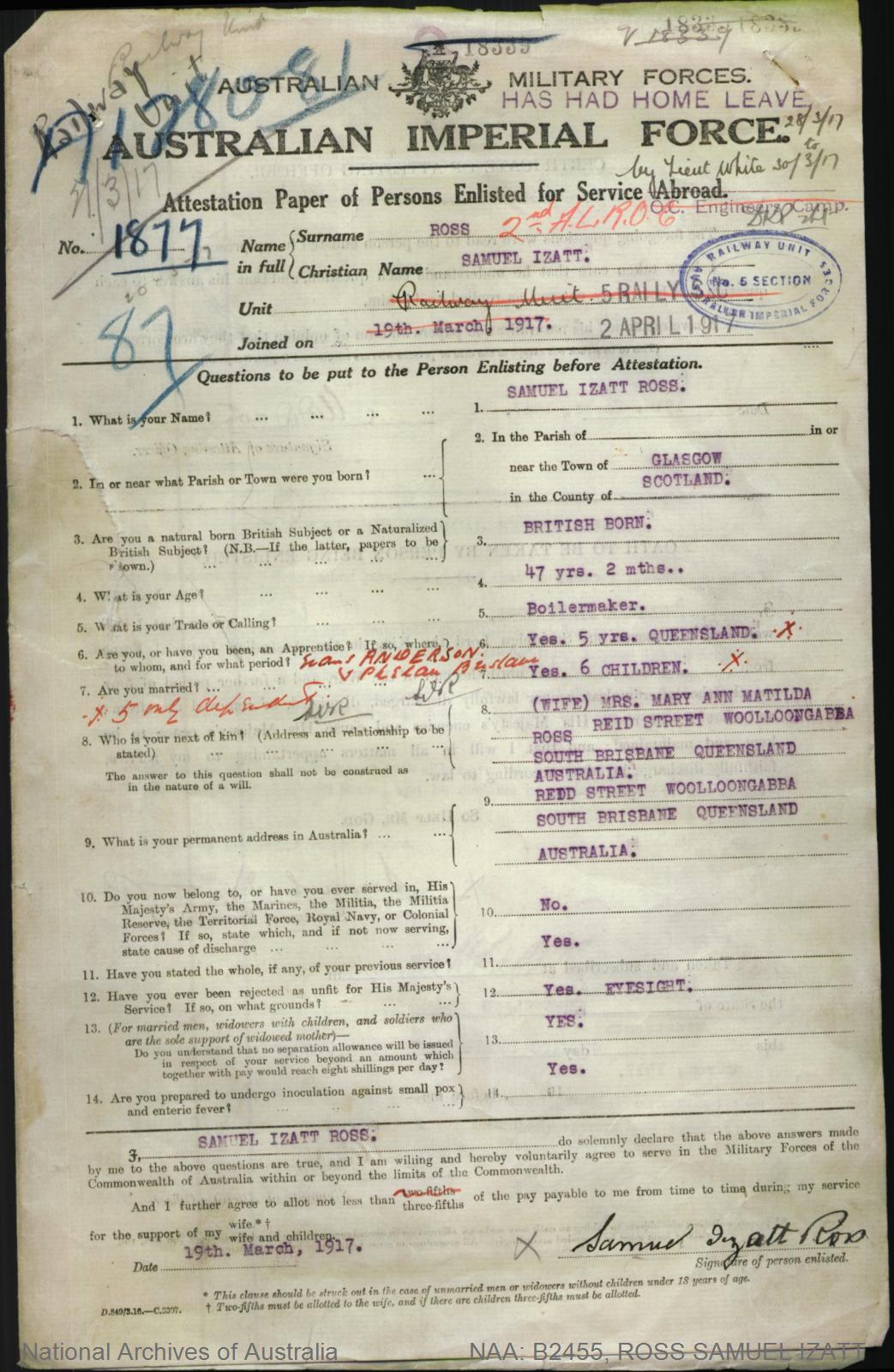
Samuel Izatt Ross was one of the most important figures in Australia soccer during the Great War until his own enlistment aged 47 in 1917. As secretary of the Queensland Brisbane Football Association (QBFA) from 1915 he championed local and interstate schoolboy football at a time senior football was depleted by enlistments. This was one of his many legacies in Queensland over a 50-year career as a player, referee, manager and administrator from 1887.
Ross emigrated to Brisbane from Scotland in his late teens and soon after joined the St Andrews club. In 1890 he helped organise Queensland’s inaugural state team which toured New South Wales. A year later he moved to the newly-formed Alloways as captain and began his first stint as the secretary of the QBFA. A boilermaker by trade, Ross resigned from the QBFA in 1894 to move to Maryborough, the centre of Queensland steam train and ship manufacturing. He helped form the Union Football Club in Maryborough as well as the Wide Bay and Burnett British Football Association, becoming the first secretary.
Ross returned to Brisbane in 1898 where he finished his playing career at Normans and Brisbane North. During the next decade Ross became a leading referee, and a selector for the Brisbane representative team. In 1907 a cup competition for schools was initiated at his suggestion.
In 1911 Ross became the first president of the Queensland’s Referee’s Union, a position he largely held until 1935. Two years he later became the Queensland representative and vice-president of the newly formed Commonwealth Football Referee’s Association at a time when Australia was making its first tentative national football bodies.
A year after the war was declared John Kendall, the incumbent secretary of the QBFA, resigned after enlisting. Ross, who was too old to enlist, returned to the position. At the time Ross was a selector and manager of the Queensland state team for the home (1914) and away (1915) series against New South Wales, which featured future Australian captain Alec Gibb. For the 1915 series, Ross organised a parallel schoolboys tour with games played before the senior matches. The QBFA suspended senior competition in Brisbane in 1916 to encourage players to enlist. Friendlies were organised for those rejected, while competitive football was only played by those too young to enlist. By this time 250 players from Brisbane had already joined up. Ross subsequently travelled to the NSW Department of Education to successfully organise a schoolboys’ tour of Queensland, ensuring a continuation of interstate football.
Ross finally enlisted in 1917 after the minimum age was raised. He joined the 2nd Light Railway Operating Company and was stationed in France. The During his active service, he played football against Belgian, Canadian and British West Indian teams.
Ross returned to Australia in 1919 and soon resume the presidency of the Referees’ Union. Over the next 20 years he became a vice-president of the short-lived Queensland Ladies Soccer Football Association, managed the Australian national men’s team in two games against the English Amateurs in 1937, and managed Queensland in two games against Palestine a year later.
As president of the Referee’s Union, Ross was seen as an independent peacemaker during the various conflicts for control of soccer in Queensland during the 1930s. The conflict was largely resolved when Ross became the secretary of the Brisbane and District Football Association in 1936 and treasurer of successive state bodies, the Queensland Soccer Council (1938) and the Queensland Soccer Association (1940). Ross continued to be involved in the sport in the early 1940s.
He passed away in 1949.