
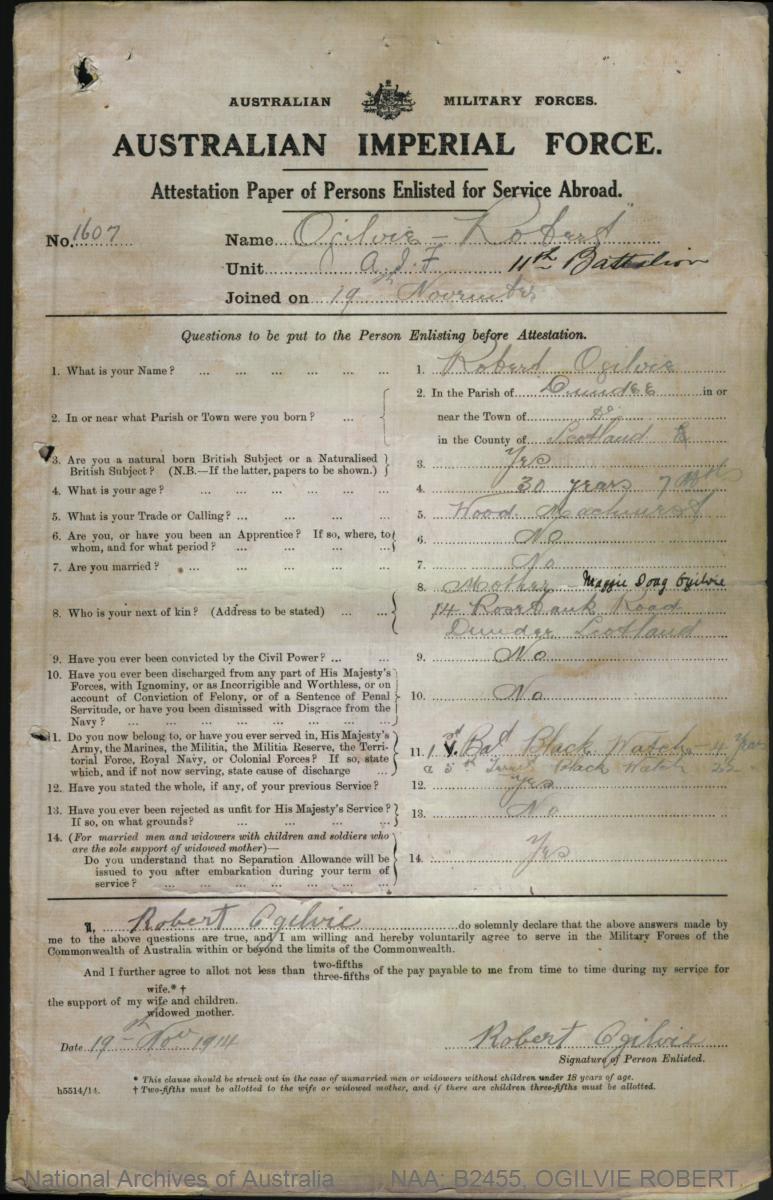
Born in Dundee, Scotland, Robert ‘Bob’ Ogilvie worked in the jute mills of his hometown as a teenager. He served four years in the Royal Regiment of Scotland with the Black Watch prior to arriving in Perth, where he worked as a Boilermaker’s Assistant with Western Australian Government Railways and was later a Wood Machinist.
Robert Ogilvie joined the Thistle club, which drew its players from the WA Government Railways workshops at Midland Junction, in 1912. Operating in the middle of the park across three seasons, he orchestrated the clubs’ rise which resulted in back-to-back Division One and Division Two championships along with Charity Cup, Challenge Cup and Wanderers Cup successes.
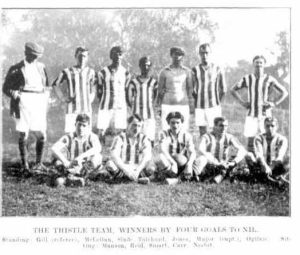
In 1914 Robert Ogilvie was selected to play for Scotland against England in the local international series. A profile published in The Truth newspaper a few months later described him as “a raw boned Scotch lad, than whom none’s better at left half. His third season with Thistle. An ex-Dundee pro.”
Robert Ogilvie joined the 11th Battalion in November 1914, the enlisting officer signing him off as fit for active service “provided teeth are satisfactorily fixed”. He arrived in at Gallipoli, Turkey, in June 1915 but 42 days later was evacuated to a hospital ship with severe gun shot wounds to both legs and a leg fracture. Admitted to hospital in Alexandria, Egypt, Robert Ogilvie was soon invalided to Bethnal Green Military Hospital in London.
In April 1916 he spent 24 hours in detention for being absent without leave and by the end of the month had been declared “permanently unfit for war service at home or abroad” and discharged from service.
Robert Ogilvie returned to his hometown of Dundee in Scotland, where he lived with his wife, Eliza Imrie. Robert Ogilvie passed away on 13 January 1958, at the age of 73.