

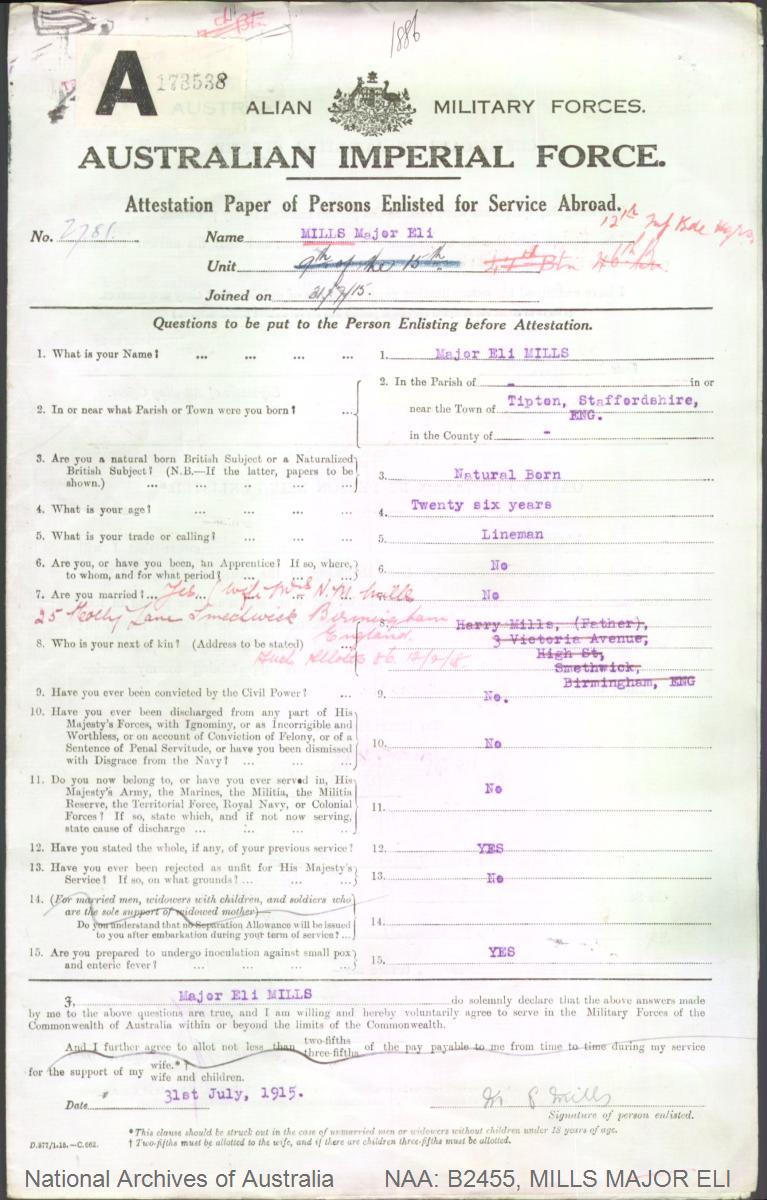
Major Mills never rose above the rank of Regimental Quartermaster Sergeant but was known in the Toowoomba newspapers by his uncommon first name, rather than his initials. This can cause some confusion for later readers as local Methodist clergyman Major-Chaplain A. A. Mills, a Military Cross recipient, was also contemporaneously known as Major Mills in local newspapers. But only the Mills with the birthname of Major was known to play soccer after the war.
Though not as highly decorated as the clergyman, Mills received his own award for his military conduct. The Commonwealth Gazette of 25 July 1915 stated Mills had been awarded the Meritorious Service Medal:
For consistent, thorough work and devotion to duty as C.Q.M.S. since the landing of his Unit in FRANCE. He has endeavoured to carry out the spirit of his regard to salvage work, and has been most successful in taking up supplies to the Front Line under all circumstances. He is in every way an excellent N.C.O.
Mills emigrated to Australia in 1913 and enlisted in Toowoomba in August 1915 at the age of 26. He reached Gallipoli with the 15th Battalion on 13 November 1915, a month before the evacuation. He was allocated to the 47th Battalion in 1916, though his record after this point largely mentions his promotions, finally reaching Regimental Quartermaster Sergeant in February 1918.
Mill’s military record erroneously claims he married a widow, Mary Cecilia Scott (nee Collins), in Hurdcott in September 1918. The confusion was caused by the fact another soldier, Ora Howard Mills, from Northern NSW and four years older, shared the same enlistment number of 2781. The marriage certificate mentions both the initials M. E. and Ora Howard, but the age on the certificate, 33, correlated with the older man.
Mills arrived back in Toowoomba in 1919 and played for Cities in 1919. His game play was highlighted by the Darling Downs Gazette on 13 October. He joined Diggers in 1920, the side created as Returned Soldiers and briefly known as Casuals in 1921. By 1925 Mills had moved south to Thulimbah near Stanthorpe where he worked as a farmer. In 1928 he was selected for the Stanthorpe representative soccer side to play Toowoomba.
Mills became a member of the Thulimbah Local Producers’ Association in the 1940s and was still living in the Stanthorpe region when he died in 1963.