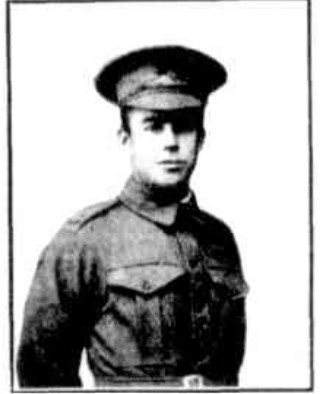
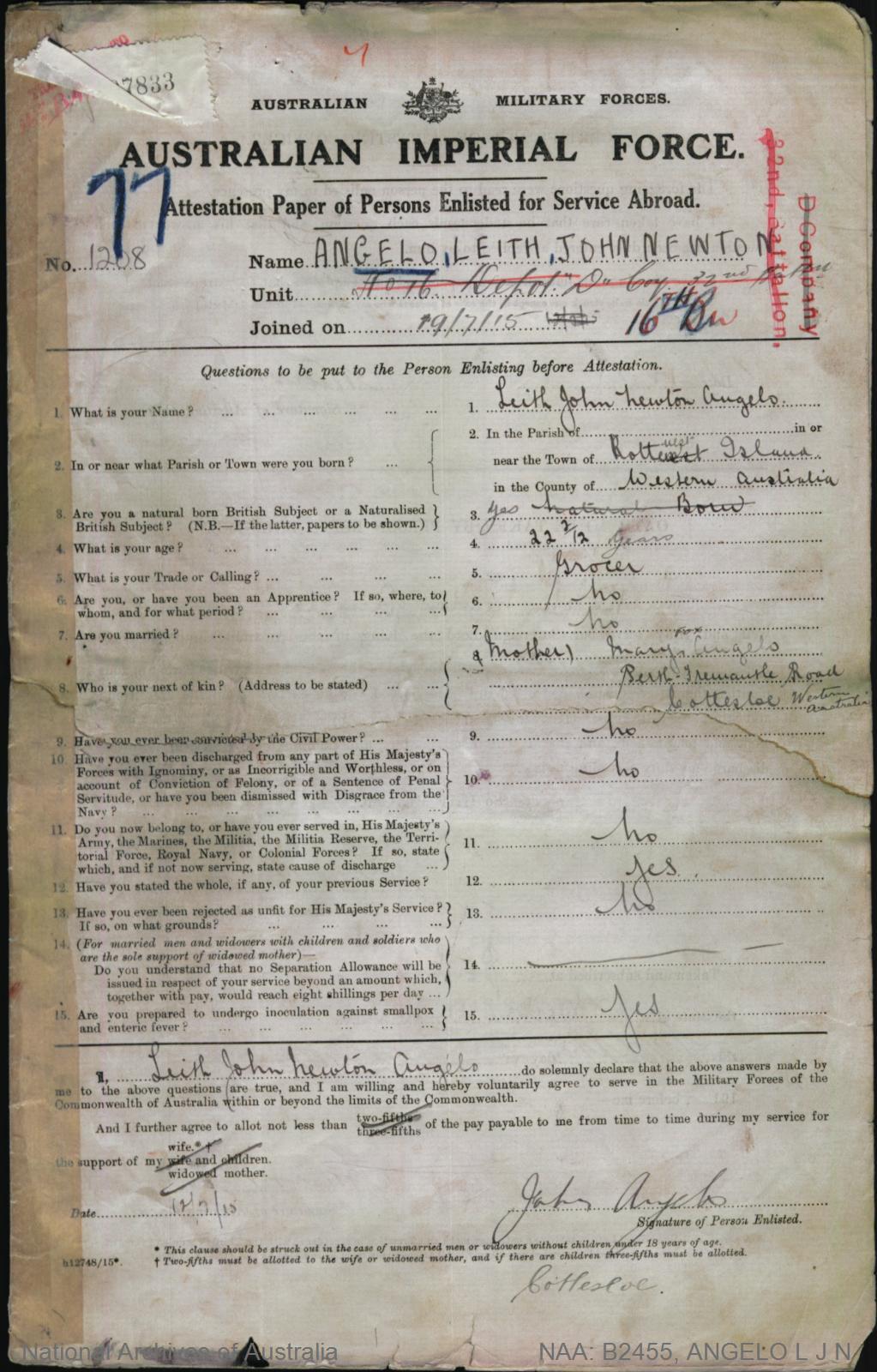
When Leith Angelo was born on Rottnest Island in 1892, it was into a family steeped in British military heritage. Edward Angelo, Jack’s father, served close to 30 years with the British Army in Crimea, Malta and India and was the former Commandant of the Western Australian Defence Force; his grandfather, John Angelo, was a veteran of 45 years with the 3rd Bengal Light Cavalry in India.
Tragedy called on Jack early in life with his father, Edward, passing away in 1902 followed by one of his twelve siblings, Charles, the following year. During the week Jack worked as a grocer in Armadale while on the weekend he found enjoyment on the football field, turning out in successive seasons for Fremantle Albion, Claremont, Cottesloe Hotspur and Swans.
In July 1915, Jack enlisted as a Private with the 32nd Battalion. After basic training at Blackboy Hill camp, his unit departed for Egypt where Jack forfeited a days pay for overstaying leave at Ismailia. Also while in Egypt, he met up with another of his brothers, Clennell Angelo, and arranged a transfer to join him in the 16th Battalion.
Deployed to northern France in June 1916, Jack took part in bloody trench warfare in the Somme valley, most likely around Pozieres and Mouquet Farm. The following year he was involved in the ill-fated first attack on Bullecourt in which the 16th Battalion suffered over 600 casualties. A few months later Jack was granted leave in England. Two weeks after rejoining his unit in October 1917, Jack suffered back wounds from bomb shrapnel while on Westhoek Ridge, south of the Belgium town of Zonnebeke. After initial assessment in the field, he was transferred to the Keighley War Hospital in England where he spent six weeks receiving treatment.
His return to active service began with a month at the Overseas Training Brigade in the village of Longbridge Deverill. Jack returned to the trenches of France early in 1918 and was part of the Allies successful capture of Hamel village. In early August, he received gun shot wounds to his left forearm, resulting in a fractured ulna, near Amiens. One of 105 casualties from his unit on that day, Jack was transferred to the 22nd General Hospital in Dannes-Camiers, France, where two operations were carried out. Requiring further treatment, Jack was admitted to the Coombe Lodge Auxiliary Hospital in Great Warley, England.
After being discharged he spent the remainder of the war in various depots in England while waiting to be declared fit enough to return to France. During this period he was admitted to Sutton Veny Military Hospital in Weymouth for eleven days with influenza.
On returning to Australia Jack spent five days at the 8th Australian General Hospital in Fremantle before being discharged from military service in April 1919. Within a few years Jack was raising and managing livestock at Kurrawong Station in Eastern Goldfields town of Menzies.
Leith Angelo was 31 years of age when he passed away of double pneumonia on 8 December, 1923, in Menzies.