
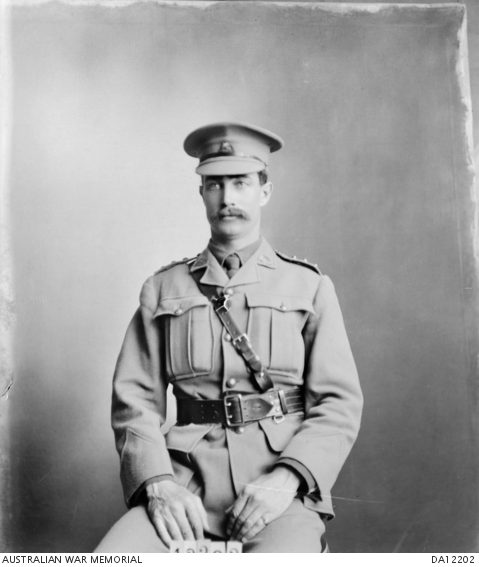
“The election of officers resulted: President, Captain Kimber”
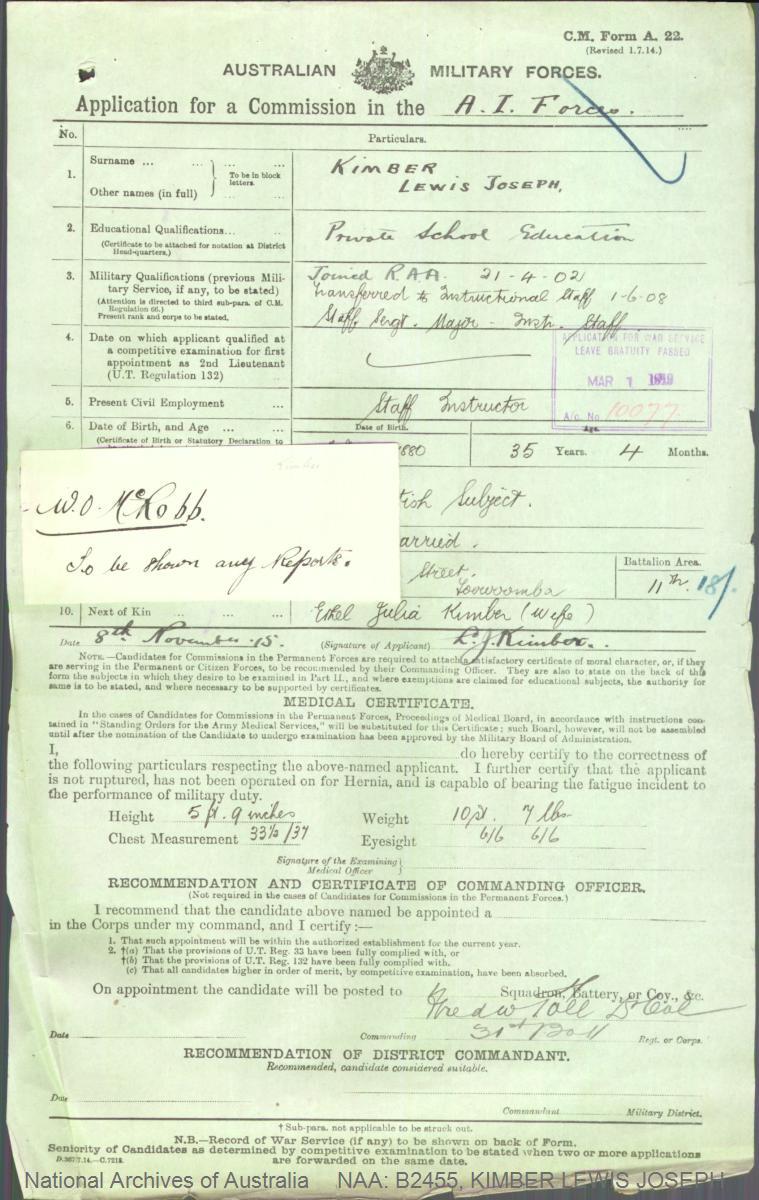
The Toowoomba Chronicle of 12 April 1919 reported on the formation of the local Returned Soldiers’ soccer club. Lewis Kimber, the inaugural president, was 39 at the time, having been 35 when he embarked for the war in November 1915. Kimber was a professional soldier, having joined the 2nd NSW Regiment in 1898 before transferring to the Royal Australian Artillery in April 1902.
Being an officer, there is much information about his career. Kimber completed “Short Course on Gunnery” and “Armourers Course” in 1906 before being transferred to the instructional staff in 1908. A year later he was sent to Tasmania to undertake a course in topography and later completed courses on rifles and machine guns.
He married Ethel Kelly on Christmas Eve in 1912 in Brisbane. At the time he was a military staff instructor at Charters Towers. The couple moved to Toowoomba in March 1915. By this point he had already undertaken war service, having spent several months at the end of 1914 on Thursday Island.
Kimber formally enlisted for overseas service in August 1915. At the time he was a Staff Sergeant but was promoted to Lieutenant and then Captain within two months. He was allocated to the 31st Battalion and sent to Egypt. The post-Galipolli reorganisation saw Kimber transferred to the 46th Battalion and then onto the 4th Division Australian Divisional Base Depot. He was sent to France in August 1916 where he served at Etaples.
Kimber suffered two bouts of bronchitis either side of the turn of the year and was eventually transferred back to the 46th Battalion. In April 1917, he received a compound fracture of the right foot and leg in action at Bullecourt which led to the amputation of his right leg. He was evacuated to England, deemed permanently unfit for duty and discharged back to Australia.
The loss of his leg did not prevent him from being involved in soccer or the military. He helped form the Returned Soldiers’ club in Toowoomba, which was soon renamed Diggers. It provided a social outlet for returned soldiers and continued well into the 1920s, becoming one of the strongest clubs in the district. Kimber was also elected as a vice-president of the Toowoomba British Football Association in 1920.
Kimber returned to his staff instruction work in Toowoomba after the war and registered a copyright in 1920 for a literary work called “The Self Instructor Cards or How to Become Command Perfect on Company Drill”. Ethel passed away the same year at the age of 35. She was survived by Kimber and their two daughters, Elizabeth and Phyllis. According to her obituary in the Darling Downs Gazette on 24 September 1920, she had undertaken “patriotic work” for the war during her husband’s absence and assisted the Returned Soldiers’ Imperial League on his return. The funeral was well attended and received wreaths from many community groups from Toowoomba.
Kimber was transferred to Brisbane in 1921, which led to a public send-off by the Mayor and for the Toowoomba Chronicle of 25 November 1921 to write:
Since his return, with the honorable scars that distinguish him, he as rendered a very valuable assistance to Australia, as a president of the Toowoomba branch of the R.S.S.I.L.A, as an officer who commands the respect of the lads as he moulds their minds and gives them technical tuition in the art of defence of their nation and their homes and in connection with the Cadets’ Welfare Movement.
Kimber served in the Australian Instructional Corps, where he was promoted to Major in 1930. He reached the rank of Lieutenant-Colonel in 1939 but soon retired. Retirement was short, as he was called up again in May 1940, aged 59. He spent several months working with the Headquarters Staff at the Victoria Barracks, Brisbane before being discharged as medically unfit.
He was the president of the National Rose Society of Queensland in his later years, becoming an exhibitor and judge of roses. He died in 1960 and was survived by his second wife Mary Elizabeth Kellond.