



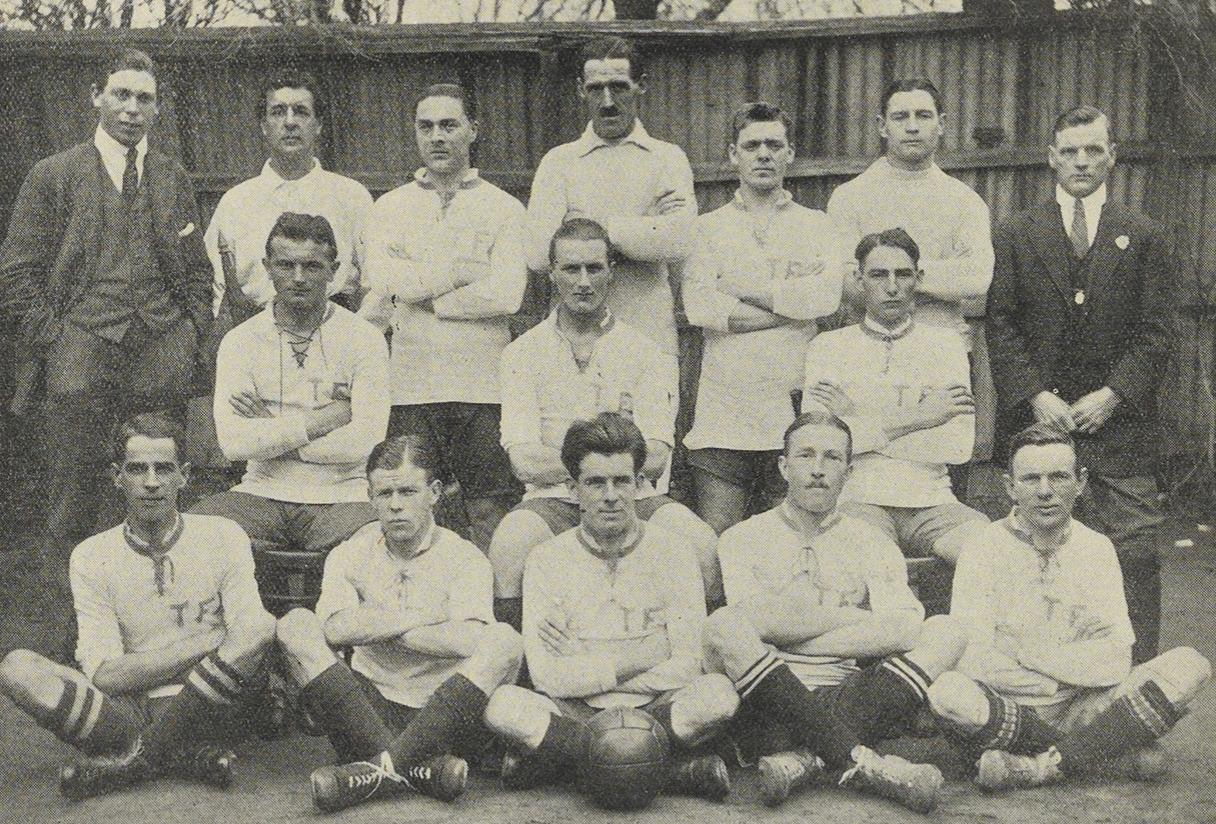
Leslie Robinson Honeysett was born in Wallingford, England in January 1896. His family moved to Henley-on-Thames, home to the famed Henley Royal Regatta, by 1901, where his father was the local postmaster.
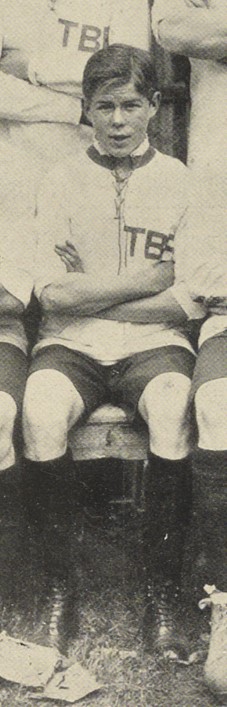
Les joined his extended family in Tasmania in 1913 and began playing for the South Hobart club as a left winger. Les is the nephew of J.J.B. Honeysett and cousin of J.H. Honeysett, both men whose contribution to football in Tasmania has seen them inducted into the Football Australia Hall of Fame.
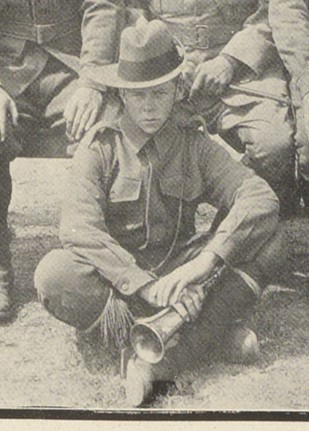
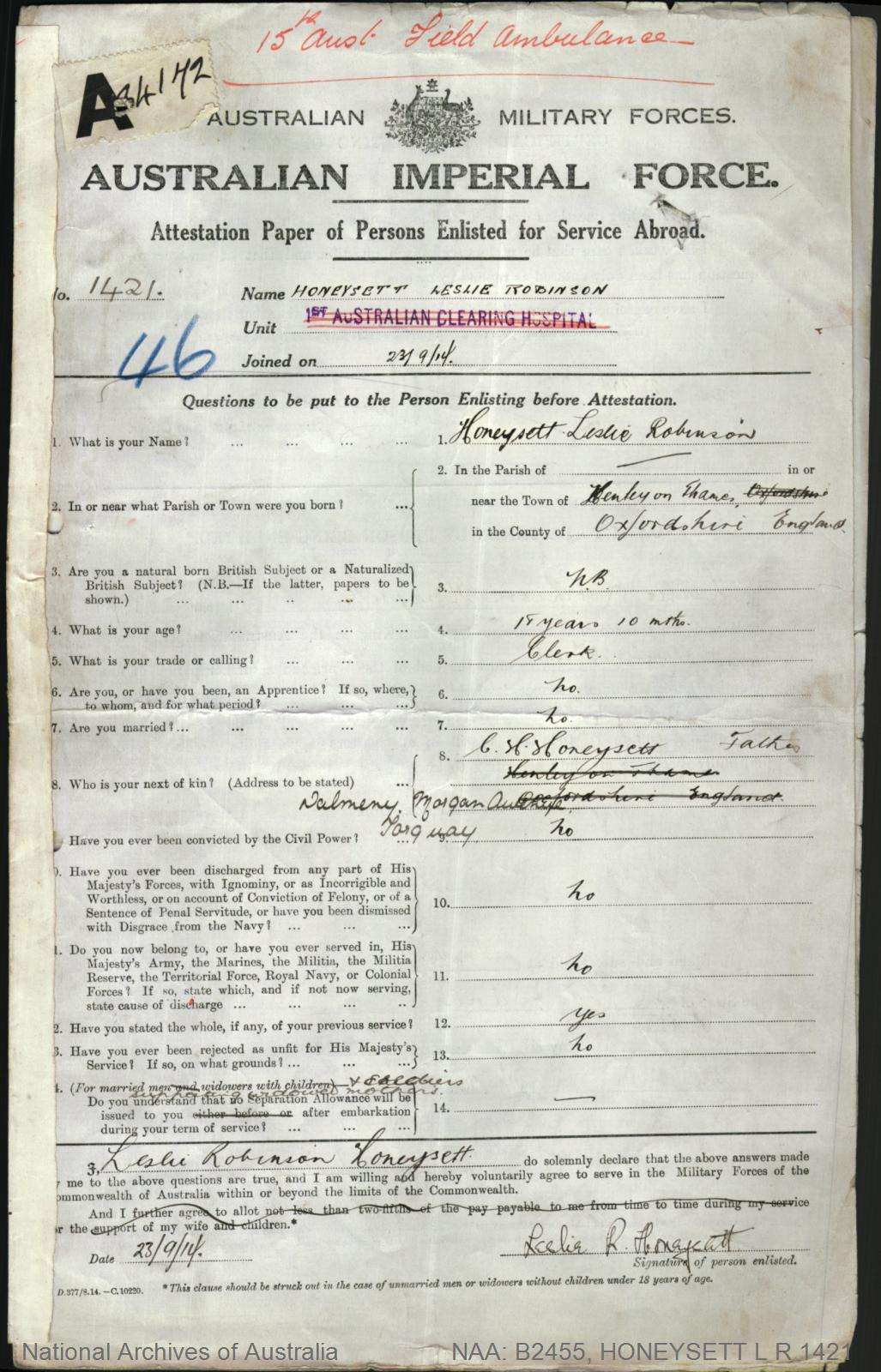
He made his first appearance for Southern Tasmania intrastate team in 1914, and played in the Falkinder cup final of that year for South Hobart on 26th September 2014. Three days prior to this match, Les had enlisted in the forces, joining the 1st Clearing Hospital as a Bugler. This unit featured Captain E.T. Boddam and South Hobart teammate Wallace Swinton.
Les was present at the Gallipoli landings on 25 April 1915, and throughout 1915, his letters home were often published in Hobart’s Mercury newspaper, his employer prior to enlisting. His writing brought life on the front line to readers back home. One extract, from 21 July 2915, describes the landings in great detail:
Sunday, April 25: We are nearing our destination, and can hear guns booming. Our warships are firing. Queen Elizabeth is going great guns. I’m glad we’ve got Lizzie on our side! We are waiting for our turn to land. The first pinnace returns with dead and wounded. After slight delay we left in lifeboats. Big shells fell near us, and shrapnel fell all round us, but we got ashore without any casualties. We seem to have had charmed lives. Saw Nugget Hudson and Alf. Eccles dead. Plenty of work. While unloading our boat some stretchers were hit by shrapnel. I promptly ducked for cover. My first sensation! Little shelter on the beach. We could see our chaps getting into it a treat on the hill. Beach soon crowded with wounded. Awful sights! We made a dressing station, and were kept busy all night.
His second extract describes the joy of receiving gifts from home, as well as the other soldiers he’s met, which include fellow Soccer Anzacs Roy Vincent, Dudley Perry and Douglas Sunderland. His third story describes the illness that plagued him, and so many of his fellow soldiers on the Gallipoli peninsula. Taken ill for five weeks he was eventually sent from Turkey to Malta and then back to England to recover.
It was the first time Les had set foot in England since emigrating to Tasmania. Once Australian troops had left Gallipoli, Les was transferred to the western front where he stayed for the remainder of the war, continue to work in clearing hospital and ambulance units. He was regularly taken off the front line due to illness and gassing, with his most severe incident requiring a month’s hospital stay due to the effects of being gassed.
Numerous other members of Les’ family enlisted in the war effort, with cousin Joe and brother Bertram both seeing considerable action. Bertram, who played football for Oxford City in England and served with the Royal Engineers as a signaller, was killed in September 1918. Cousin Joe was taken prisoner of war in 1917 and was awarded a military cross for his service.
Following the end of hostilities, Les returned to Tasmania in March 1919 aboard the ship Port Hacking. He rejoined South Hobart for the 1920 season and represented Tasmania against a side from the visiting warship H.M.S. Renown. In 1921 he debuted for Tasmania against Victoria in Tasmania’s first interstate match following the war. Les scored both of Tasmania’s goals in a 4-2 defeat, including a penalty.
By 1923, Les had firmly established himself as one of Tasmania’s leading players, and thus was rewarded with his first selection for an Australian XI, against the visiting Chinese Universities side. Les would again represent Australia against Canada in 1924, playing in a ‘B’ international played at the Melbourne Cricket Ground.
Les’s career peaked the following year, in arguably one of the best years any Tasmania footballer has ever had. He scored an astounding 65 goals, including 7 in one game, for Sandy Bay in the 1925 league season, played for Tasmania against South Australia and again played for Australia against a visiting English FA team in Adelaide and Melbourne.
With a total of 4 appearances for Australia ‘B’, Les held the record for most appearances in a senior Australian side by a Tasmanian until Dominic Longo in the 1990s.
After such a successful period on the field, his life off the field began to collapse. In February 1926, Les appeared in police gazettes across Australia, with a warrant out for his arrest on charges of stealing. The Gazette reads:
that he, between the 6th day of January 1925, and the 8th day of January 1926, at Hobart, in Tasmania, being the then employed as a servant of the Tasmanian Government, to wit, Deputy-Recorder of Titles, unlawfully stole the sum of £229, 13s. 10d., the property of the Tasmanian Government.
Les was described as 29 years old, standing 5 feet 6 inches of fair complexion and hair colour, and a native of England. The warrant suggested Les could be found in Melbourne, Sydney or Canberra, and makes mention of his being a returned soldier and a professional soccer player.
Later that month, a further notice in the police gazette was published, seeking the apprehension of Les as a matter most urgently desired.
Up to the present, no trace of him can be found, but as a result of enquiries made there is every reason to believe that he is residing in one of the mainland states. Honeysett is a professional soccer player; possibly some information concerning his present whereabouts may be obtained from the secretaries of the various soccer clubs on the mainland.
In March 1930, the arrest warrant was withdrawn. It is unknown whether this warrant was executed or whether the charges were dropped. The name Les Honeysett disappears from all available records from the point onwards, until his death in 1951.
As it would transpire, the advice given by police to contact secretaries of mainland soccer clubs regarding his whereabouts was the correct way to track him down. Les would continue to play football across Australia for another decade, but not as Leslie Robinson Honeysett. In June 1926, a match between Orange and Cowra in regional New South Wales ends in a 6-3 victory to Orange, with one player scoring 4 goals for Orange. This player, Charles Hannon, is listed as a ‘representative Tasmanian player’.
For the rest of the season, Charlie Hannon took the Orange soccer world by storm, scoring in matches against Lithgow and Bathurst. The following year, Charlie was involved in the establishment of the Central Western Soccer Football Association and played for Orange again. In July, Charlie moved to Cowra and was again introduced as a “former inter-state player” in the local press. He played immediately for a Cowra regional team against a side from Canberra, where his cousin was the assistant secretary of the association.
After a year, Charlie returned to Orange and for the next five years, became a stalwart in the Orange soccer scene, playing in the half-back position and assisting with running clubs and associations in the area, while working at local hotels. The Orange side became the dominant team in Central West region, going undefeated in 1929. Charles continued to live and work in hotels across rural NSW, moving from Orange to Dubbo, and then on to Bourke. His last recorded game was for Dubbo in 1934, at the age of 38.
According to news reports, he left a positive impact on the game of soccer in all the towns in which he lived, with the Dubbo newspaper describing his departure with sadness:
There will be a regrettable absentee from Sunday’s ranks, the well-liked international, Charlie Hannon having tendered his resignation, owing to his early departure for Sydney. On and off the field, Charlie will be greatly missed. A great player and a loyal worker for the uplift of the game, the Soccer section of the community will be the poorer for his departure.
By the late 1930s, he had moved to regional Queensland, continuing to work in hotels and pubs, including one in Cunnamulla in 1937. By the time World War II broke out, he was working in Brisbane at the Australian Hotel. It is not known whether his friends and comrades in these country towns had any idea that Charlie Hannon was not his real name.
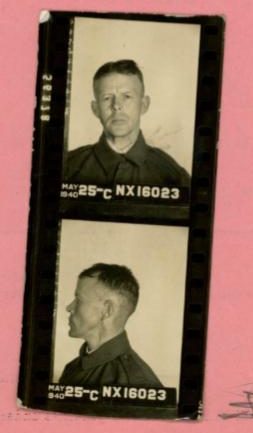
While trying to enlist for the Second World War in 1940 Charles Hannon’s true identity was revealed. On 21 May 1940, Charles William Hannon attempted to enlist in the Australian forces. On his service record, Charles William Hannon states that he was born in Wallingford, England and his next of kin is Mrs J.H. Honeysett, sister, living Alt Crescent, Ainslie, Canberra. Both matters are consistent with the place of birth and family history of Les Honeysett (He lived in Wallingford as a child).
After being taken on strength in Canberra, Charles was declared medically unfit in Sydney and discharged in July 1940. A pink discharge form includes a photo of the discharged officer, which shows that this man is Les Honeysett. After this rejection, Charles returns to Brisbane and is back working in hotels in 1943.
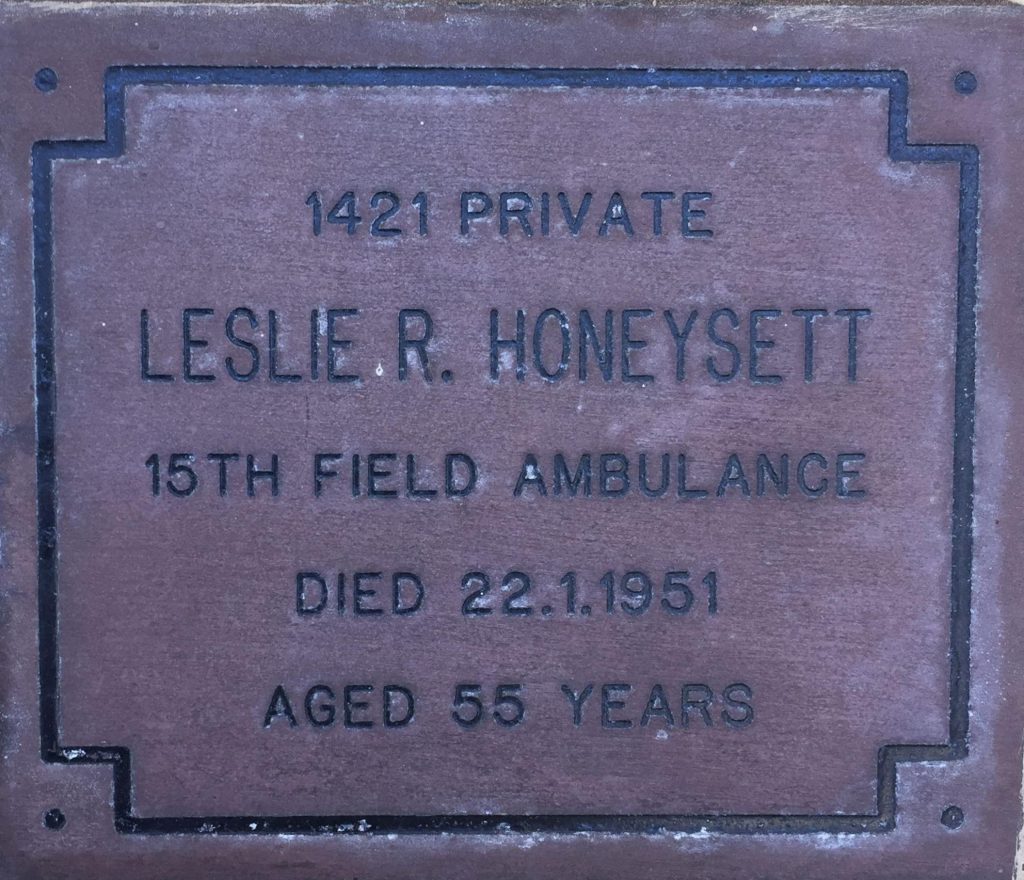
Subsequently, his exact whereabouts are not known until 1951. On 23 January 1951, a short obituary appears in The Mercury reporting that on 22nd January 1951. Leslie Honeysett passed away in a Randwick hospital, NSW aged 55, with a brief mention of his sister Vie and brother Charles. He was interned at the Eastern Suburbs Memorial park in inner Sydney, in the Returned Soldiers pavilion, with a plaque outlining his service given to Australia in World War One.