

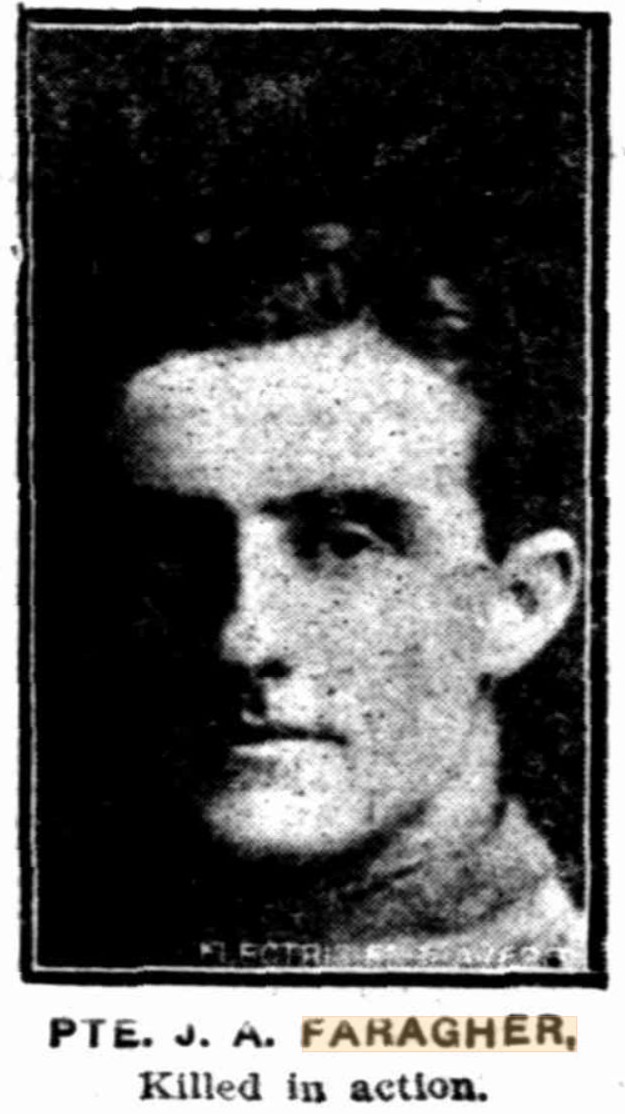
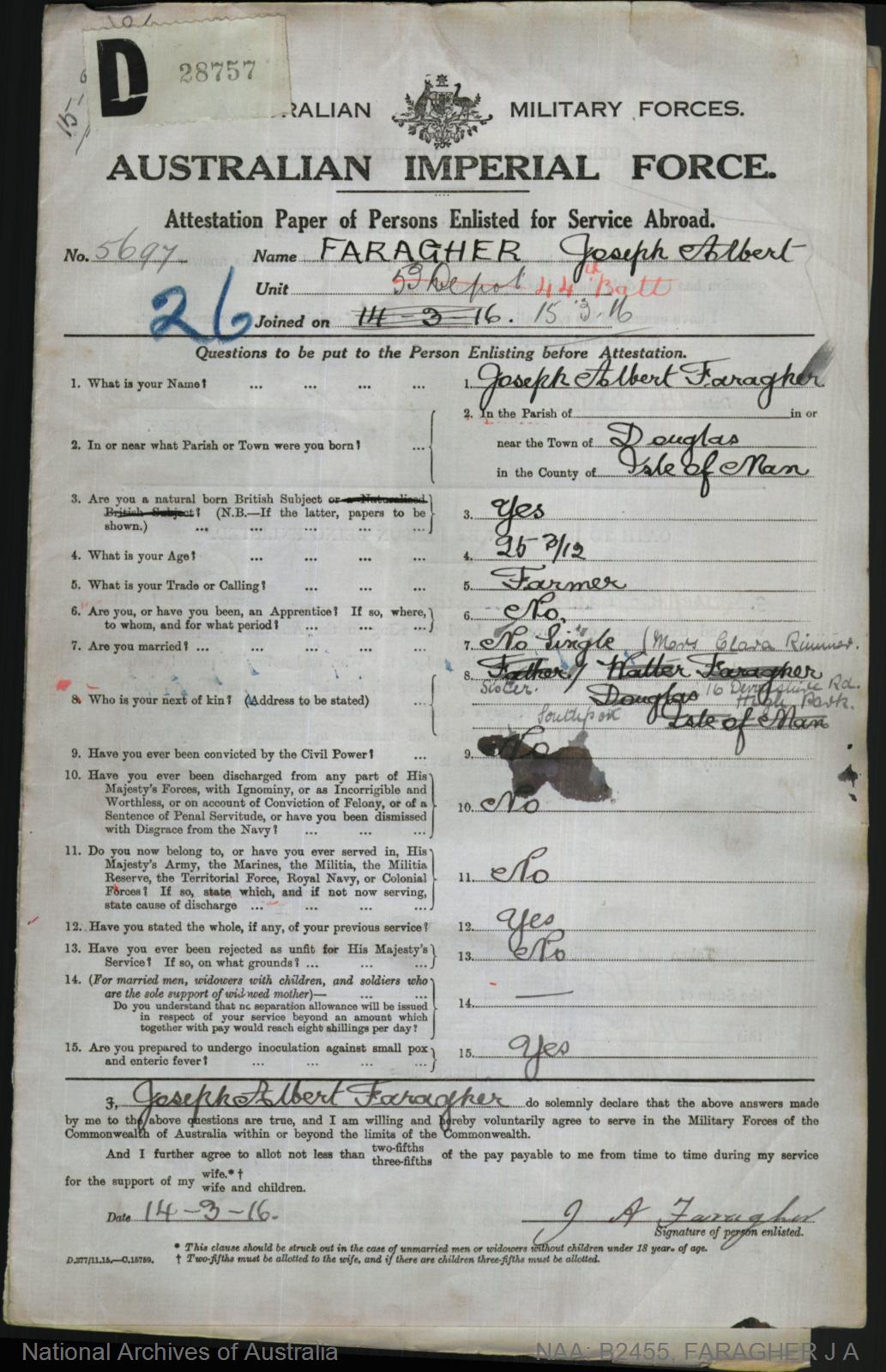
Joseph Faragher was born in Douglas, Isle of Man, on 8 January 1891. His mother, Sophia Ore, passed away the following year leaving his father, Walter Faragher, to bring up six children under the age of nine. It’s unclear when Joseph arrived in Australia but by 1912 he was working as a farm hand in the regional town of Mt Erin, about 40km to the north-east of Geraldton.
An influx of migrants into the area had prompted the creation of the Geraldton British Football Association in 1913. The following year Joseph turned out for the newly formed Moonyconooka team, who played a trio of friendlies against clubs from the association and qualified for the Hansen Cup final only to be defeated 2-0 by Thistle.
Moonyconooka didn’t re-appear in 1915 so late in the season Joseph joined Thistle, just prior to their 2-1 Hansen Cup final win over Geraldton Town. However, the game was ordered to be replayed after it was found Joseph was ineligible as he was not a registered Thistle player. Town claimed a seesawing replay 3-2 in extra-time.
In March 1916 Joseph enlisted as a Private with the 11th Battalion. He trained at Blackboy Hill camp ahead of a mid-year departure for Europe, where he endured a harsh winter in the trenches of the Somme Valley, France. Early in the new year he wrote a letter home to Miss Ada Shield which ‘the Geraldton Express’ published on 5 March 1917
I am now taking the chance of writing you; one never knows when the next will arise. When I wrote last I thought that I was in for a few days’ rest, but had to go in the trenches the following day, Christmas Day. No doubt you can understand what a Christmas Day it was – tin dog and bread for dinner. We did have a bit of plum-duff for tea. I was also in the trenches for New Year’s Day. It was about the hottest day I have put in. I was dodging shells all day. We came out yesterday for a spell, which I was badly needed. I went to bed at dinner-time yesterday and didn’t wake up until eight this morning, so I am feeling first-rate now. I got a letter from you while in the trenches. I could hardly hear the Huns’ shells going over while I was reading it. I think we have the Huns well beat now. They are very frightened of us. It is very rare they raid us, and when they do they don’t fight long before they give in. Our artillery is giving them no rest; they bang away at them all day. Very often one can see a few Huns or pieces of them flying in the air. It makes one laugh at times to see us dodging the German shells. One bloke would sing out, ‘Here’s one coming,’ and we would lie flat down in the trench before he had finished saying it, very often up to our eyes in mud. I suppose you would like to know what we do at nights when out of the firing line. There isn’t really anywhere to go. There is one picture show. I go one night, and the rest is spent knocking about the town, or what was once a town. It is a fairly big place, but there is hardly a building standing. It is only a few miles behind the firing line, and always under shell-fire. The Huns have a great fancy for knocking down the churches. There isn’t one left standing. I have not received any of the parcels you sent me. It seemed so hard; all the other chaps had something, poor me nothing. But it can’t he helped; things like that will go astray. My sister sent me a parcel from England; I never got that either. With kind regards to all.
By the time this letter was published, Joseph had been admitted to 1st Southern General Hospital in Birmingham, England, after suffering a gun shot wound to his left knee. After a period convalescing at No. 3 Command Depot, Hurdcott, he rejoined his battalion in France where, in July, he was appointed to Lance Corporal.
Around this time the 11th Battalion moved to Belgium where they were soon engaged in fighting in the Ypres Sector. Joseph Faragher was declared to have been killed in action on 2 August, 1917, after being reported missing in action a few days earlier.