

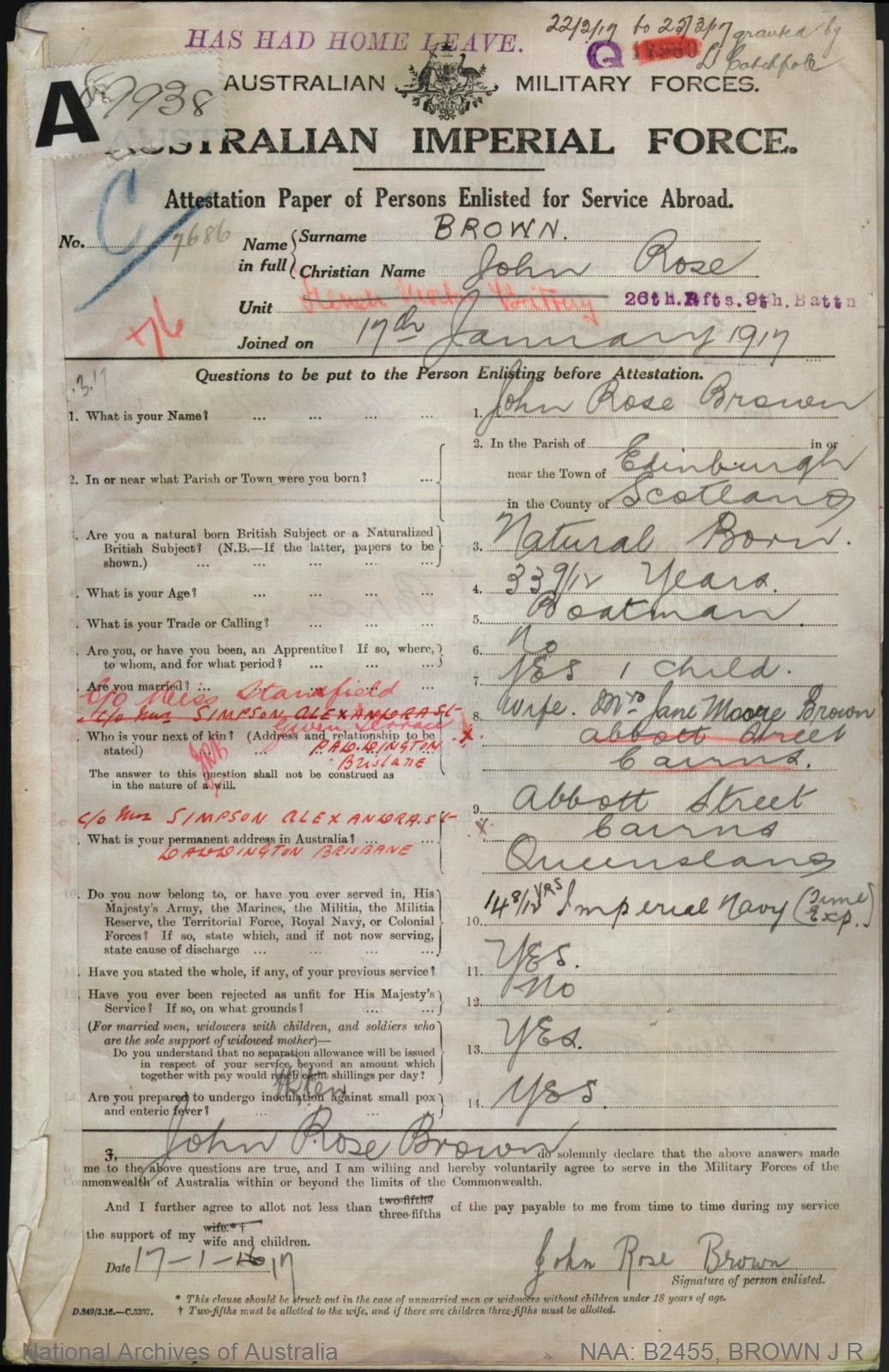
John Rose Brown emigrated from Edinburgh to Australia in 1910. He initially worked on the survey ship HMS Sealark, which went as far as Hobart and the Pacific Islands. The crew of the Sealark was known to play soccer, including matches against fellow survey ship HMS Fantome in Hobart around New Years 1914. Whether Brown played in these games cannot be determined given the short match reports.
Brown enlisted in 1917 in Cairns. At the time he was 33, married with a child. His enlistment paper noted his experience with the Imperial navy and the anchor and heart tattoo on his right forearm. Brown left Australia in October 1917 and spent months training at Sutton Veny in England. He finally reached France in April 1918 with the 9th Battalion during the time it was stationed around Hazebrouck. It was presumably at Hazebrouck where he was shot in the arm in July. Brown was evacuated to England and then onto Australia in December.
Brown was noted as moved to Cairns in 1923 where he helped reintroduce soccer to the city following its decline late in the war. He became president of the association for five consecutive years and again in 1930. Brown also refereed. He quit the association suddenly in 1931 when his work was unexpectedly transferred to Bowen.
The Cairns Post of 22 April 1931 reported on Brown’s farewell, where it was lamented that the code which he helped revive now coincidentally died again on his departure due to the depression. Brown, replying to his farewell gifts, said:
I have always been a lover of soccer. There is, of course, nothing unusual in that, as I have been born and bred in Scotland, where soccer is their national game. I am sorry the game has fallen through this season, but I hope that soccer will again be in full swing next year.
Brown later joined the marine pilot service in Townsville. He died suddenly in 1943 aged 62.
John Rose Brown was born in Edinburgh in 1881. He came to Australia in 1910 and worked on a Cairns based survey ship until 1925. While in Cairns he took an interest in the game and for seven years he was president of the Cairns club.
He enlisted in Cairns in 1917, serving in France and suffering a gunshot wound in England. He returned to Australia in December 1918, resuming his administrative interest in soccer after the war and died in 1943 at the age of 62.
His son David Brown served as a pilot in the RAAF in WW2.