
John Morgan’s known contribution to Queensland soccer started in the late 1920s. In 1927, Morgan donated a trophy for a midweek soccer competition and spent some years on the Midweek Football Association’s committee. The midweek competitions existed for those workers who could not play on the weekend and were normally company teams. At various times workers from the Goonda Mental Hospital, the Tramways, various taxi companies and the Woolloongabba locomotive yards competed, as did Morgan’s own company, Reel Cabs.
The inaugural final saw Morgan hand his trophy over to future Socceroo Eric Gorring, who had scored a hat-trick for winners Woolloongabba Loco. Morgan’s Reel Cabs would continue to play in the competition into the 1930s. Reel Cabs started as The Central Auto Company in 1918, and was later renamed as Returned Soldier’ Auto Co. Ltd. Morgan was one of the company’s founders.
The Brisbane Courier announced the new company on 10 August 1918.
Six Queensland returned soldiers have opened a motor garage in Bowen street, near the Central Fire Brigade station in Ann street. Prior to their war service they had practical experience in the motor vehicle business, and it is announced that they are careful drivers. The soldiers referred to are Sergeant G. Thistlewaite, Corporal G. Colville, Trooper Robinson, Trooper Simpson, Corporal J. J. Morgan, and Corporal J. Motley. They announce that their cars are up-to-date models.
The emergent taxi industry was everchanging, and by 1926 Returned Soldier’ Auto Co changed its structure and became Reel Cabs. According to The Brisbane Courier of 5 March 1927, 95% of shares in the company were still owned by returned soldiers, while “90 per cent of the drivers have been members of the A.I.F., N. Z. or B.E.F. Forces.”
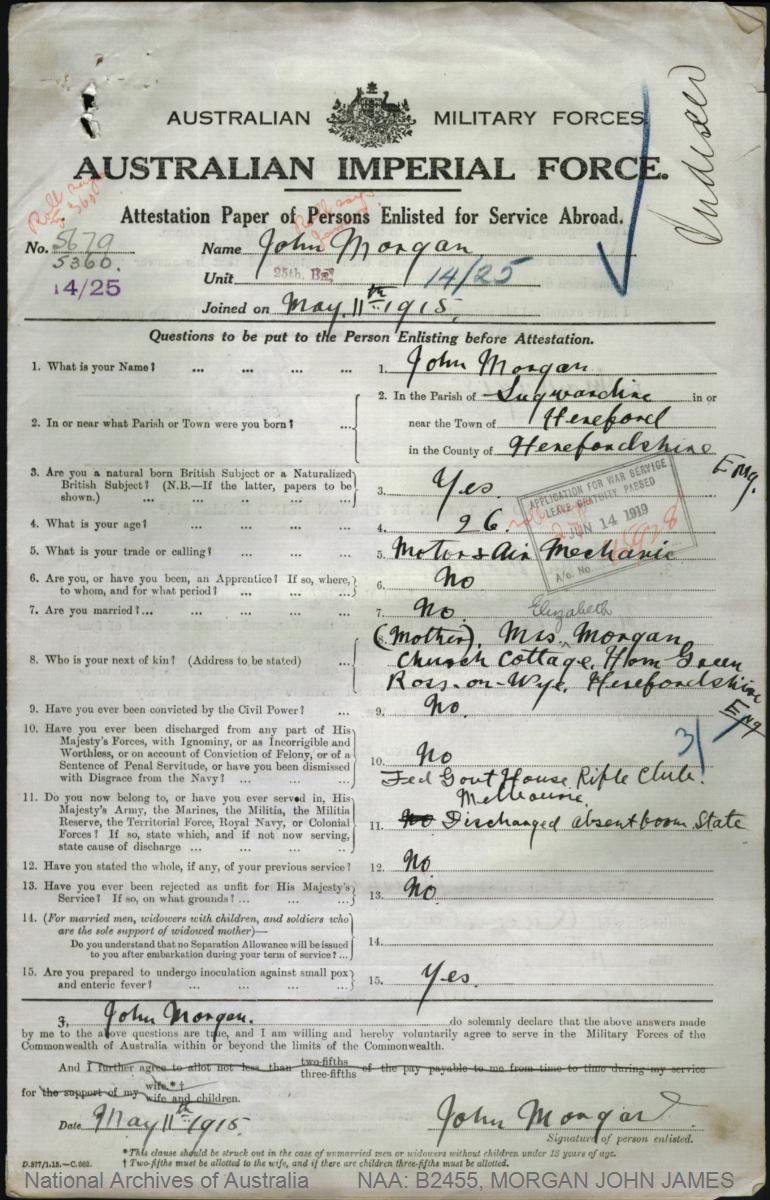
Morgan was born in Hereford and was a 27-year-old engineer when he enlisted in Brisbane in May 1915. Assigned to the 25th Battalion, Morgan reached France in December 1916 but spent some time at the depot in Etaples, his war paused by a bout of laryngitis. He eventually reached the fighting and was promoted to Corporal, but received a gunshot wound to the scalp in May 1916. This saw Morgan evacuated to England and discharged back to Australia by the end of the year.
The next year he helped start the Returned Soldiers taxi business. Morgan ran into trouble when trying to honour his old Battalion after the company became Reel Cabs in 1926. The 1927 Courier article stated the business struggled to find a way to identify their cars as taxis, given colours such as black, white, yellow and green were already taken. Morgan’s solution was to use the 25th Battalion black and blue diamond. The state executive of the Returned Soldiers and Sailors League, however, complained, saying the company could not use it. Despite the complaints and a meeting, the company continued to use the logo for several years.
While it is unknown whether Morgan played soccer before the war, he was a patron of the Thistle Soccer club in 1927, the same year he presented the trophy for the midweek competition. In 1928 he was elected to the committee of the Midweek Football Association, a role he held into the 1930s. Reel Cabs had a soccer team as early as 1927, when it played a QFA second division representative team for the Reel Cabs Cup – with the expectation it became an annual fixture. This game acted as a curtain raiser to an Ipswich versus Brisbane representative match. The club also joined the Midweek Football Association competition that season. In 1928, Reel Cabs and Yellow Cabs merged and were sometimes known as Reel (Yellow) Cabs. It is unknown whether the merger was related to an employment and wage dispute at Reel Cabs in late 1927. The blue and black diamond of the 25th Battalion was retained as the logo, while Morgan remained as manager. The new Reel (Yellow) Cabs would keep fielding teams in the midweek soccer competitions most years until 1931. A year later Reel Cabs was liquidated, but Morgan would manage a seeming continuation of the entity, variously as Taxi Town Pty Ltd and Yellow Cabs. Morgan still worked for Yellow Cabs in the mid-1940s. The Midweek soccer competition awarded the Morgan Trophy until 1936. The teams who competed that year were Goodna Mental Hospital, Blue and White Cabs, Ascot Taxis and Morgan’s Yellow Cabs.