
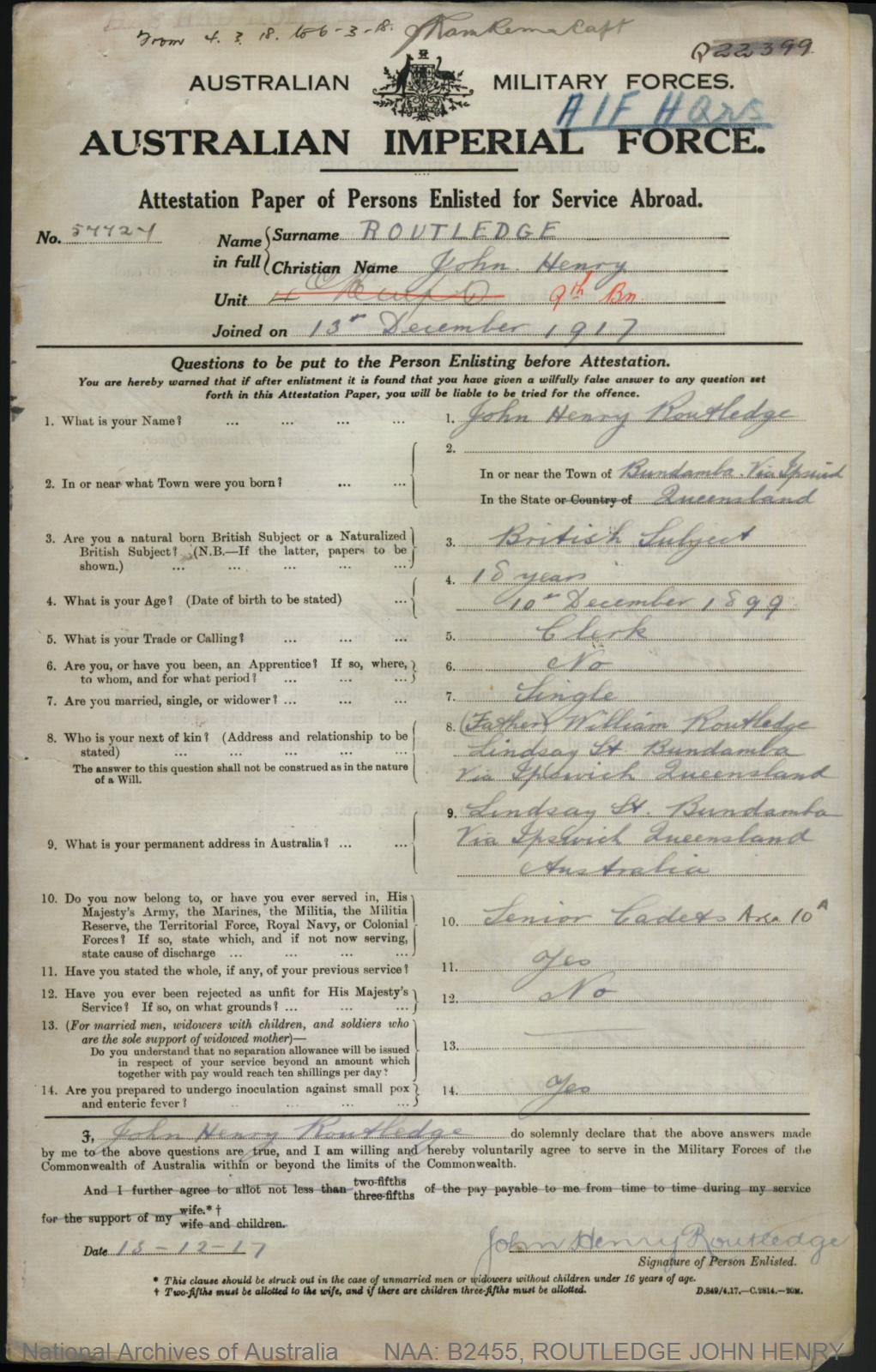
John Henry Routledge was only 18 when he enlisted in December 1917. Soccer players of such youth were rarely seen in the newspaper of the era, but a report in the Queensland Times of 23 July 1912 shows him scoring for Bundamba school against Boys Central. A month later he played in a trial match to select an Ipswich and West Moreton team against the visiting New South Wales schoolboys. Many of those in the trial match were second-generation Ipswich soccer participants, including members of the Nunn, Bemi, Marsh and Lindsay families. As was Routledge, whose father William had been chairman of the Ipswich and West Moreton Football Association from 1909, while his uncle Jack Routledge had been captain of Dinmore Bush Rats for almost a decade.
Routledge made it as far as London before the war ended. He embarked from Australia after training in June 1918. On arrival in August, he was allocated to the 1st Training Battalion but was not placed on active service until after armistice, when he was marched into the Australia Infantry Base Depot on 22 November. A month later he was marched out again, after being evacuated to England with pleurisy. He recovered in February and continued to serve until his discharge in September 1919.
After the war, Routledge returned to Ipswich and worked as a clerk for many years. He returned to Bundamba Rangers where he played during the 1920s. He was selected for the Ipswich representative side against the visiting English tourists in 1925. Routledge died in 1969, seven years after his father.