
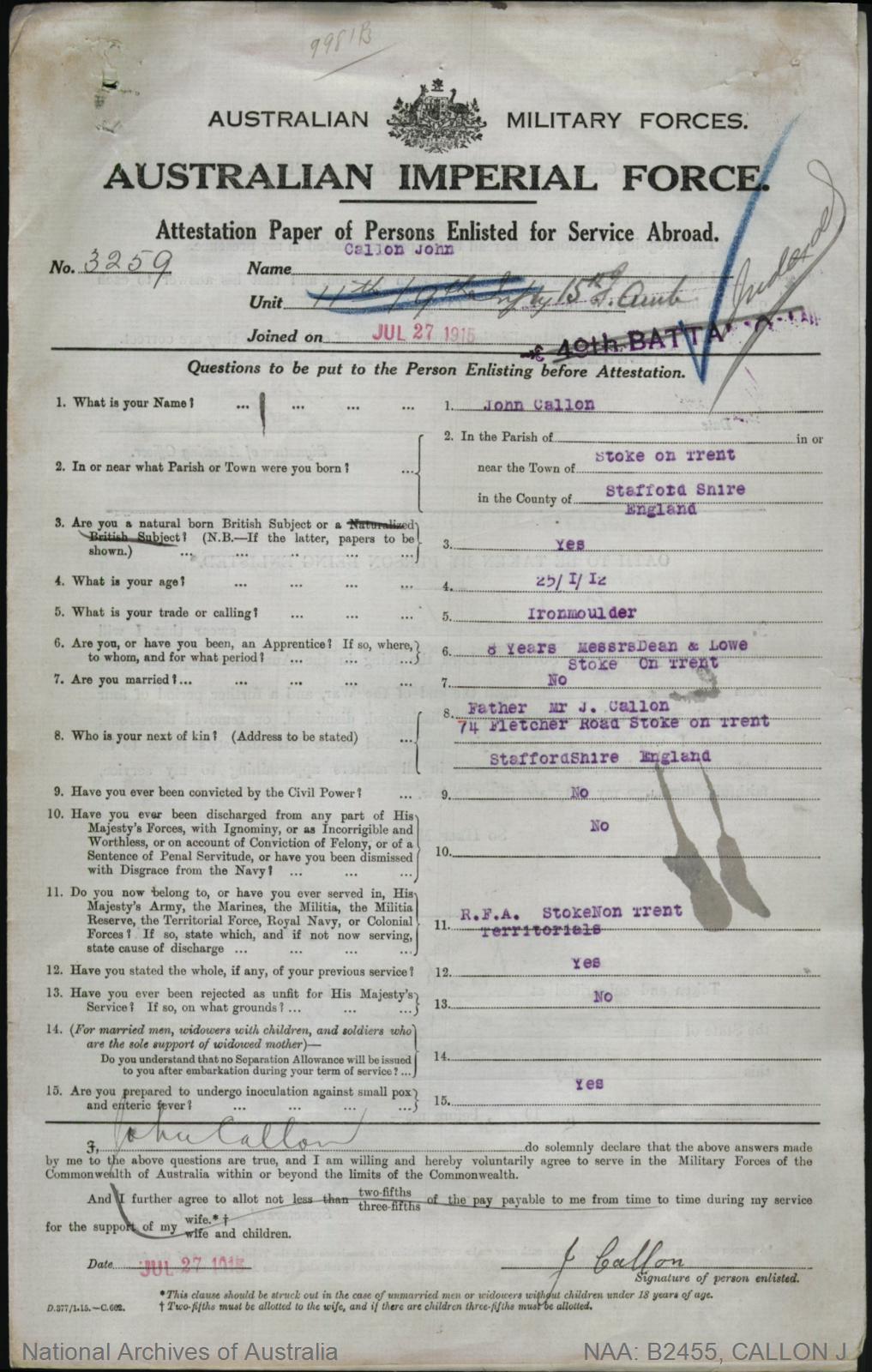
John Callon enlisted in July 1915 and died from wounds in September 1917. At the time of his enlistment, he lived in Ellenborough Street, Ipswich, a few blocks from the St Stephens Presbyterian church. Despite being Anglican, he played for the St Stephens soccer team immediately before the war, and in one case after enlisting, when given leave from the Enoggera base to play. Callon had played for Ipswich Railways in 1912, when he was also selected as a reserve for the Ipswich and West Moreton representative team which played the visiting New South Wales side.
Callon was initially assigned to the 9th Battalion and left Australia in October, but like many headed to Gallipoli at the time, and whose arrival would have coincided with the evacuation of the peninsula, his records are blank until early 1916. The same year he was transferred to 49th Battalion, and then onto the 15th Field Ambulance.
He died on 27 September 1917 in hospital in Boulogne, almost a week after receiving a gunshot wound to the chest.
His brother Edward, despite being the beneficiary of Callon’s will, faced the same bureaucratic issues as many families regarding medals. The Base Records Office, citing the Soldiers’ Estate Act of 1918 stated “irrespective of the provisions of a Will unless they are specifically mentioned therein, the mementos may only be handed over to blood relatives in the following order :- Father; mother, eldest surviving brother etc”.
The Records Office went on to state the 1914/1915 Star and British War Medal had already been sent to London to be forwarded to the brother’s father in Staffordshire. Edward had already received Callon’s personal effects from the front and applied for a death certificate to finalise his brother’s affairs. It was, however, not uncommon for the next of kin stated on the enlistment form or in the will, who were often mothers but also siblings who also lived in Australia, who took responsibility for all communication with the AIF over their deceased family member and to finalise the estate, to be passed over for receiving the medals for the father simply due to the law.