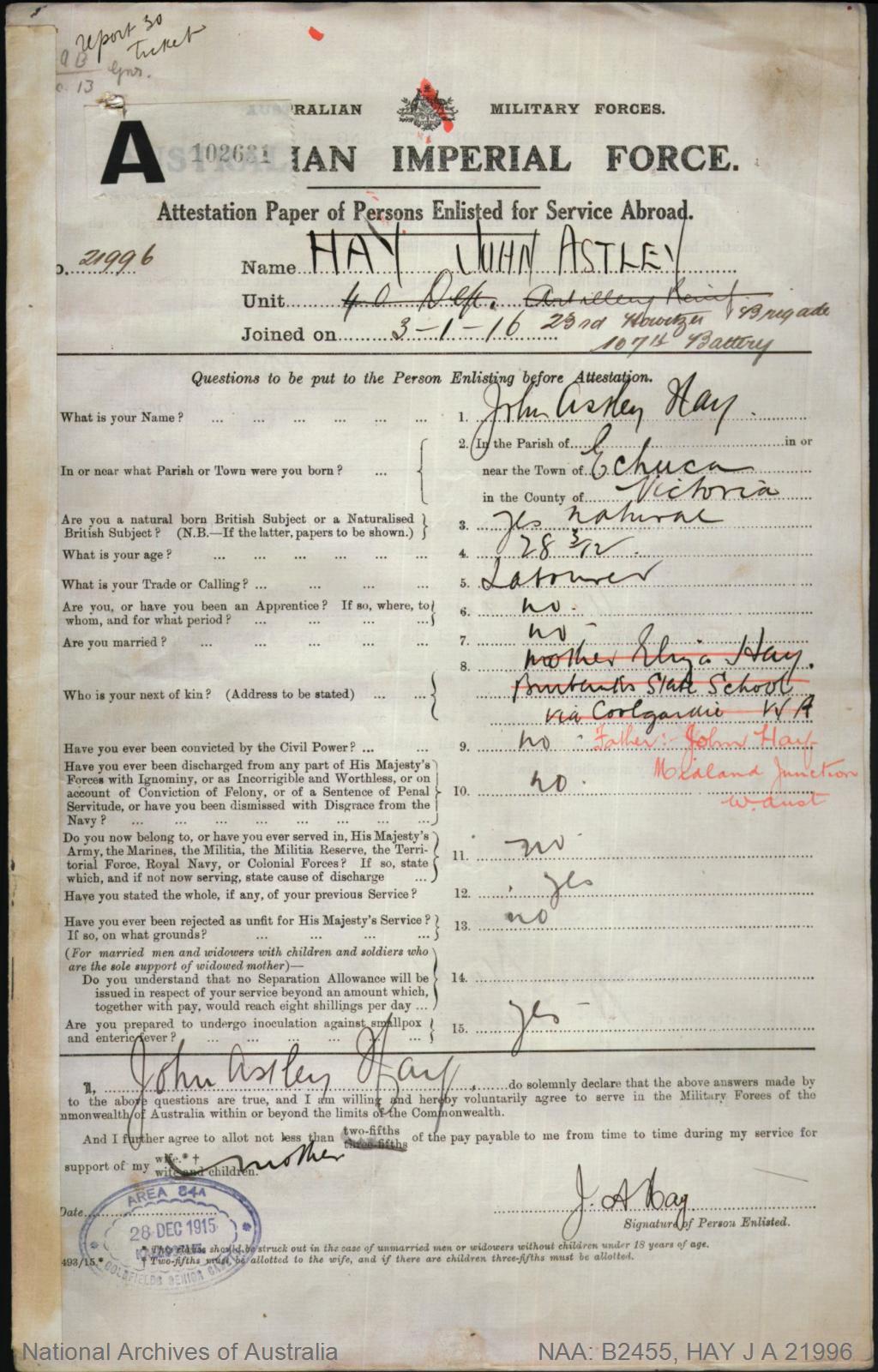
John Hay was born on 8 September 1887 in Echuca, northern Victoria. His parents, John Hay and Eliza Homer, lost two children under the age of 2 in quick succession before welcoming the arrival of Annie and then Jack. During the early 1890s the family moved to Western Australia where they settled in Midland Junction.
Jack was educated at Midland Junction State School and was made captain of the football team for their entry into the Schools League in 1902. The following year he joined the recently formed Olympic club where he captained the Junior League team across two winters while playing at fullback. There are a few indicators as to what prompted Jack to cut short a promising football career.
Jack had commenced a cadetship with Western Australian Government Railways — his father’s employer — in 1902. He accepted the position of junior porter in mid-1904 but lasted just twelve months before being “Dismissed for irregular conduct at Midland Junction” according to his railways employment record. It was a sign of things to come.
In September 1906 Jack and his mate, Walter Walsh, were found guilty of an unprovoked attack on railway worker Albert Guy during a late night trip from Perth to Midland Junction. “Hay was the most violent in the assault (which) was one of a particularly cowardly nature” reported the Swan Express. Jack was ordered to pay fines of £15.00 plus court costs or face six months hard labour.
A few years later Jack had found employment as a fireman and was living with his parents and sister on Dudley Street, Guildford. The construction of the Trans-Australian Railway led Jack to accept a labourer position at Zanthus, a very small and remote railway settlement located about 850km east of Perth.
Jack enlisted as a Gunner with the 23rd Field Artillery Brigade, 107th (Howitzer) Battery, in January 1916. The second half of the year was spent in England training and in hospital with bronchitis. Re-assigned to the 7th Field Artillery Brigade, he proceeded to France in January 1917 but within days was struck down by mumps and admitted to hospital, where he stayed just under a month.
The first major action for Jack would have been the Battle of Messines in June, after which his battery rested out of line in Boulogne. Their return to the frontline was near Ypres in Belgium where, in relentless rain and heavy mud, they supported the infantry at Menin Road, Polygon Wood, Broodseinde Ridge and Passchendaele.
After eight months on the battlefield Jack’s brigade were granted two weeks leave in England late in March 1918. After being part of fighting at Morlancourt, Villers-Bretonneux and Amiens, Jack was caught in a German gas attack and invalided to England where, in September, he was admitted to Bristol’s Beaufort War Hospital. Jack was at Littlemoor Camp in Weymouth recuperating and preparing to be repatriated when he was admitted to nearby Fovant Military Hospital suffering bronchopneumonia, a side effect of exposure to chlorine and mustard gas.
His condition slowly improved and in January 1919 he began the journey back to Australia. Jack’s father, John, passed away soon after he disembarked at Fremantle. In 1921 Jack married Annie Vennell with who he would have three sons while working as a guard at Hoffman Mill in Wuraming, near the town of Boddington.
His sister 28-year old Annie passed away in early 1927 and six years later he lost his mother, Eliza. Into the 1940’s and Jack worked as a guard in Hakea, also near Boddington, and the city of Bunbury.
John Hay was 65 when he passed away in Bunbury on 20 February 1953.