

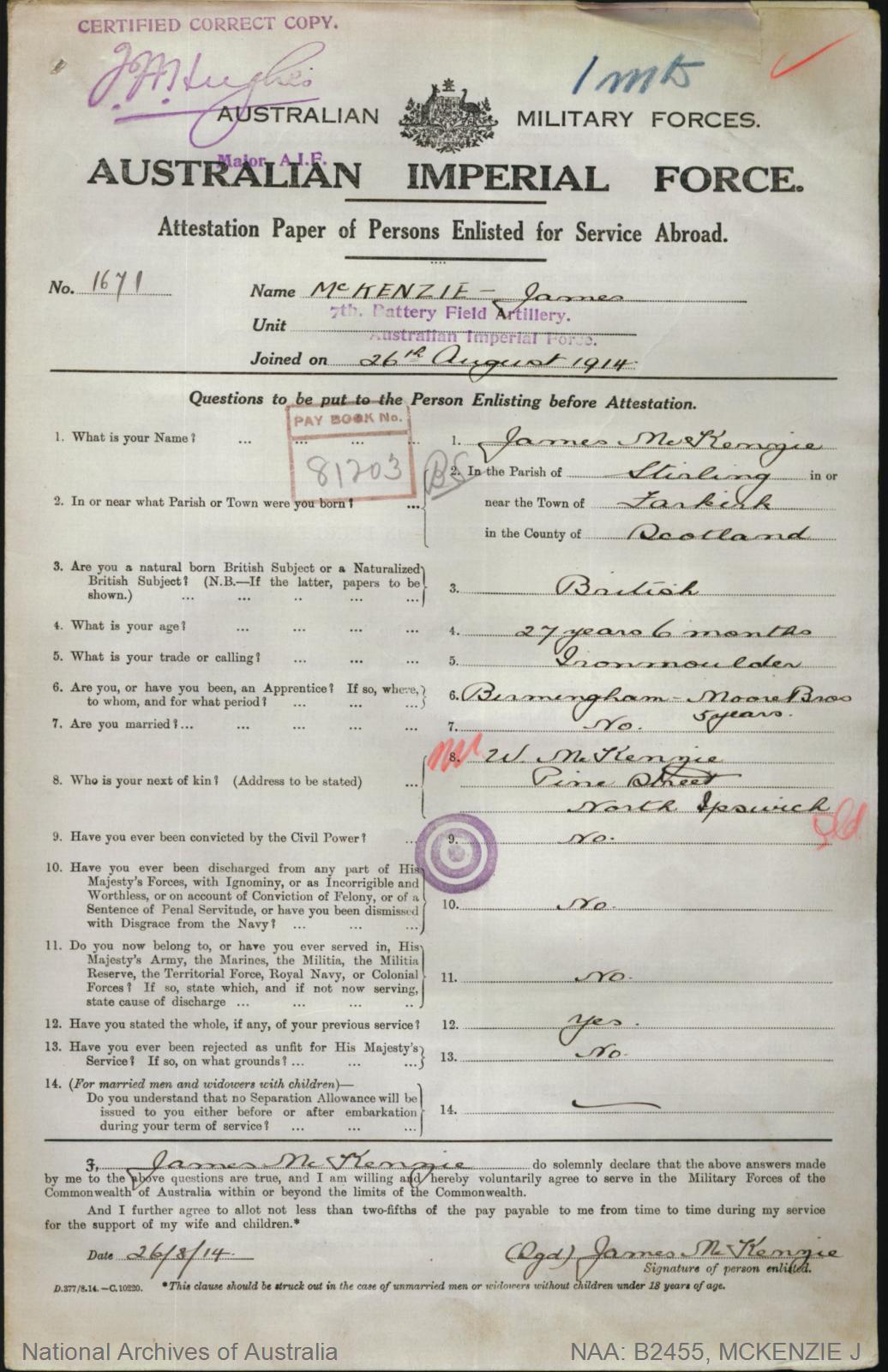
A native of Falkirk Scotland, James McKenzie was one of the first to enlist from Ipswich, in August 1914. He had played in goal for West Moreton against the visiting New South Welshmen in 1912 before moving to Blackstone Rovers.
In action in France he was wounded twice, receiving a gunshot wound to the buttock on 21 August 1916 and one to the thigh on 9 August 1918. He left England to return to Australia on 23 October 1918. He documented his experience in letters to the Queensland Times, three of which are reproduced below.
Queensland Times, 21 October 1915
LETTER FROM DRIVER McKENZIE. Our sporting contributor has received the following letter from Driver J. McKenzie, of the 7th battery, Australian Field Artillery :- Camp, near Alexandria, Egypt, September 10, 1915. – I am in Zariah Camp at the present time, with horses, as our battery, the 7th, are in action at Anzac, and have been there since that memorable landing in the 25th of April. I was up at the Dardanelles, and was to be one of the first to go ashore with horses, in our battery from Queensland, being the senior battery of the 3rd Brigade, were to send their horses (leaders and wheelers only) ashore, to take the guns and waggons up to support the infantry; but, unfortunately, shells began to drop near our transport, and we were ordered to get up anchor, and get out, to save being sunk.
It is not much good for me to go into details about our doings there, as you know most of the news from Ipswich-folks, who are up on the peninsula. Regarding the Queensland artillery, it has kept up the reputation that it made at Mena during the maneouvres, both in gunnery and line discipline. I don’t know if you heard that the 7th battery, under Major Hughes, came out on top in several actual firing tests before we left for the Dardanelles.
No doubt you are aware that our casualties are very heavy, and although we sometimes grumble at being kept here with horses we can consider ourselves very lucky, although I think every man here would he over there if he could get. I may state that one or two have gone over independently without being sent, but they only get punished for it afterwards, as there must be discipline when there are so many lives at stake. The horses may be wanted any time now – in fact, the authorities did manage to land some, but, on account of insufficient cover and water, they all had to come back with us to Egypt till they can advance.
I met Mr. Hall, the chemist, from Ipswich, in Alexandria, the other evening. He is here trying to regain what he lost on the Peninsula, during the first few weeks – health and vitality. He has a good word for Lieut. Roberts, so have all the Roberts’ Company I have met here, wounded. They cannot give him enough praise for his daring courage and skill. They all say he died as he lived – an officer and a gentleman. Your son is in camp here, also Norman ***ts and D. Donohue, from North Ipswich – all keeping well, but a bit downhearted, like myself, at being stuck here with the artillery horses. I must congratulate the Ipswich soccer players (I notice G. Burns is amongst them), who went down South with the Queensland team, on their display at Wollongong, against the pick of the South Coast of New South Wales, but at the same time I can tell you I would sooner see them trying to get an International Medal “Queensland, against German Brutality,” for they would be doing the British Empire, also the world, a good turn, then. I wish you all my old Ipswich friends the best of times. Hard lines for Sharp, Bundanba, and Cassidy, of North Ipswich, both wounded.
Queensland Times 1 February 1916
FROM DRIVER JAS. McKENZIE. The following letter has been received from Driver Jas. McKenzie, of the 7th battery of the 3rd Field Artillery Brigade, under date of Oasis Camp, Heliopolis, near Cairo, November 29:—Your welcome letter of the 16th of October to hand. I showed it to your son, Bert. He was very pleased at hearing from you. I also told him about that parcel you sent, but he has not received it up to date. I suppose you will have heard of his promotion. He is a bombardier now, and is doing well. I have just come out of the hospital at Alexandria, having been operated on for internal hemorrhage, and I am at present on base duty here in Cairo. I am getting better, but very slowly. Still, considering the cold weather is coming on I should soon be myself again.
Norman Ploetz and a fellow named O’Keeffe, with the Infantry transport, are here, and all wish to be remembered to you, also Dan. Donohue. He is in the battery now, having been promoted to this from the ammunition column. You were asking me about the re-union of the Queenslanders who came over on the Rangatira, with the first contingent. It was held at the Grand Hotel, Camp of Caesar near Alexandria, and was a great success, so far as the evening was concerned, both to officers and the men, but a lot of old familiar faces were missing from those who came over with us. Some are on the Peninsula, doing their share to uphold the honour of Australia, in other cases duty has been nobly done.
Lots of new fellows are arriving here every week from Australia as reinforcements to the different units. Cairo is alive with our lads. I am sure when the war is over Egypt, if no other country, will always remember the boys from the Southern Cross, for I do not think the business people have had such a harvest for many a day. I suppose you hear sometimes of what the press or rather, I should say of what some private individuals write, respecting the conduct of the troops here. All I can say is that with the exception of a couple of cases, I would call the conduct excellent, especially when you take into consideration the numbers there are, all within a radius of a few miles, and with only the one town to spend leisure hours in. That town is one of the so-called “liveliest” in the world—there is nothing in Australia to compare with it. I hear some of the reinforcements are grumbling at having so much training before getting to the Dardanelles or Suez Canal. I wonder what they would have said if they had had to go through what the original 9th Infantry had to do every day before they were allowed to fight at the front. Men here belonging to any of the States cannot praise the original 9th sufficiently—that is before they went to Gallipoli, and everyone knows, or should know by this, that it wanted fighting men, and well trained men at that, to go through what they experienced.
I think I have just about exhausted my stock of news at present, but will drop you a line later, as we may be drafted away any day from here either as light horse or as gunners to our battery, which is still in action on Anzac. I suppose you would read about one of our officers receiving a military cross for keeping his gun in action during the August advance. He is a fine young fellow named P. J. Ross, who belongs to the Toowoomba family of Ross and Co. Aerated Water Manufacturers, and is an old Brisbane militia officer, who came in charge of one of our sections. Wishing you the compliments of the season, and hope you are spared to see many more.
Later, December 5. Since writing the first part of this letter I have to inform you that quite a number of Ipswich volunteers are here in Heliopolis. Jack Mannion out of the railway moulding shop and H. J. Woodford, from Booval, have just joined up with their unit, the 2nd Light Horse, 1st contingent. Mannion was badly wounded, and is down for light duty in Egypt, but he states that he is trying to get away with the next draft. R. Mulvihill, Sergt. Alf. Perrett and Richmond, are here, also Sergt. Turley. I have much pleasure in telling you your son (driver B. J. Barker), has been further promoted to Corporal. We are trying to get all the Ipswich volunteers together to be photographed at the Pyramids next Sunday, as we have found another in young “Charlie” Sharp, of Bundanba.
Queensland Times, 17 September 1918
… in the fighting lines on the western frontier, Gunner Jas. McKenzie, (formerly a railway employee, residing at North Ipswich), of a Queensland battery of artillery, doing service in France, writes to Mr. T. J. Barker, of the Queensland Times, thanking the latter for his welcome letter, and states that he supposes Ipswichians will have read how their soldier-lads are holding up the German advance, and driving Fritz back on to the lower country south of Albini. With all the great thrusts that the Germans have made, the enemy has not gained an inch of ground from the Australian troops. Instead, the Aussies have won ground from Fritz.
South of them the French and Americans were making a good advance; in fact, they have made a Fritz advance into a defeat. There is no doubt that the Americans were going to make a big difference in the results of the struggle (this letter was written in July), and if Fritz could only see the type of man the Americans are, he would be glad to make any terms to get peace before the “Sammies” get all their manpower organised and over in France. They all seem to be from 25 to 30 years of age, and Gnr. Mackenzie says that he has not seen such a uniform lot of men as the Yanks are, since the first Australian Division left for the scene of action, four years ago. The Americans are very popular with the Australians. He further states that Mr. Wm. Hughes was not far from them the day pre-vious to writing, he being with Birdwood and staff.
All the Ipswich boys were sorry to hear of Vic. Finnimore’s death. He mentions that the following Ipswich boys were with him: Dan. Donohue (just returned after a gas attack), Calow, Renton, Burns, Deacon, McIntosh, and Norman Ploetz. The last-named went to the hospital, he having got knocked about through his horses bolting while going up to the guns, but it was not serious. Westwood and Symonds were well when met by McKenzie, who was “all serene” himself. Mr. John Barlow, of Thomas-street (formerly of the Commercial Hotel, Allenborough-street) has received advice that his soldier son. Pte. John W. Barlow, of the 9thi battalion, is well in France. Mr. E. M’Allan, of the Railway Department, has received a communication from the front which states that his brother, Sergt. John M’Allan, of Booval, has received the Military Medal for the following deed:-During an attack on the enemy positions, south of Morlancourt, near Albert, on the night of the 10th and 11th June, 1918,’ this N.C.O., seeing the platoon on his left was suffering, heavy casualties from a machine gun in a strong position, worked his gun round to the flank of the enemy and opened a heavy fire on them, enabling the platoon, to advance and capture the post. By his action, this N.C.O. saved a heavy list of casualties. Finding he was the. only N.C.O. left with his platoon, he led them on and captured his objective. He showed great initiative and gallantry through out. Signed: C. Rosenthal Major General commanding 2nd. Aust. Division.