

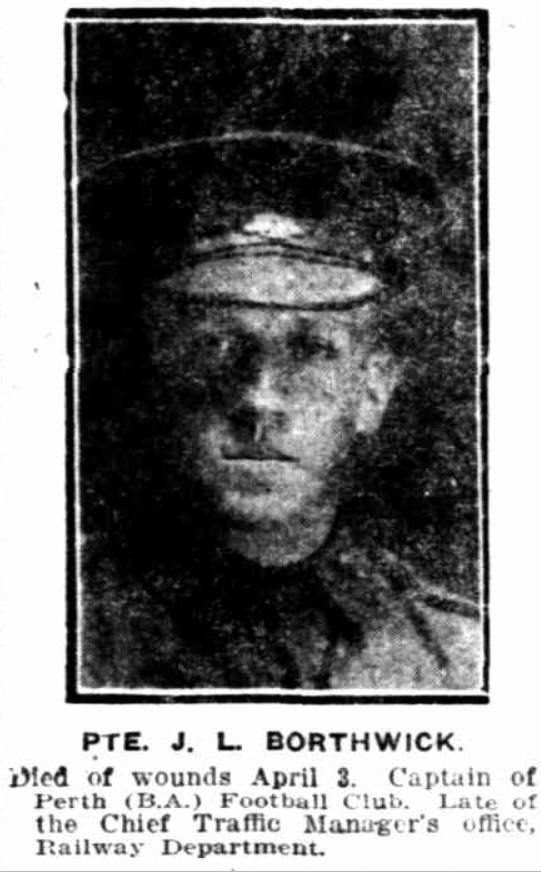
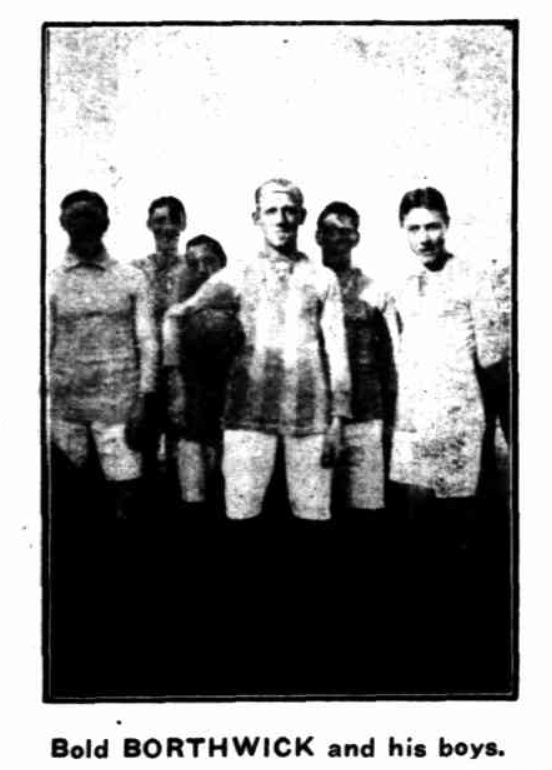
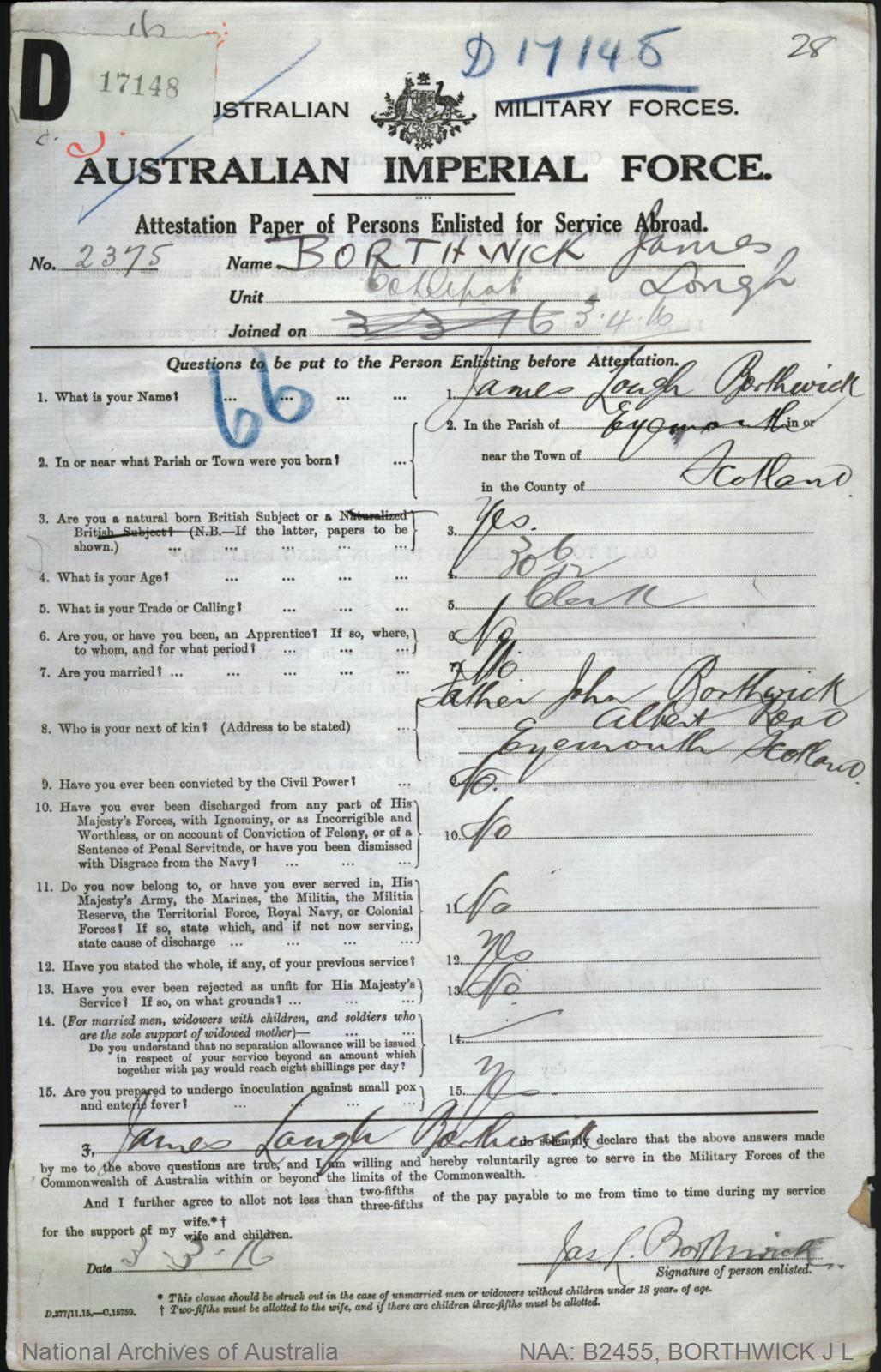
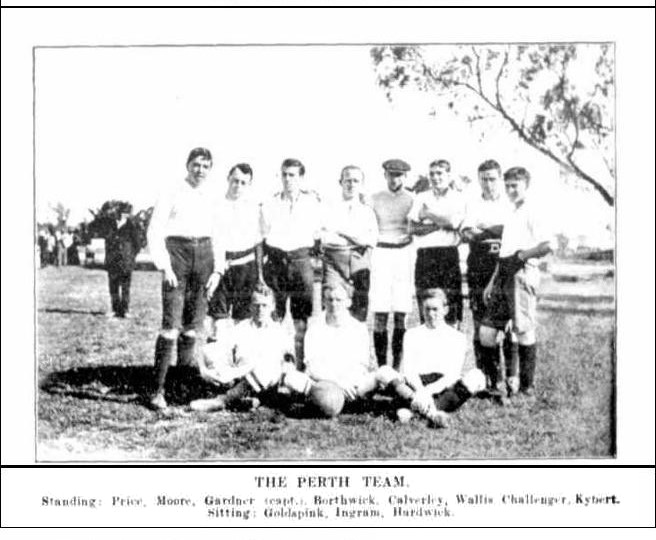
James Borthwick arrived in Perth from Britain on 8 May 1911 to work for the Railways Department as a clerk. Barely a month later he was turning out for the Perth club in the local competition.
In 1914 he was selected to play for “Scotland” against “Australia” in the international match. He was appointed captain of the Perth club at the start of the 1914 season and led the team for two seasons before his enlistment in April 1916.
Private Borthwick received a gun shot wound to the abdomen in Pozieres, France on 2 April 1917. He died the following day at the age of 31. Shortly after his death Perth’s Sunday Times published the following extracts from a letter:
Private J. L. Borthwick (well known here as captain of the Perth City soccer team), as the writer was not long after its despatch killed in action at the front. Private Borthwick comes of a family which has given much for the Empire, his father, brother, and all fit male relatives being in the Empire’s service in one way or other. In the course of the letter referred to, which is written from England, he gives some informative sidelights on life in the Old Country under war conditions. Some extracts: “On reaching Home, and meeting my people again. I found that there was not a man in the house except myself and my brother, both of us being in khaki. One of my brothers-in-law it was, by the way, who put a few shots into the Zepp. recently brought down in the sea off West Hartlepool, while father spent a few days locating same and standing by in order to guard the divers who are endeavoring to raise it. lt is 60ft. down, and is well worth raising, as each costs, as you know, £264,000. Have received from my relatives a number of interesting war relics… One soon recognises in this country that a war is on, for foodstuffs here reached an exorbitant price. Eggs are 5s. per dozen, and matches, which used to realise 1 1/2d. per packet, are now 3d. Every train you enter is simply packed with, fighting men. on leave or proceeding to or returning from the trenches: Then, again, there are the lady tícket collectors, and on reaching London you find ladies, wheeling barrows, changing train-boards, collecting at barriers, cleaning, sweeping, and doing almost every station duty. The same thing applies on all the principal stations. Again, on coming to many of the desks in head offices, you find they are lined with females where only an occasional typist was to be seen before. People in Australia, honestly, don’t realise how the British nation is being tested by this war. This is not to say that the colonies are failing to do their bit, for Australia is a word of some standing and distinction nowadays, and it is good to be an Australian in this war… While I was walking by the quayside at Home one of my uncles pointed out to me what appeared to be an ordinary motor fishing boat, some 70ft. in length, but it turned out that its duty was of far greater importance. On reaching camp after my trip up north I found that the majority of our fellow had left for France. We will be ready to go with the next draft.