


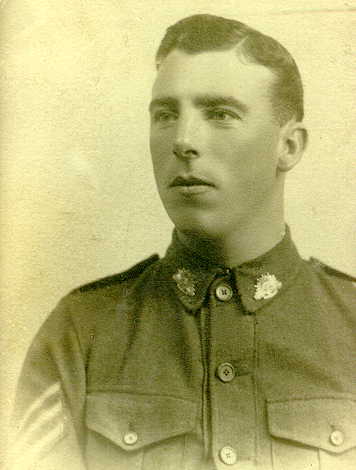
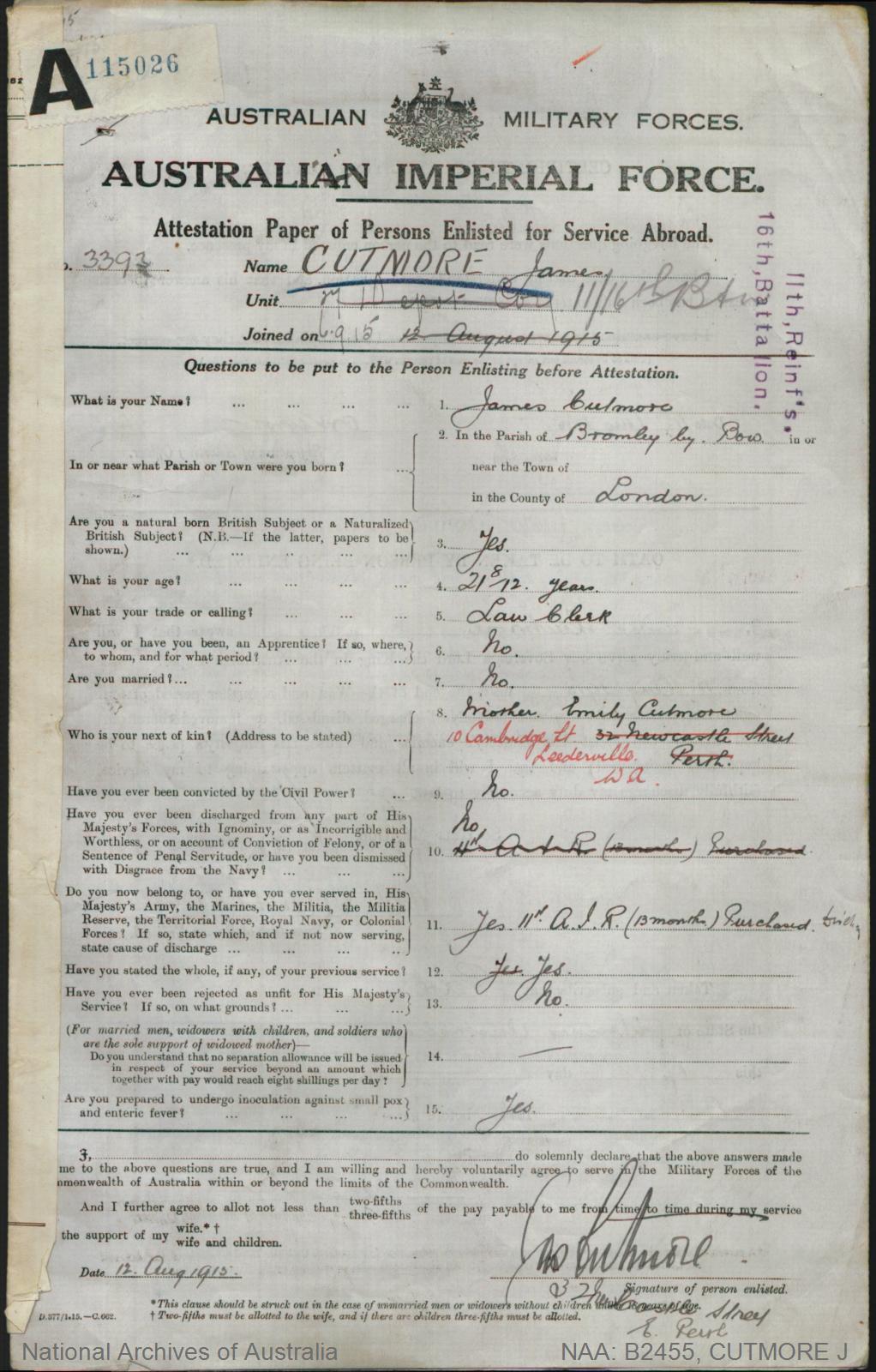
James Cutmore was born in Bromley, London, and as a teenager moved to Perth, where he found employment as a law clerk. Within a few years his mother, Emily, and sisters Elsie and Ethel had joined him in Perth (his father, also James, passed away in 1902).
On the football field Cutmore turned out for Subiaco and Rangers United, winning the Division Two championship with the latter in 1915. That same year he represented England in the local international series with Scotland, scoring in a 3-1 loss, and was treasurer of the Junior British Football Association of WA.
When the season was over Cutmore enlisted with the 16th Battalion but still found time to take an active interest in football. ” Claremont Glebe’s Standish de Courcy “O’Grady and Cutmore … were members of an Egypt team that did well in competition,” reported the West Australian newspaper of 20 May 1916. Two months later he was admitted to Military Hospital with a sprained ankle. Before the year was out Cutmore was assigned to the 4th Training Battalion, based in rural Codford, England. While there he was promoted from Private to Corporal.
By August 1918 Cutmore was back with the 16th Battalion in France, where he suffered severe cerebral concussion as a result of shelling and consequently spent four months convalescing at Bath War Hospital in England. In February 1919 Cutmore turned out for the powerful AIF Westham camp team against the Dorset regiment team, scoring 2 goals in an 8-1 victory.
Cutmore returned to Australia in March 1919 and within two months had accepted the role of assistant secretary of the WA British Football Association, later serving as secretary between 1920 and 1922. Two seasons playing for Northern Casuals were highlighted by his senior State team debut, Cutmore scoring in a 7-0 routing of the Australian Naval Fleet in July 1920. Cutmore married Ivy Lewis in 1926 and soon after they started a family. Between 1930 and 1940 he was part of the 11th and 16th Battalions of the Citizen Military Force and following the outbreak of world War II served in the 28th Battalion.
Cutmore passed away in Perth on 6 July, 1961, at the age of 66.