
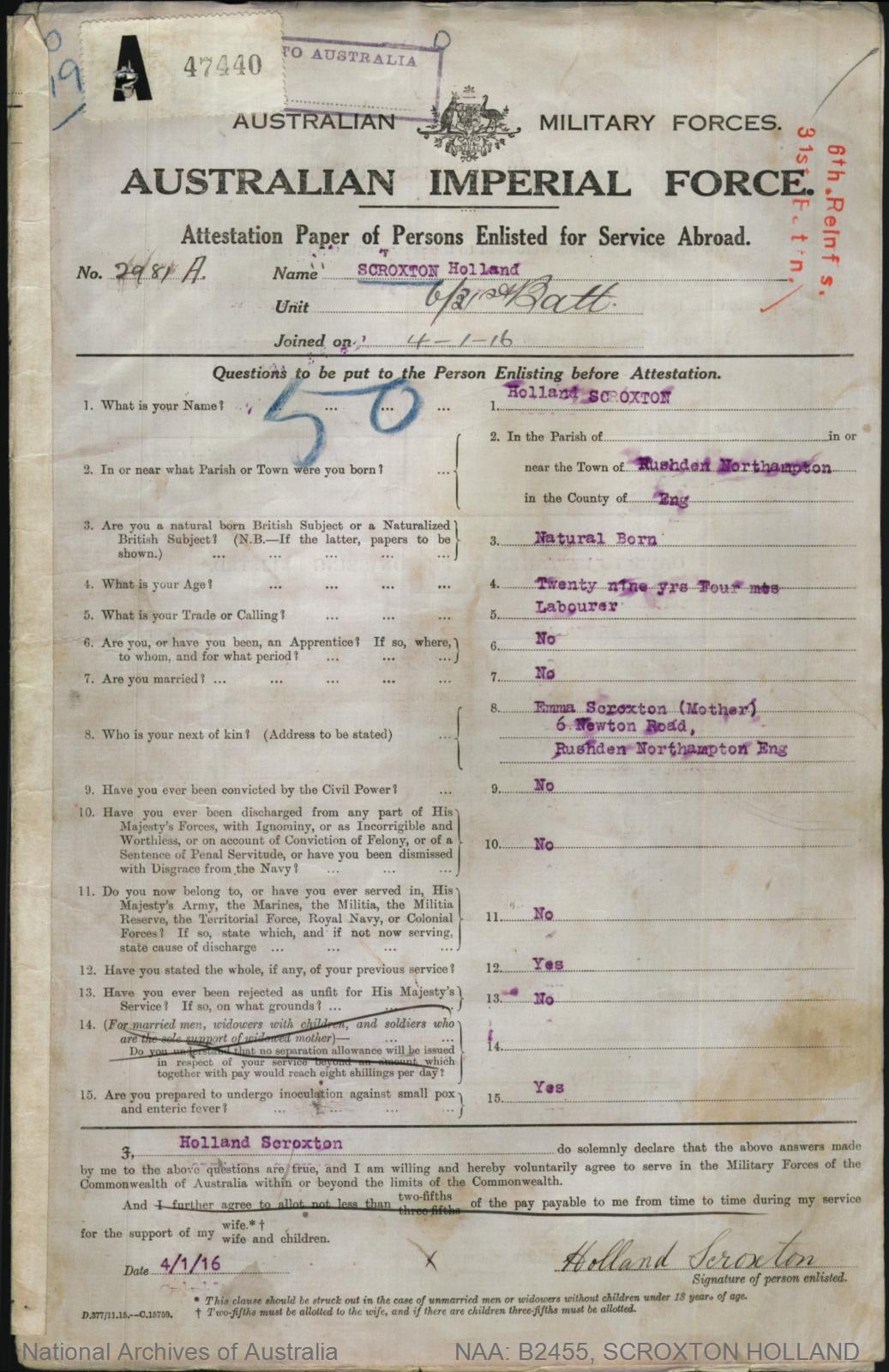
Holland Scroxton played two games for the Enoggera base in Brisbane in April 1916. He first appeared in a selection trial between members of the 26th and 42nd Battalions on 1 April and was subsequently picked for the combined AIF team to play a Brisbane representative side the next weekend. A few days later, on 14 April, Scroxton departed for Europe. (The Telegraph on 10 April, covering the game against Brisbane, named Scroxton as Croxton. It was true a Harold Croxton enlisted in Charters Towers but did so some months after the games were played. Conversely, The Evening Telegraph on 30 June 1920, misspelled Harold’s surname as Scroxton when writing about Charters Towers’ veterans.)
Scroxton was born in Northampton in 1886, where he lived until the death of his father in May 1911. He left England in November that year and arrived in New South Wales in February 1912. By 1913 he was living in Toowoomba where he worked as a labourer. By the time he enlisted in January 1916, he had moved west to Jondaryan where he worked at a local quarry.
Whether he played soccer in Australia, other than the AIF matches, is unknown. Soccer was played in Toowoomba during the time he lived there, but his name does not appear on any team line-ups, though reportage of the sport was limited. Scroxton did play cricket for the quarry’s team, but this was only mentioned on his return to Australia.
Scroxton arrived in France in September 1916 with the 31st Battalion but was evacuated to England with trench feet a month later. He returned in February 1917. Scroxton received a gunshot wound to the back in September and was again evacuated to England. The injury saw him return to Australia where he was discharged in March 1918.
The Jondaryan Patriotic League welcomed Scroxton and another soldier back home with a euchre party and a dance which was reported in the Darling Downs Gazette on 18 March 1918. The quarry men presented Scroxton with a solid silver hunting watch. Scroxton moved back to Toowoomba where he married Florence Lockyer, a widow with children in May 1919. The couple would add three more children to the family. Scroxton returned to work with the railways, while Florence became known for her flowers. Daughter Lilian, their first child together, became a well-known local hockey representative player. She would later join the Women’s Royal Australian Airforce in the second war, alongside her younger sister, also named Florence.
Scroxton died in November 1956.