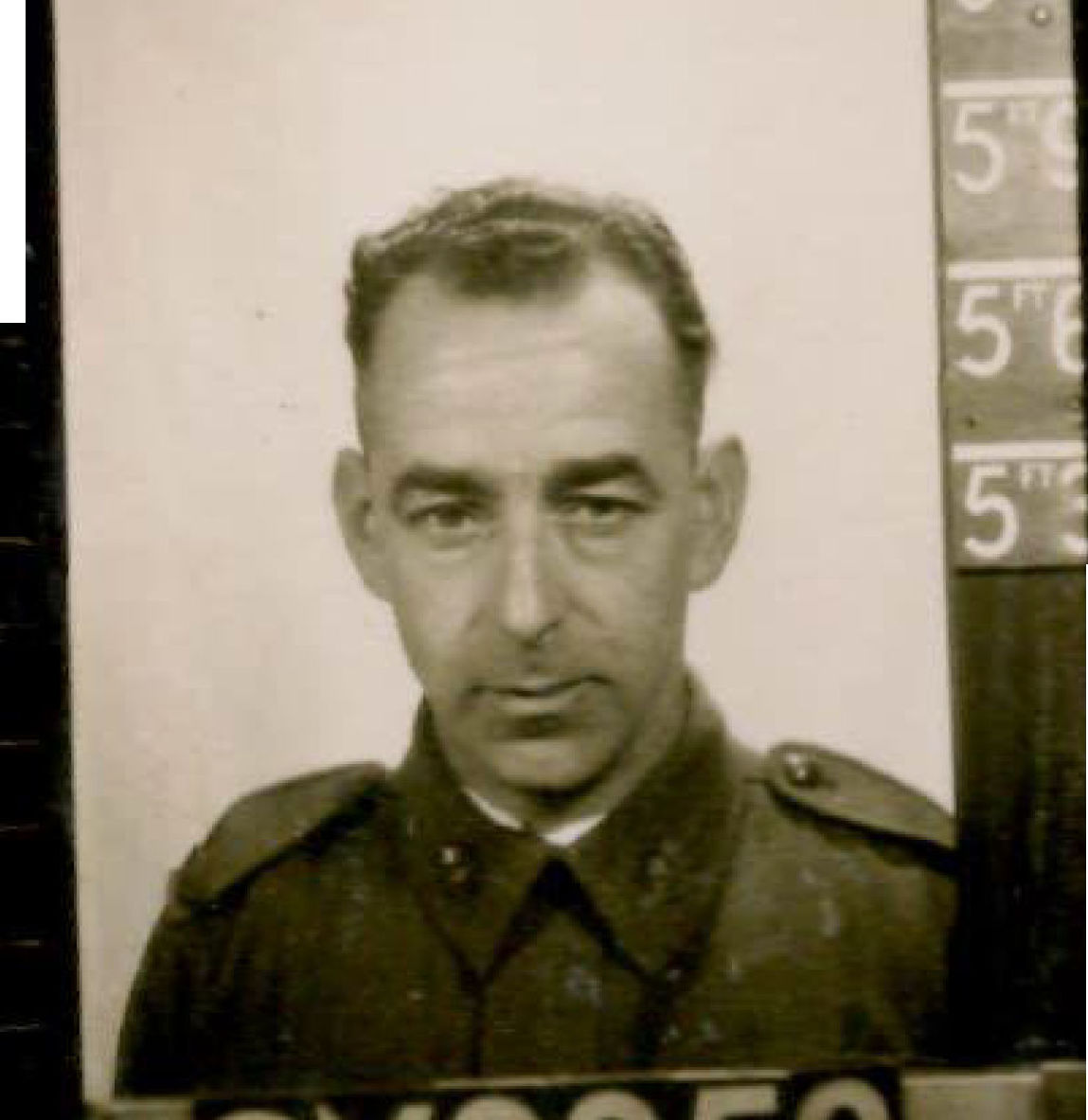
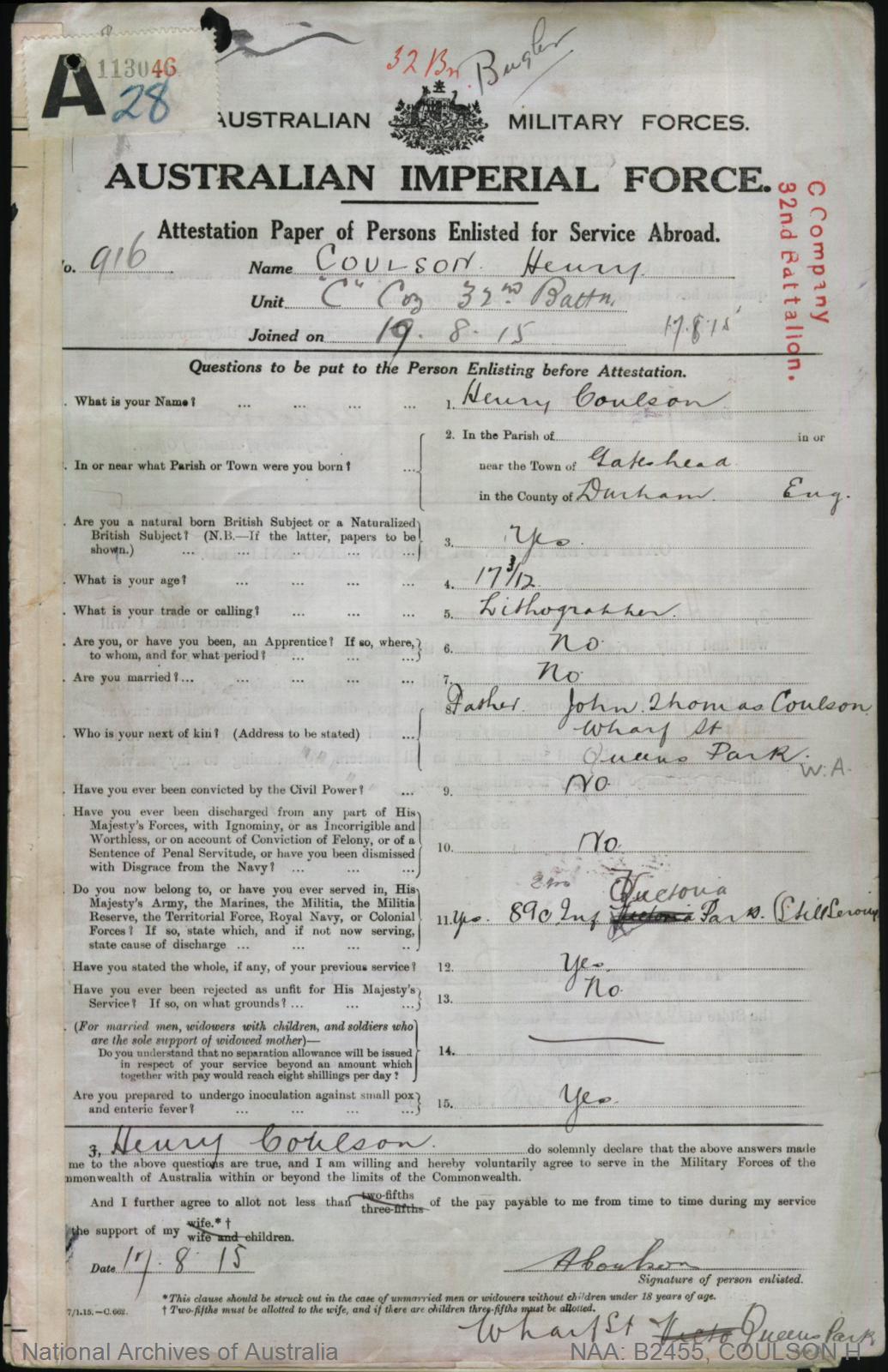
Henry Coulson was born on 2 April 1899 in Gateshead, England. He attended school in his hometown and was in his early teens when he made the journey to Western Australia with his parents, John Coulson and Sabina Lavelle, and younger sister Alma.
Harry found work as a lithographer and at the end of each day returned to the family home on Wharf Street in Queens Park. In early 1915 he signed up to play for the Queens Park football club and would no doubt have been honoured when he was named captain of the Second Junior team. During this time he served in the 89th Infantry, a battalion of the Citizen Forces.
In August of that year Harry — who was 16 — lied about his age in order to enlist as a Private (Bugler) with the 32nd Battalion. Before the year was out he had completed basic training at Blackboy Hill camp and travelled with his battalion to Egypt. He was hospitalised in February 1917 with ringworm and three months later required treatment for tonsillitis.
Harry proceeded to France in June and four weeks later received a severe gunshot wound to his left wrist. After being treated in the field he was evacuated to England, spending time at various hospitals before being discharged in October to No.2 Command Depot in Weymouth where he prepared for his return to active duty.
It was while he was at Weymouth that Harry went absent without leave on three occasions. In November he was confined to barracks for five days and forfeited two 2 days’ pay; in January 1917 he was awarded 8 days detention and forfeited 17 days’ pay; and five months later his sentence of 104 days detention was accompanied by total forfeiture of 234 days’ pay.
Perhaps not surprisingly, Harry was found guilty by court martial and sentenced to 184 days detention on top of the 25 days he had already spent in prison awaiting trial. On completion of his sentence he attended the Overseas Training Brigade at Longbridge Deverill where the syllabus included bayonet work, bombing, gas defence and trench routines.
Harry was sent back to France in May 1918 where he saw out the remainder of the war. The 32nd Battalion were kept in reserve through until August when they participated in the Battle of Amiens. Their last major action arrived late the following month when they attacked the heavily fortified St Quentin Canal tunnel on the Hindenburg Line.
There is no indication that Harry played football following his returned to Australia. In early 1924 he married Gertrude Ludemann in the South Australian regional town of Renmark, close to the New South Wales border. In the years that followed three children — Kenneth, Joy and Robert — were born and by the 1930s the family were living in Glenelg, where Harry worked as a painter.
Harry again lied about his age, this time reducing it by a year to sneak under the 40 year age cap, to join the Australian Military Forces in May 1940. He served 20 months in Egypt before returning to Australia where he was initially stationed in Bathurst, New South Wales, before transferring to St Kilda, South Australia. He was discharged in August 1945 with the rank of Sergeant.
Henry Coulson was 70 years of age when he passed away on 9 May, 1969, in Adelaide, South Australia.