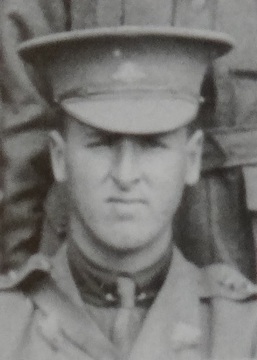
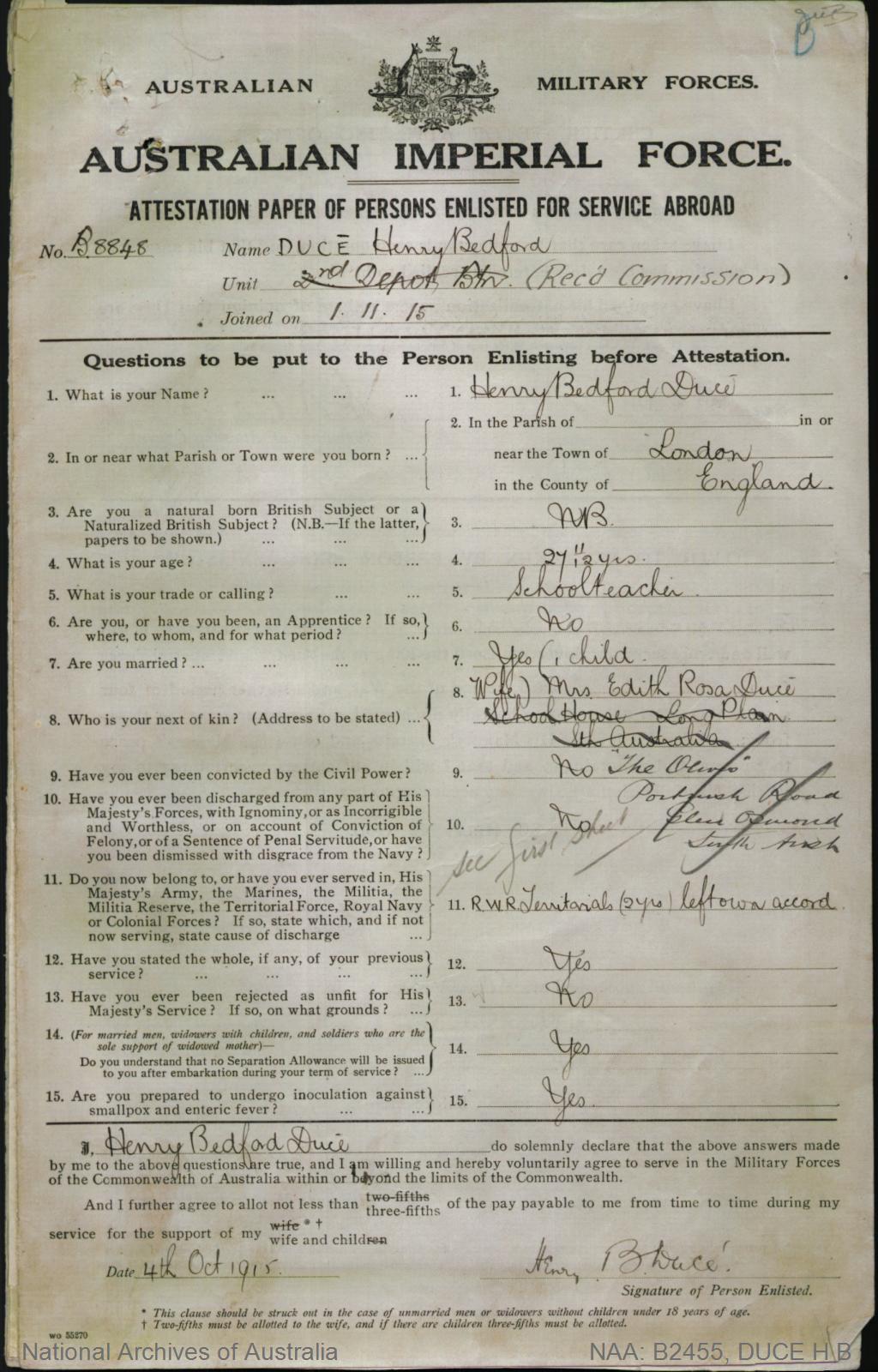
Henry Bedford Duce was a school teacher when he arrived in Adelaide in early 1913. He sometimes wrote his surname as Ducé. He was born in London in 1888.
Bonded to the SA Education Department, his first appointment was at the Wellington Road school in the eastern suburbs of Adelaide. He married Edith Powell, a fellow Londoner and also a school teacher, at Norwood in 1913. Six feet tall and weighing over 12 stone, Duce was an imposing figure. A keen sportsman, he joined the Hindmarsh soccer club and was part of a strong half back line as the Marshites won the league title in 1913. He was named “best on ground” in several matches. He played in the cup final in 1914, but Hindmarsh lost in extra time to Adelaide. In the same year he played for a “Metro XI” against HMAS Pioneer. Duce also played cricket and even tried his hand at Australian Rules football.
However, the arbitrary hand of the Education Department removed Duce and his wife from the pleasant eastern suburbs to the small settlement of Long Plains, 75 kms north of Adelaide, for the 1915 school year.
He joined the AIF at the end of the year when the Duces’ baby son was only 18 months old. He was appointed as a 2nd Lieutenant to the 32nd Battalion in France. Here he was twice wounded in action, in July 1917 and June 1918. After the second occasion he was hospitalized in England for some time. He recovered and was promoted to Lieutenant.
Whilst working as an education officer at Australian Army HQ in England he was twice granted “leave to do non-military work”. On one occasion this was a course on how to run a motor garage. Around this time the army records indicate that he was not communicating with his wife. Due for return to Australia for demobilisation in May 1919, Duce insisted on being allowed to resign his commission in England. The reason for this was that he had obtained a good job as a welfare and educational superintendent for the General Electric company. The army contacted Mrs Duce in Adelaide and found that she had not heard from her husband and had no idea where he was. Duce remained in England, and the final outcome of their domestic situation is unknown. Back in South Australia Henry Duce was named in the annual Education Department appointments to schools lists in 1918 and 1919; so at that point he had not communicated with his employers either. He was a soccer Anzac who only lived three years of his life in Australia.