
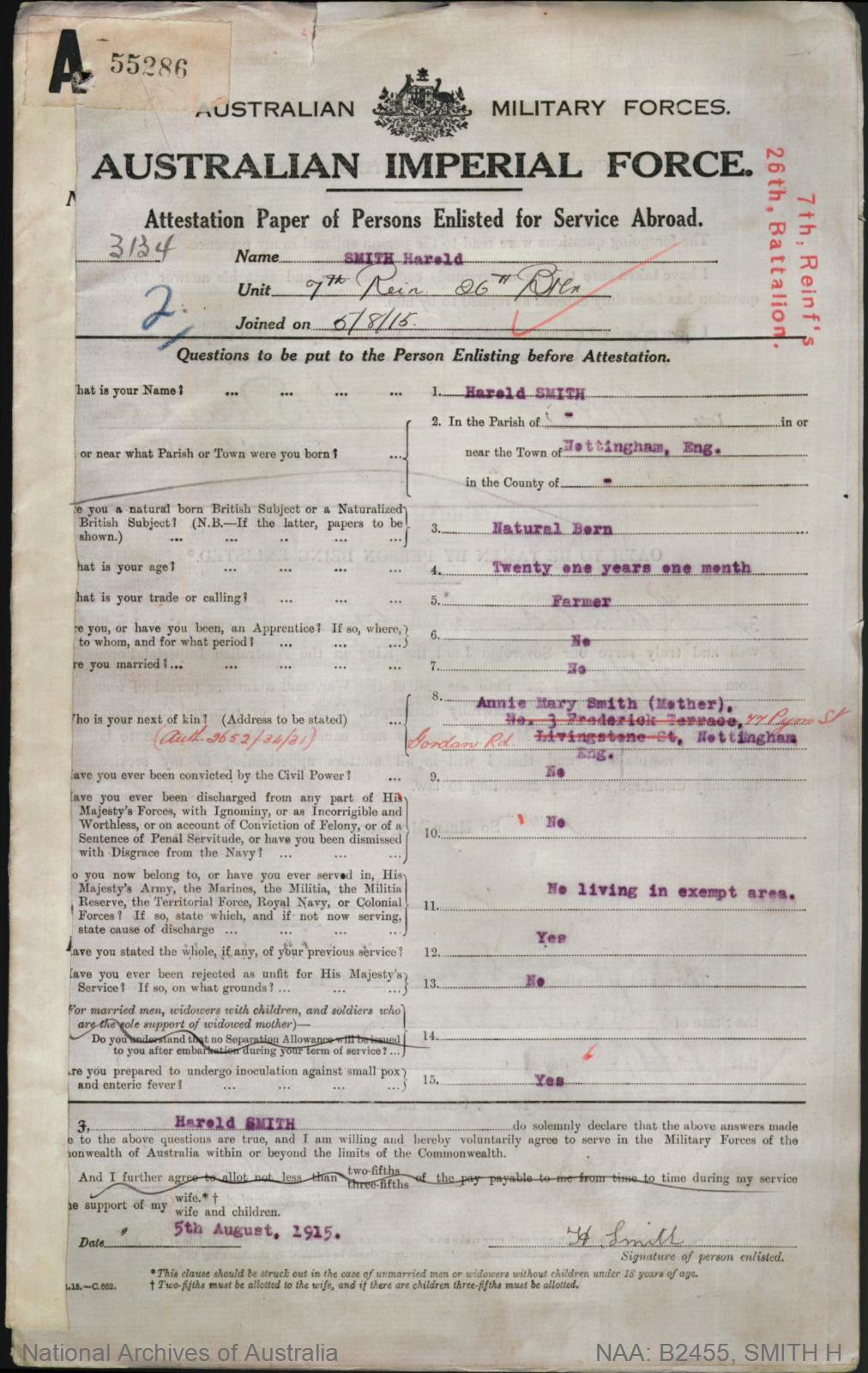
Harold Smith played in a match between soldiers from the Enoggera training base and Brisbane City in October 1915. The Telegraph newspaper on 1 October 1915 stated several of the soldiers had played for teams in the UK, including Aston Villa, Linlithgow Rose and Belfast Athletic. The article purported that Smith had played for Nottingham Forest, which cannot be proven either way.
Smith was born in Nottingham and arrived in Australia in 1913. According to The Nambour Chronicle and North Coast Advertiser on 7 July 1950:
Among thousands of other English working youths he spent some few months training under the Church Army. Sailing from London on the SS Waipara in August 1913, he landed in Brisbane about the end of September that year. He worked on farms for some time.
The Church Army was an Anglican evangelical organisation set up to train the lay poor to become ministers. According to the Bathurst Times on 18 April 1910, the Church Army had planned to raise £50,000 to send 5000 Church Army trainees to Australia to undertake farm work. It appears Smith was one of those later chosen to emigrate. At the time of his enlistment on 5 August 1915, he had been working on a farm at Helidon, near Toowoomba.
Smith’s enlistment form stated he was 21 years old, but it appears he may have fabricated his age to enlist without parental permission. His enlistment form for the second war stated he was born 14 June 1896, making him 19 in August 1915, an age which required a parent to consent. After completing training at Enoggera, Smith departed for Europe in December 1915. He arrived in France the following April with the 26th Battalion. Smith was hospitalised in September 1916 with shell shock. This may have been when he suffered an injury to his right eye which was later mentioned by the Nambour Chronicle article. No eye injury was mentioned in his records, but it was common for injuries to have no more description than the word “wounded”.
Smith was also gassed twice. The second occasion, in November 1917, saw him evacuated to England. He would not return to the front and instead started back for Australia in February 1918. He spent three years after the war as a real estate salesman in the Charleville region, where he presumably met a local named Alice Rose. They married in the early 1920s and moved to Burleigh Heads. Here, Smith became involved in the local chapter of the Returned Services League and the Burleigh Heads Progress Association, as well as the local tennis, rugby league and surf clubs.
Alice died in 1933 after a short illness, aged 33. Smith and their three children remained in Burleigh Heads until 1937. By the time he enlisted again in 1941, he had married again, to Elizabeth, and the family were living in Clayfield in Brisbane.
He spent the second war with the Records Office at Warwick, Queensland, at an established training base. Smith and Elizabeth later moved to Maroochydore where he became a government approved valuer. He died in 1950, aged 56.