Harold Pike’s war was illustrated by two very different news articles, one in 1917 and the other in 1928. The first highlighted a fit and healthy man who captained his unit’s soccer team successfully against the supposedly superior British. The second highlighted a tragic figure who took his own life due to long-term chronic illness caused by the war.
Pike had been born in London and arrived in Queensland in 1911. By 1914 he was living with his mother in Auchenflower and worked as a clerk. There is no sign of Pike playing soccer in Brisbane before the war, but team line-ups were rarely printed in the Brisbane newspapers, despite the existence of 60 men’s teams at the time. Pike had easy access to soccer, as the neighbouring suburbs of Milton and Paddington were home to clusters of clubs who played at modern-day Lang Park and Gregory Park respectively.
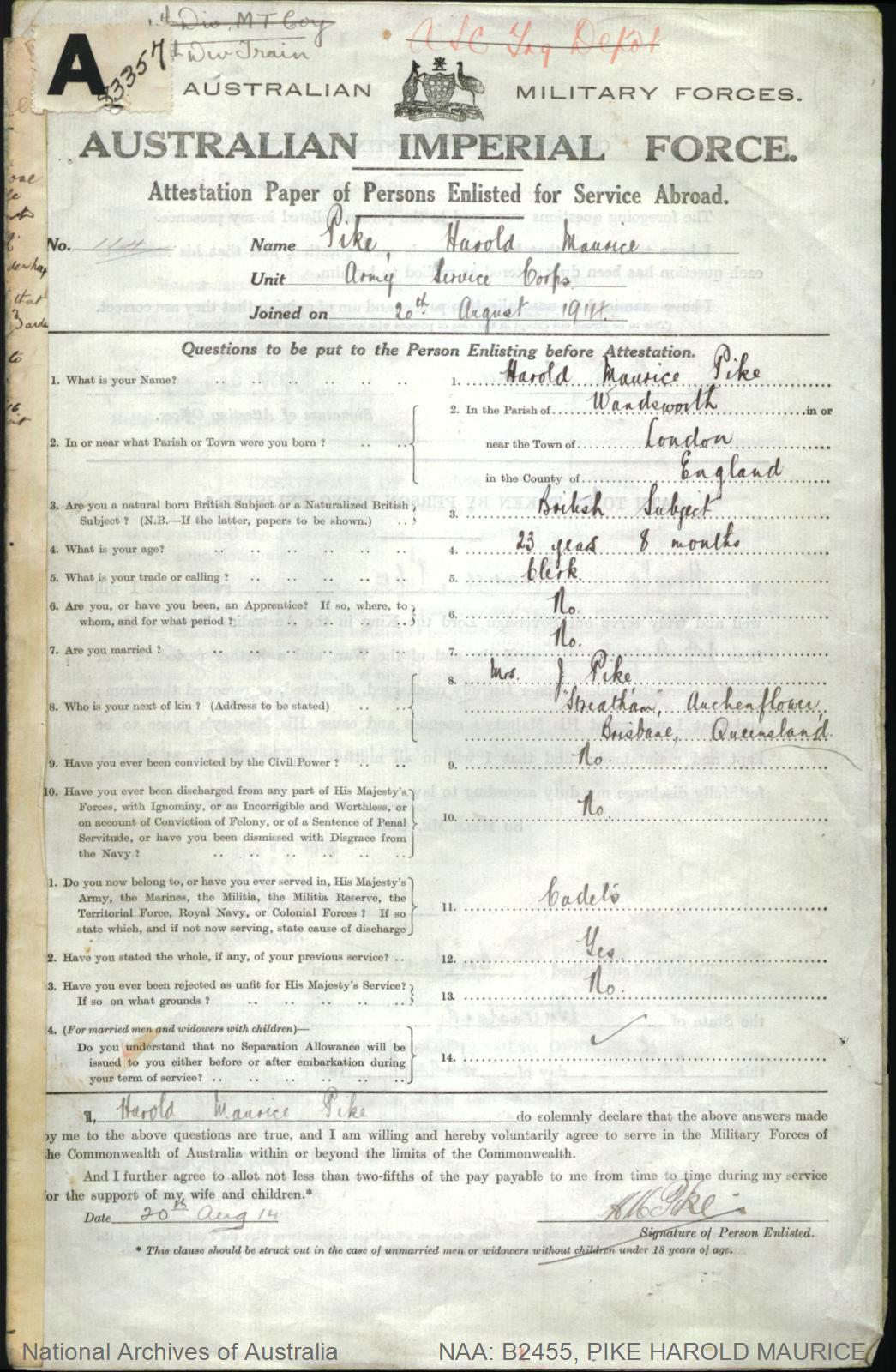
Pike enlisted in August 1914 as a Driver. His age was reported as 23, which does not correlate with his immigration record stating his age was 17 in 1911. Departing Australia in May 1915 and reached Alexandria in July, Pike arrived in Anzac Cove by October before being evacuated back to Egypt in December as the peninsula campaign was abandoned.
In April 1916, Pike was mentioned in despatches for “gallant service rendered during the period of General Sir Charle Munro’s Command of the Mediterranean Expeditionary Force.” According to a letter written in 1944 by his brother Albert to the Department of the Army in Canberra, Pike had received the recognition for his duty during the evacuation of Gallipoli.
April 1916 also saw Pike court martialled. He was charged with neglecting to obey an order, and “using obscene language to Colonel Zarba Bey, Commandant Egyptian Police”. He was also charged with “resisting an escort whose duty it was to have him in charge.” Pike “resisted the escort by knocking Pte. Upcott actg.M.M.P. … with his fist.” Pike was sentenced to 6 months imprisonment with hard labour, but the Commander in Chief of the Egyptian Expeditionary Force suspended the sentence in August and ordered his release back to his unit.
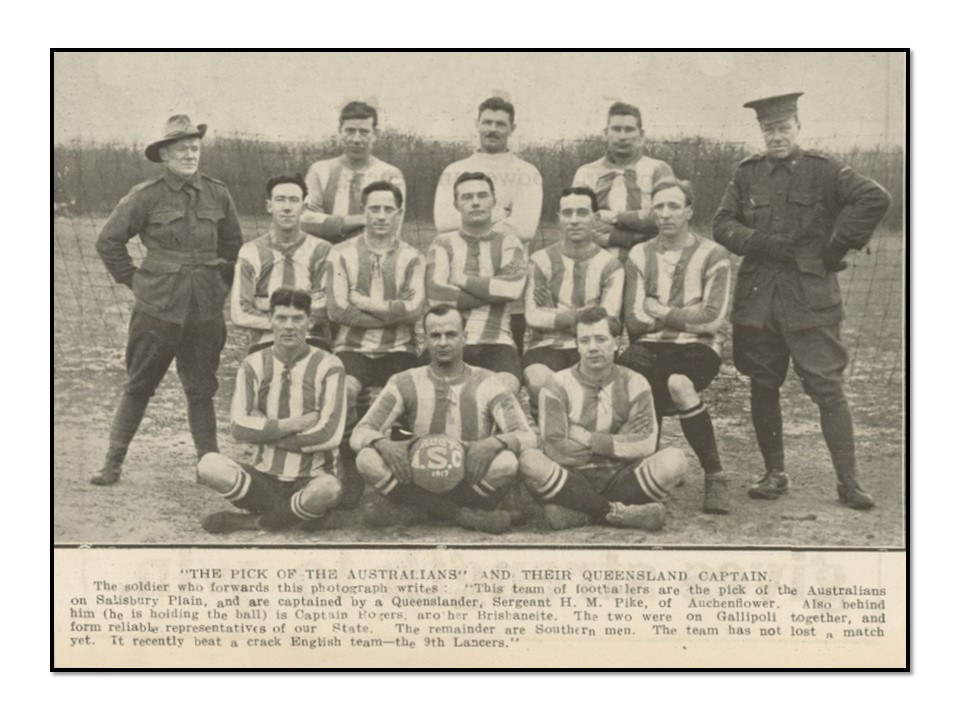
Pike’s disciplinary issues did not prevent him from being promoted to Temporary Sergeant in January 1917. By this time, Pike was in England with the 5th Company Army Services Corp at Salisbury Plain. He captained the unit’s soccer team with such success the team’s photo appeared in The Queenslander of 7 April 1917 under the title “The Pick of The Australians and Their Queensland Captain”. The accompanying caption stated:
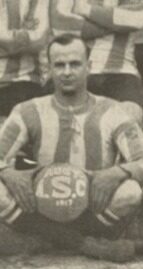
The soldier who forwards this photo writes: “This team of footballers are the pick of the Australians on Salisbury Plain, and are captained by a Queenslander, Sergeant H. M. Pike, of Auchenflower. Also behind him (he is holding the ball) is Captain Rogers, another Brisbanite. The two were on Gallipoli together, and form reliable representatives of our State. The remainder are Southern men. The team has not lost a match yet. It recently beat a crack English team – the 9th Lancers.”
(Captain William Rogers from Bundaberg was the other Queenslander pictured. A record of the team’s results cannot currently be discerned from available unit diaries.)
Pike returned to the rank of Driver in February 1918 when his unit was sent to France. He caught influenza in April and moved between hospitals in Boulogne, Etaples and Havre until June. He was promoted to Lance Corporal in September, but in October left for Southampton and then onto Australia.
His final medical report stated he suffered Enteric Fever (typhoid) in 1916 and influenza in March 1918, but that his lungs were healthy. There was no mention of Pike being affected by gas, which became accepted as the cause of his later health problems.
Pike married Nellie Propsting in Victoria in 1922. Nellie had previously married to Claud Parker in 1916 in Tasmania, but Claud died in France in May 1917.
Pike’s medical issues were first presented to Rosemount Hospital on 18 February 1924. According to the later investigation files into his death, held by the National Records, stated: “Admitted direct by ambulance. On admission was suffering from a severe attack of Asthma. States has been suffering since 1918 after gassing in France and has frequent attacks.” The medical records suggest the Department of Repatriation recognised Pike’s condition was related to the war and gave him support during treatment at Rosemount. The treatment attempted included hypodermic injections of adrenaline, asthma cigarettes and powder, a “double Caldwell” operation on his sinuses and the removal of a polyp in 1926. Nightly asthma attacks continued, however, leading to medical advice suggesting he leave “Brisbane for the country for change of climate.”
Pike subsequently went to Roma, though he had returned to Brisbane by 1927. Harold Pike took his own life in 1928. The copy provided to the newspapers got his initial and rank incorrect. The most common published version of the story appeared in the Toowoomba Chronicle of 28 May 1928:
BRISBANE, Sunday – The body of Captain A. M. Pike, employed as a traveller by the Vacuum Oil Company, was found beside hie motor car with a bullet through his head, and an automatic nearby, on the side of the road to Redcliffe, on Saturday morning. Affixed to the car was a brief note, stating that the writer was taking his life, owing to his inability to endure pain, caused by a cough which had troubled him very much, and from which he repeatedly suffered, as the effects of gas during the war. He is survived by a widow and a young family.
The Week, of 1 June, added that the deceased was “a brother of L. H. Pike”, late secretary to the Premier.” Queensland Birth, Deaths and Marriages confirmed it was Pike who had died on that date, as do the investigation files on his death. He was the younger brother of Leonard Pike, the former secretary to the Premier. Despite the initial coverage, no more was mentioned of Pike’s death, not even funeral details, except for The Brisbane Courier on 16 June 1928 stating that the probate of his will had been granted to solicitors to finalise.
When Pike’s brother Albert wrote to the Department of the Army in Canberra in 1944, he stated he was the only surviving brother. Albert asked for the delivery of Pike’s medals. The request was forwarded to Base Records, who said only the Victory Medal could be sent to Albert, as the 1914-15 Star and British War Medals had already been issued to Pike. Base Records requested a Statutory Declaration from Albert stating he was the eldest brother and that Pike had been unmarried. The status of Nellie, who was still alive, was not discussed in the correspondence. Despite Pike’s death reports stating he had a young family, no children of the marriage can be confirmed, nor that Nellie had children during her brief first marriage.
Nellie continued to live in Brisbane until her death in 1946. She was buried next to Pike in Toowong Cemetery.