
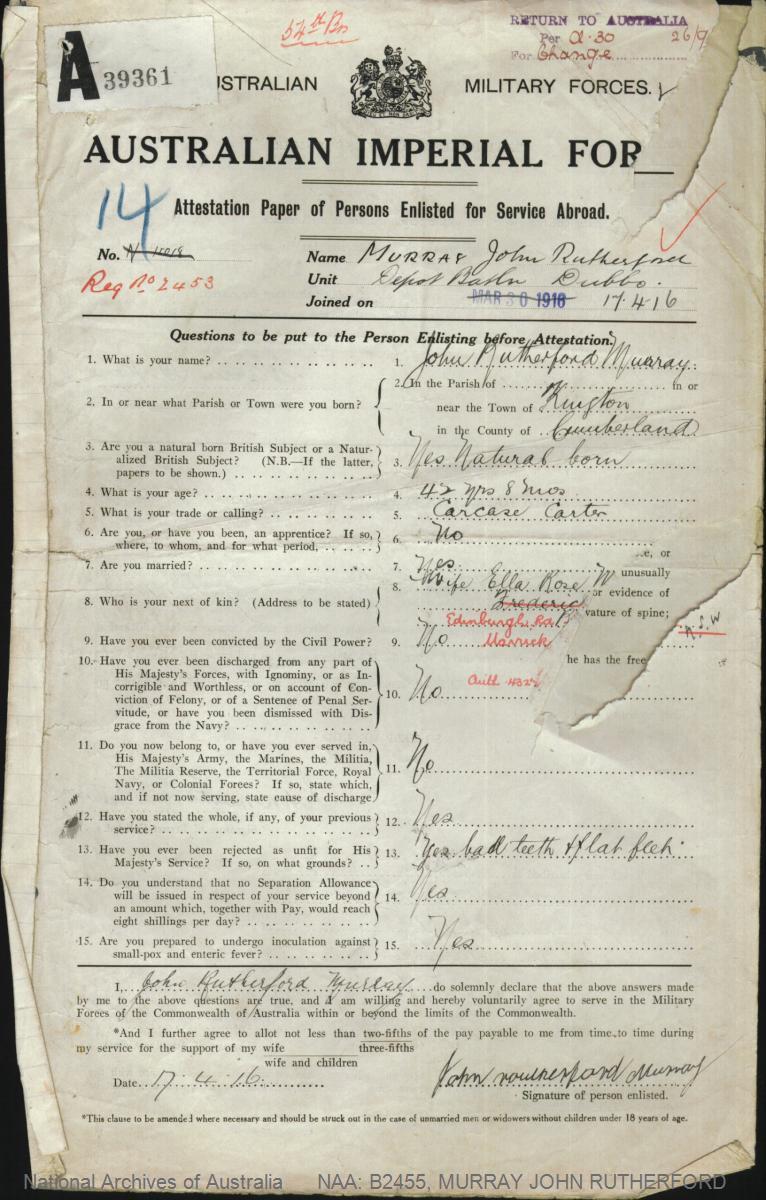
Harold Murray was a promising footballer for Annandale’s junior team. In 1914 he scored Annandale’s only goal in their 4-1 defeat by Balmain in the Nurse Cup Final. He gave his age as 17 on his attestation papers but investigations made after the war suggested that Murray was actually just 15 years old when he enlisted.
Murray saw action with the 2nd Battalion on the western front where he was badly wounded in the arm and both legs in a bomb blast. In 1917 Murray was awarded the Distinguished Conduct Medal for bravery. His platoon commander and sergeant had both been wounded and he assumed command of his platoon and captured a heavily defended enemy trench.
Between the wars Murray spent time in New Guinea and the surrounding islands. In 1942 he was in Kavieng, New Ireland. When the Japanese invaded he managed to escape to New Guinea with a group of soldiers in a small boat. He joined a special operations unit and was appointed to the rank of Captain. He was awarded an Australian Military Cross for leading a party of soldiers behind enemy lines for over a month, sending important intelligence back to Allied HQ. Murray also won the United States Silver Star for a pre-invasion reconnaissance mission on a Japanese held island. Leading a group of US Marines he successfully repelled a Japanese attack. Murray died in 1966 in Innisfail, North Queensland.