


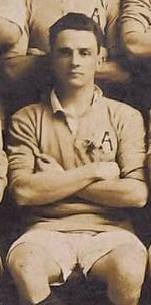
A potted biography of George Brown appeared in the Brisbane Telegraph on 25 May 1922. The occasion was his selection in the inaugural Socceroo squad which would soon depart to New Zealand.
Brown’s soccer career in Australia started in 1914 when at 16 he helped Rebels win the third-grade junior competition. The junior competition was not age-related, but in the Scottish sense of meaning lower-division adult competition. In 1915, Rebels was absorbed into the newly formed Brisbane City, which ran teams in several divisions. Brown’s side moved up to the second-grade junior competition, where they secured another premiership. Brown had enlisted in June and departed in August, meaning he missed the end of the season. The Telegraph biography stated Brown continued to play soccer with his unit during the war.
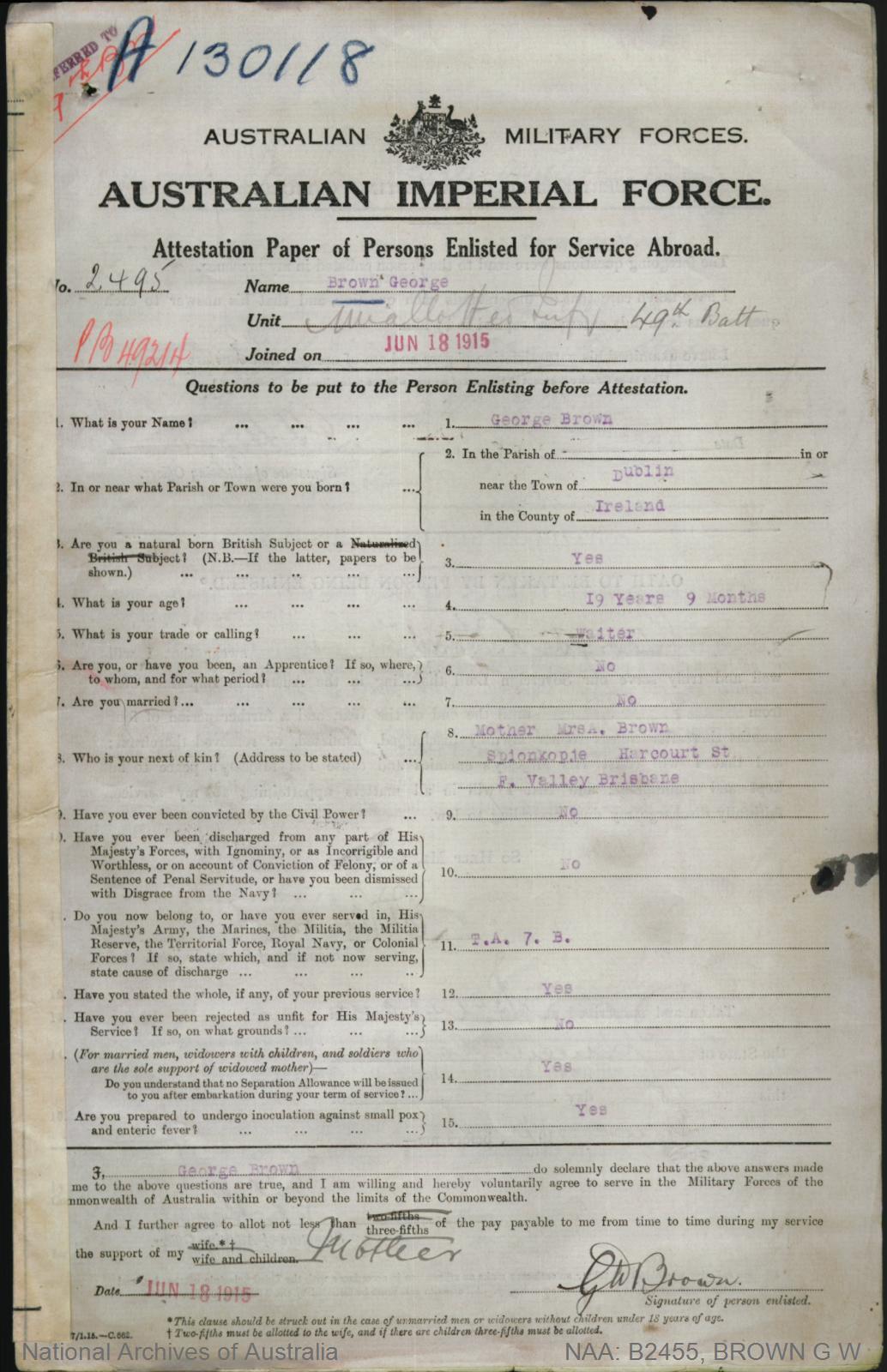
Brown was born in Dublin but had learned the game growing up in England. He emigrated to Australia with his mother Annie and his siblings on the Marathon in early 1911. His age was given as 13 and was likely turning 14 that year. This tallies with the Telegraph biography which stated he was 25 in 1922. But his age does not tally with his enlistment forms. He claimed he was 19 years and 9 months, but it is likely he inflated his age to sign up. His mother, Annie had to sign a parental consent form as he was under the age of 21.
Brown arrived in Egypt in October where he was hospitalised with mumps. He finally reached Gallipoli with the 9th Battalion in mid-November but was back in Egypt on 4 January 1916 following the evacuation of the peninsula. The post-Gallipoli reorganisation saw Brown reassigned to the 49th Battalion in February. His time in Alexandria saw he was court martialled for being absent without leave but was later promoted to Lance Corporal. He departed for Marseille in June, and was promoted twice more, to Corporal and then Sergeant, by the end of the year.
Brown was wounded on 6 April 1917 after being shot in the left hand. He was evacuated to the 6th General Hospital in Rouen where the 4th finger of his left hand was amputated. He recuperated in England, first at Reading Hospital, then the depot at Weymouth. Brown returned to the field in France in November. He was wounded again in April 1918 when he was gassed and was again evacuated to England. Brown returned to France in August where he stayed until he was marched out in January 1919.
He started back for Australia in March 1919, and was discharged in Brisbane as medically unfit. Back in Brisbane, Brown rejoined Brisbane City in 1920, this time in the senior division, and was selected for an AIF XI which took on the visiting warship Renown.
His form saw him selected for the Queensland team touring New South Wales. Brown retained his spot in the state squad for the 1921 home and away series against New South Wales and was selected for the inaugural Australian squad which toured New Zealand in 1922. He played in Australia’s first ever international match against Wanganui before showing prolific scoring skills over the rest of the tour. He scored against Nelson (3), Westland (2), Tanaki (4), Auckland (3) and South Auckland (2). He was kept scoreless on his official Socceroo debut in the second test against New Zealand but secured Australia’s only goal in the third game. His Australia career ended with 1 goal in 2 A-internationals, while in all matches, he scored 15 goals in 10 games.
Brown remained with Brisbane City until 1925 when he switched to Pineapple Rovers. That season he won another premiership, his first at senior level. He continued to play for Rovers in 1926 after which he seems to disappear from public view. He married Eileen Geddes in 1924 and died in 1964.